Upcoming Earnings
Big Tech and the Power Grid Steal the Spotlight as Earnings Season Heats Up
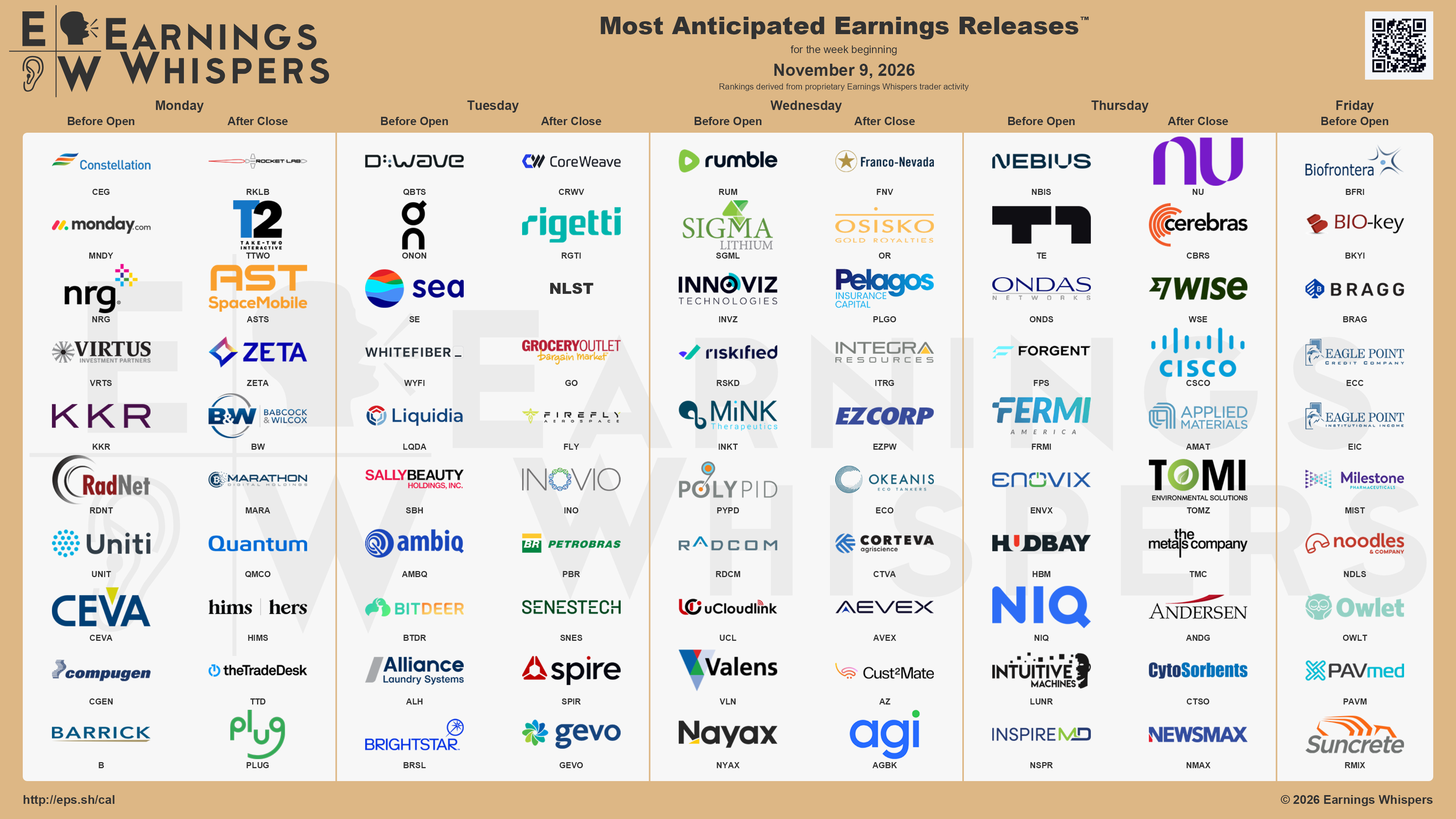
This is one of those weeks where the market's biggest obsessions all step up to the microphone at once. The old guard of technology is leading the charge, and the mood here is cautiously upbeat. Cisco, Applied Materials, and chip-tool maker Onto Innovation all head into their reports with the wind at their backs, riding business trends that have been quietly improving quarter after quarter. Keep an eye on the energy-and-power complex too, where Constellation Energy and NRG Energy have become the unlikely darlings of the artificial intelligence boom, since all those data centers need somewhere to plug in. On the flip side, a cluster of the market's flashiest storylines looks shakier than the headlines suggest. CoreWeave and Nebius, the darlings of the AI infrastructure gold rush, are walking in with investors feeling distinctly nervous, and the crowd of speculative names from quantum computing outfits to space and rocket companies carries a similar cloud of doubt. When expectations run this hot, even a solid report can leave traders disappointed.
The real fireworks, though, may come from the stocks where the whisper on the street has turned sharply sour. monday.com, the workplace software company, and ad-tech player The Trade Desk are both drawing unusually gloomy chatter, and the smart money appears to be bracing for turbulence. Video gaming fans will be glued to Take-Two, the studio behind Grand Theft Auto, where the stakes always run high, and the swings can be dramatic. Meanwhile, the quietly confident corners of the market are worth a look for bargain hunters: data outfit NIQ Global and miner Hudbay Minerals are among the names generating genuine optimism rather than hype. And of course, there is always one grown-up in the room. Berkshire Hathaway, Warren Buffett's sprawling empire, reports with its usual steadiness, a reminder that for all the drama swirling around AI and crypto-adjacent plays, sometimes boring is beautiful. Expect plenty of white-knuckle moves, a few genuine surprises, and more than one stock that defies whatever the crowd was betting on.
Nu Holdings: Cheap Stock, Big Growth, Grumpy Mood
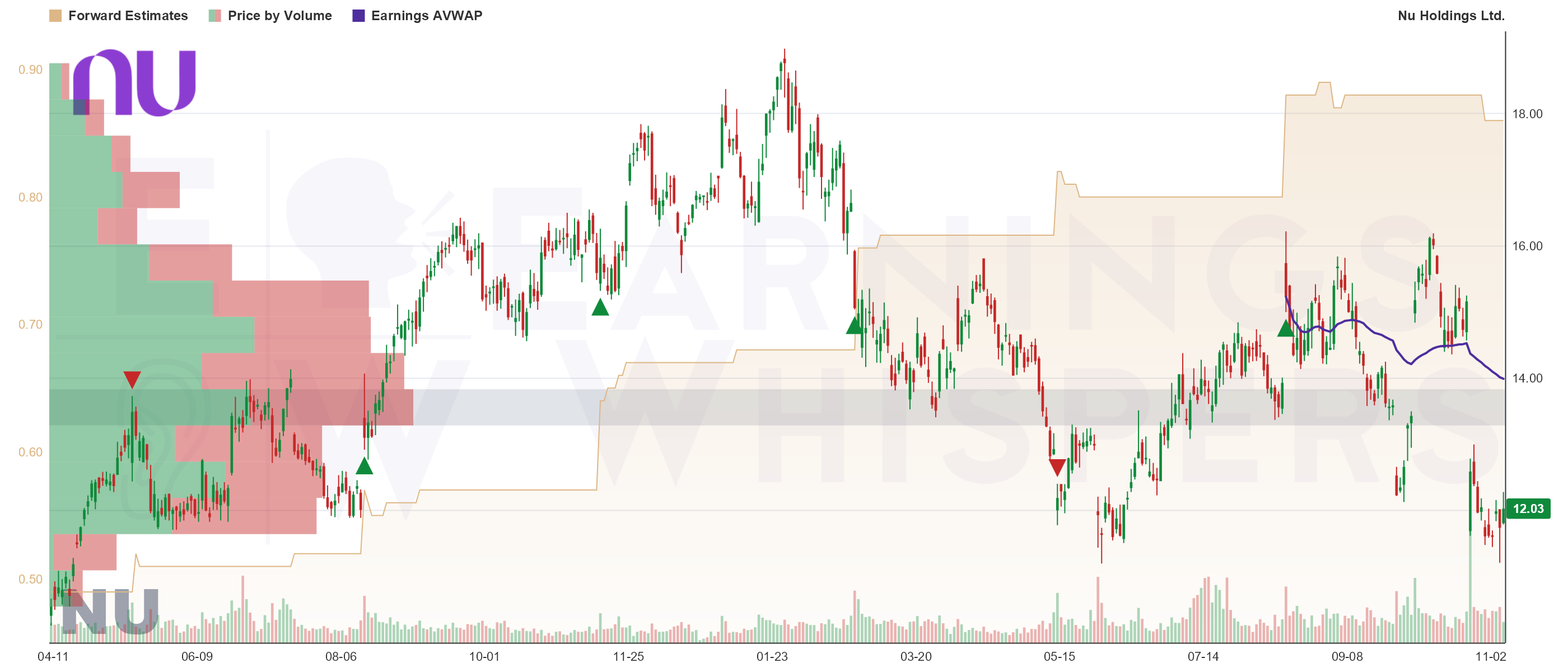
Nu Holdings (NU) steps up to the plate after the bell on Thursday, November 12, 2026, with numbers expected around 5:40 PM ET. Wall Street is looking for $0.22 per share on revenue of $5.70 billion, a juicy 36.6% jump from last year, while the Earnings Whisper number nudges a touch higher at $0.24. Here is the funny part: investors are walking in bearish, yet a whopping 86.1% still expect the company to beat. So everyone is frowning while quietly betting on a win. Option traders are bracing for an 8.4% swing, a bit bigger than the 6.3% average move we have seen lately, so buckle up.
The real story is the mood going in. The stock has slid 23.6% from where it opened after last quarter's report and now sits 16.1% below its 200-day moving average of $14.34, and analysts have been quietly trimming their estimates since the last release. That is the cautious side. The hopeful side showed up on Friday, October 23, 2026, when someone scooped up 28,137 of the $14.50 calls expiring November 20, a sizable bet that this beaten-down name could bounce back fast. Growth is still strong, the price is low, and the bulls are circling. Thursday tells us who was right.
Nebius: The AI Cloud Rocket Whose Fuel Gauge Keeps Climbing
Nebius Group (NBIS) is set to report earnings before the bell on Thursday, November 12, 2026, at around 7:40 AM ET. Wall Street is bracing for a loss of $0.61 per share on revenue of $916.78 million, which would be a jaw-dropping 527.5% jump from a year ago, though our own Earnings Whisper number is a slimmer loss of $0.49. Investors are walking in nervous, yet nearly 68% of them still expect a beat, which tells you this is a crowd that is scared and hopeful at the same time. Short sellers have backed off, cutting their bets by 22% since last quarter, even as the stock has slid 42.7% from where it opened after the last report and now sits 27.2% below its 200 day average of $177.97. Analysts have been nudging estimates higher, and options traders are strapped in for a wild 19.6% swing, bigger than the stock's usual 14.5% earnings-day lurch. One eyebrow-raiser: on November 5th, someone scooped up 10,783 of the $75 puts expiring January 15, 2027, a sizable downside bet worth watching.
Here is the real story heading into the print. Last quarter, Nebius proved it is no longer just riding the coattails of Microsoft and Meta, landing four separate billion-dollar AI cloud deals with the likes of Reflection and Cohere at fatter per-megawatt prices. Revenue jumped 46% in a single quarter, annual recurring revenue hit $3 billion, and margins fattened to 41%. Its first capacity auction cleared 15% above the prior top price, so pricing power is clearly real. The one thing to keep an eye on is that management reaffirmed rather than raised full-year guidance, since those shiny new deals mostly boost 2027, not 2026. So watch two things Thursday: whether revenue clears that near-billion-dollar bar, and whether management finally lifts the numbers or hands us a first look at 2027. Given the beaten-down stock and jittery sentiment, even a confident tone could light a fire.
Rocket Lab's Earnings: Can Neutron Finally Light the Fuse?
Rocket Lab (RKLB) is set to report earnings on Monday, November 9, 2026 at roughly 4:05 PM ET. Wall Street is looking for a loss of $0.02 per share on revenue of $256.51 million, which would mark a hefty 65.4% jump from a year ago, while the whisper number is a touch brighter at a loss of just $0.01. Management had guided revenue to a range of $250 to $265 million, so they are sitting comfortably in the pocket. Investors are feeling good here, with 44.4% betting on a beat. Short interest has ticked down 1.2% since the last report, yet the stock has slid 30.4% from its post-earnings open and now sits a chilly 32.8% below its 200 day moving average of $78.98. The good news for bulls is that overall earnings estimates have been revised higher. Buckle up, because options traders are pricing in a 14.9% swing on this print, well above the 8.3% the stock has averaged recently, and someone made a notable bet with 13,332 of the $40 puts expiring December 18 getting scooped up on October 28.
Here is the real story heading in. Last quarter was a genuine step-up, with record revenue of $234 million, backlog climbing to $2.36 billion, and a monster pending Iridium acquisition that pushes Rocket Lab into the higher-margin business of actually running satellites instead of just launching them. Add in record defense wins and the tone from management got downright swaggering. But two things are keeping the champagne on ice. Margins slipped a bit and cash burn widened to over $110 million as they build out for the big Neutron rocket, and that is the whole ballgame. Neutron's first flight has been pushed back more times than a dentist appointment, now targeting a narrowing late 2026 window. If they can give a firm liftoff date on this call, the stock could stop drifting and start flying. If Neutron slips again, expect the doubters to get louder.
CoreWeave: Great Business, Battered Stock, Nervous Options Crowd
CoreWeave (CRWV) steps up to the plate after the close on Tuesday, November 10, 2026, at roughly 4:10 PM ET. Wall Street is penciling in a loss of $1.17 per share on revenue of $3.54 billion, which would be a jaw-dropping 159.4% jump from a year ago, though the Earnings Whisper number is a touch friendlier at a $1.00 loss. Management had guided revenue to $3.45 billion to $3.60 billion, so they are playing it comfortably within their own lines. The mood is upbeat with 72.0% of investors betting on a beat, and estimates have actually been nudged higher since last quarter, which is the kind of tailwind you like to see. The catch is the stock itself: it has tumbled 57.3% from where it opened after last earnings and now sits a brutal 48.5% below its 200 day moving average of $90.18, while short interest has climbed 8.4%. Option traders are bracing for a wild 21.6% swing, even bigger than the 14.8% average move of late, and on October 20 someone grabbed 42,206 of the $30.00 puts expiring November 20, so not everyone is drinking the bull punch.
Here is the real story heading in. Last quarter was the moment CoreWeave finally delivered the margin turn it had been promising for three straight calls, with adjusted operating income leaping to $128 million and management raising basically every number that matters: revenue, operating income, year-end power, and exit ARR. A roughly 25% July price hike and juicier new contracts are feeding the fire, and a brand new managed inference business rocketed from $1 million to over $100 million in booked ARR almost overnight. The flip side, and why the stock is getting whacked, is the money going out the door. Capex guidance keeps marching up to $35 to $39 billion, interest expense is swelling past $640 million, and the net loss widened to $626 million. In short, the business is firing on all cylinders while the balance sheet is doing heavy lifting, so watch whether the margin momentum keeps outrunning the mounting interest bill.
Take-Two's Big GTA VI Payday Is Finally Here
Take-Two Interactive Software (TTWO) is confirmed to report earnings on Monday, November 9, 2026 at approximately 4:05 PM ET. Wall Street is looking for $0.90 per share on revenue of $1.66 billion, a 6.4% dip from last year, though the Earnings Whisper number sits higher at $1.05 per share. Management guided revenue to a range of $1.42 billion to $1.47 billion. Investors are feeling gloomy heading in, with only 23.8% betting on a beat, and short interest has jumped 26.6% since last quarter. The stock has slid 8.0% since its last earnings reaction and now trades 1.9% below its 200 day moving average of $219.04. Here is the kicker though: overall earnings estimates have actually been revised higher. Option traders are bracing for a 10.2% swing even though the stock has only averaged a 5.1% move lately, and on Wednesday someone scooped up 10,224 of the $200 calls expiring November 20, a sizable bet that the gloom may be overdone.
The whole story here is one date: November 19, when Grand Theft Auto VI finally lands. Last quarter management stopped calling this a breakout year and started calling it an inflection point in the company's history, which tells you everything. GTA VI pre-orders were described as unprecedented and astonishing, NBA 2K26 just wrapped a record year at 12 million plus units, and the old GTA V has now sold 230 million copies and counting. Notably, the team refused to raise full-year guidance despite the beat, since pre-orders can still be cancelled and nothing is officially sold yet. So the real question is not the numbers for this quarter, which look soft on tough comps, but whether management finally cracks open that $8.0 to $8.2 billion full-year outlook and lets the GTA VI hype do the talking.
AST SpaceMobile: Satellites Soaring, Stock Snoozing
AST SpaceMobile (ASTS) is set to report earnings on Monday, November 9, 2026 at roughly 4:30 PM ET. Wall Street is bracing for a loss of $0.41 per share on revenue of $44.47 million, which would be a whopping 201.7% jump from a year ago, though the quieter Earnings Whisper number pegs the loss a bit deeper at $0.48. Investors are grumpy heading in, yet nearly half (46.7%) still expect a beat, so the mood is less doom and more cautious skepticism. The doubters have put their money where their mouth is too, with short interest climbing 11.0% since last quarter while the stock has tumbled 53.6% from where it opened after the last report, leaving it a stunning 57.4% below its 200 day moving average of $75.81. Analysts have been trimming their estimates lately, so the bar is sinking. Options traders are betting on a 20.1% swing on the news, which is a big leap over the 5.7% the stock has typically moved in recent quarters, and on Thursday, November 5, someone scooped up a notable 12,977 of the $45 calls expiring November 20, so at least a few folks are betting on fireworks.
Here is the real story heading in: last quarter was actually a good one, with revenue more than doubling to $31.5 million, the order backlog ticking up to about $1.3 billion, and more than 60 carrier partners now on board covering over 3 billion phones. The company is flush too, sitting on more than $3.7 billion after a cheap convertible deal, and it landed a big preliminary win in Japan worth up to $1 billion. The catch, and the reason the stock keeps sliding, is that management did not raise its full-year revenue guidance despite all the good news, the timeline to get its satellites in orbit quietly slipped toward early 2027, and costs are creeping higher. So the question Monday is simple: will management show real progress on launches and actual commercial revenue, or will it be another quarter of promising nothing but 'soon'? That answer, not the headline numbers, is what moves this stock.
Constellation's Big Earnings Test: Will the Data Center Deals Finally Land?
Constellation Energy (CEG) steps into the earnings spotlight on Monday, November 9, 2026 at roughly 6:45 AM ET, and Wall Street is bracing itself. The consensus and the Earnings Whisper number both sit at $3.90 per share on revenue of $8.72 billion, which would be a hefty 32.7% jump from a year ago. Investors are feeling grumpy heading in, yet a solid 64.3% still expect a beat, so it is a bit of a tug of war. The skeptics have been busy too. Short interest is up 11.6% since last quarter, the stock has slid 10.1% since its last earnings pop, and it now sits 10.3% below its 200 day moving average of $278.73. Options traders are betting on an 8.2% swing, which is spicy compared to the usual 3.7% move in recent quarters. And one trader clearly wants protection, scooping up 4,070 of the $200 puts expiring December 4 on October 23.
Here is the real story. Constellation has quietly gotten stronger under the hood. The Calpine deal is now baked in and adding around $2 a share, management is sticking to a 20% plus earnings growth plan through 2029, and they just extended their free cash flow outlook by about 45% while fattening the buyback to $5 billion. The hang-up is the big data center deals. Last year they were practically doing a victory lap, saying a marquee contract was all but signed. Then some of those hyperscaler customers hit pause, waiting on PJM to sort out the rules of the road. The good news is that clarity is coming fast, with a key FERC filing expected soon. Watch for whether a new mega deal finally gets inked. If it does, the grumpy crowd may have to change its tune.
Cerebras Heads Into Earnings Firing On All Cylinders, But The Bears Are Circling
Cerebras Systems (CBRS) is locked in to report earnings on Thursday, November 12, 2026 at roughly 4:05 PM ET. Wall Street is penciling in a loss of $0.13 per share on revenue of $215.82 million, but the Earnings Whisper number tells a rosier story at just a $0.03 loss. The company itself guided revenue to a tight $214.00 million to $216.00 million window. Here is the fun part: investors are feeling gloomy heading in, yet 71.4% still expect a beat. That is a crowd that wants to be convinced. Short interest has nearly doubled, up 90.5% since last quarter, while the stock has slid 59.2% from where it opened after the last report and now sits a brutal 53.9% below its 200-day moving average of $194.36. Still, overall earnings estimates have actually been revised higher, so the pros are not giving up. Option traders are bracing for a 22.5% swing, though the stock has typically moved around 15.7% in recent quarters. And on Monday, November 02, 2026, someone scooped up 10,533 of the $75.00 puts expiring January 15, 2027, which is a sizable bet that more pain could be coming.
Here is the catch for the skeptics: last quarter was about as clean as it gets. Core revenue hit a record $209.9 million, up 103% from a year ago, and management raised full-year guidance across revenue, gross margin, and operating margin all at once. New names poured in like Figma, Block, GSK, and CrowdStrike, plus a splashy AMD partnership that promises 5x throughput while Cerebras keeps all the rental revenue. The one soft spot everyone should watch is gross margin, which dips to a flagged low of 38% to 40% this quarter because the company is renting back its own systems before owned machines take over. Management has been loud and clear that this quarter is the bottom before margins climb again. The other nagging worry is heavy reliance on OpenAI and a data center buildout that is the single biggest limit on growth. If Cerebras shows that quarter is indeed the trough, this beaten-down stock could snap back fast.
Zeta's AI Pivot Heads Into Earnings Riding a 20-Quarter Winning Streak
Zeta Global (ZETA) is confirmed to report earnings on Monday, November 9, 2026 at approximately 4:05 PM ET. Wall Street is looking for $0.28 per share on revenue of $470.48 million, which would mark a healthy 39.5% jump from a year ago, but the whisper number is a touch higher at $0.30. Management already told us to expect revenue between $469 and $472 million, so they have boxed themselves in nicely. The crowd is feeling good here, with 58.3% betting on a beat, and they have company: short sellers have run for the exits, cutting their bets by nearly half since last quarter. The stock has quietly climbed 25.9% since the last report and now sits a hefty 36.4% above its 200 day average of $22.74, while analysts keep nudging their numbers higher. Options traders are bracing for a 16.6% swing, a bit bigger than the 11.0% average lately, and one bold trader scooped up roughly 10,000 of both the $50 calls and $25 puts expiring all the way out in January 2029.
Here is the real story: Zeta is no longer just a marketing software company, it is pitching itself as AI plumbing for big business, and the pitch is landing. Last quarter it posted its 20th straight beat and raise, lifted full-year revenue guidance by the biggest chunk all year, and cranked up both cash flow and profit targets. The new toys are the headliners, with fresh partnerships tying Zeta to OpenAI, Palantir, and Snowflake, plus a GAP win where it kicked Salesforce and three other vendors to the curb. The one wrinkle to watch is margins, since new agency deals are bringing in lower-margin social spend that nudged costs up a bit. Keep in mind guidance leaves out any upside from those shiny partnerships, so the key question Monday is whether Zeta can start turning those big-name deals into real dollars.
D-Wave's Backlog Is Booming, But Can Q4 Deliver?
D-Wave Quantum (QBTS) is set to report earnings on Tuesday, November 10, 2026 at about 7:00 AM ET. Wall Street is looking for a loss of $0.14 per share on revenue of $3.95 million, which would be 5.6% growth from a year ago, but the Earnings Whisper number is a bit gloomier at a loss of $0.16 per share. Investors are leaning bearish heading in, though a slim majority of 58.3% still expect a beat. The skeptics have been busy: short interest jumped 21.6% since last quarter, the stock has slid 42.1% from where it opened after the last report, and it now sits a painful 43.5% below its 200 day moving average of $18.90. Estimates have been trimmed across the board. Options traders are bracing for a 16.3% swing, roughly in line with the 13.5% average move of recent quarters, and on Thursday someone scooped up 7,632 of the $3.00 puts expiring in January 2028, a notable bet that someone is playing defense well into the future.
Here is the real story heading into the print: the top-line numbers look sleepy, but the plumbing underneath is getting interesting. Backlog exploded to $40.7 million from just $5.3 million a year ago, the sales pipeline is up 120% since December, and big names like AT&T, Optum, and Docomo are moving from experiments to actual production use. The catch is timing. Two annealing system deliveries slipped into the fourth quarter, management has openly warned that most of the year's revenue is crammed into the back half, and that makes this an execution test more than anything. Margins are shrinking on higher staffing costs, losses are widening, and cash is burning faster after the QCI deal. So the question clients should be asking is simple: does the heavy Q4 lifting start showing up, or does the slippage keep sliding? The commercial momentum is real, but the near-term math still has to cooperate.
Broadwind's Big Makeover: Wind's Out, Precision's In
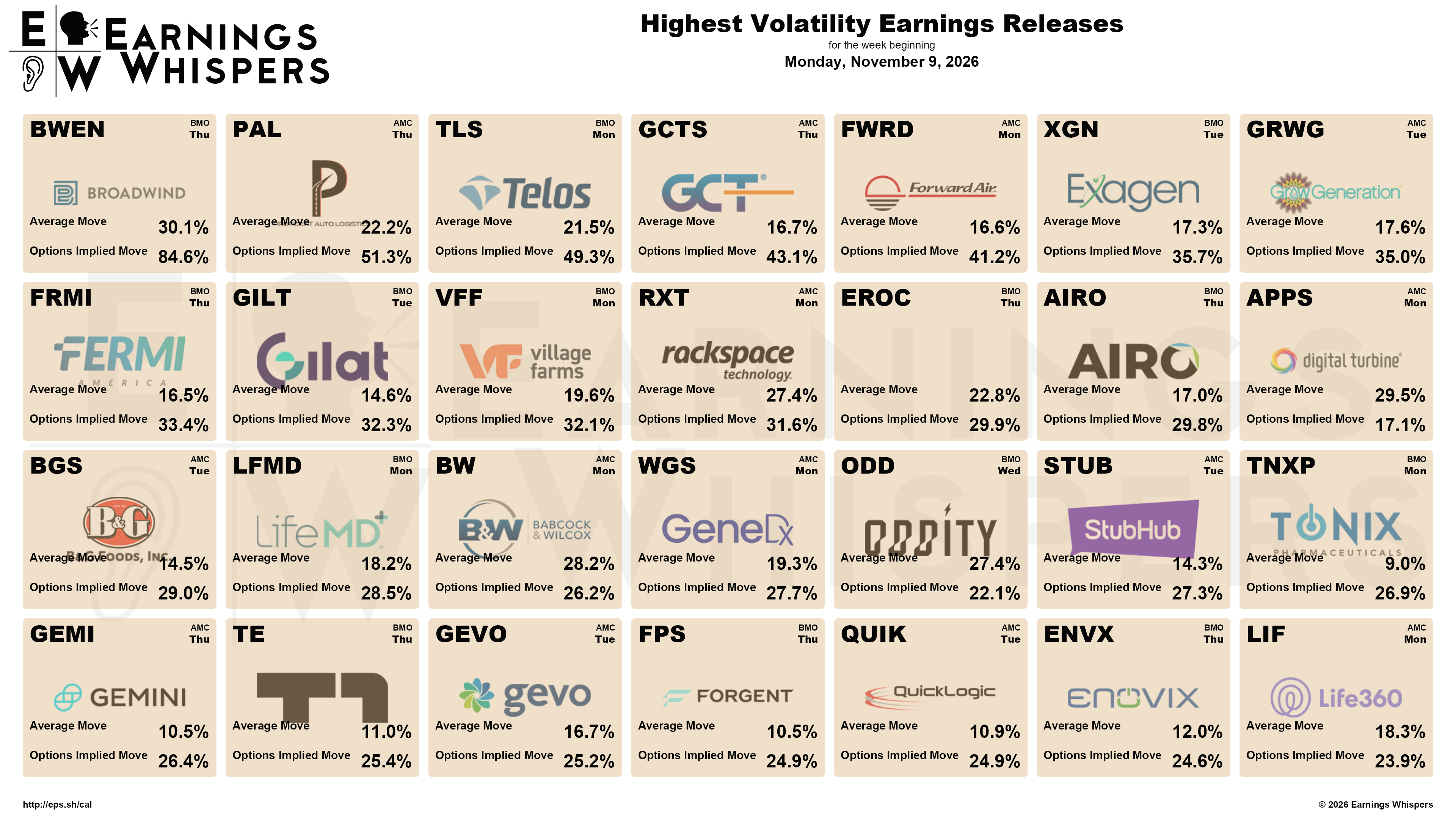
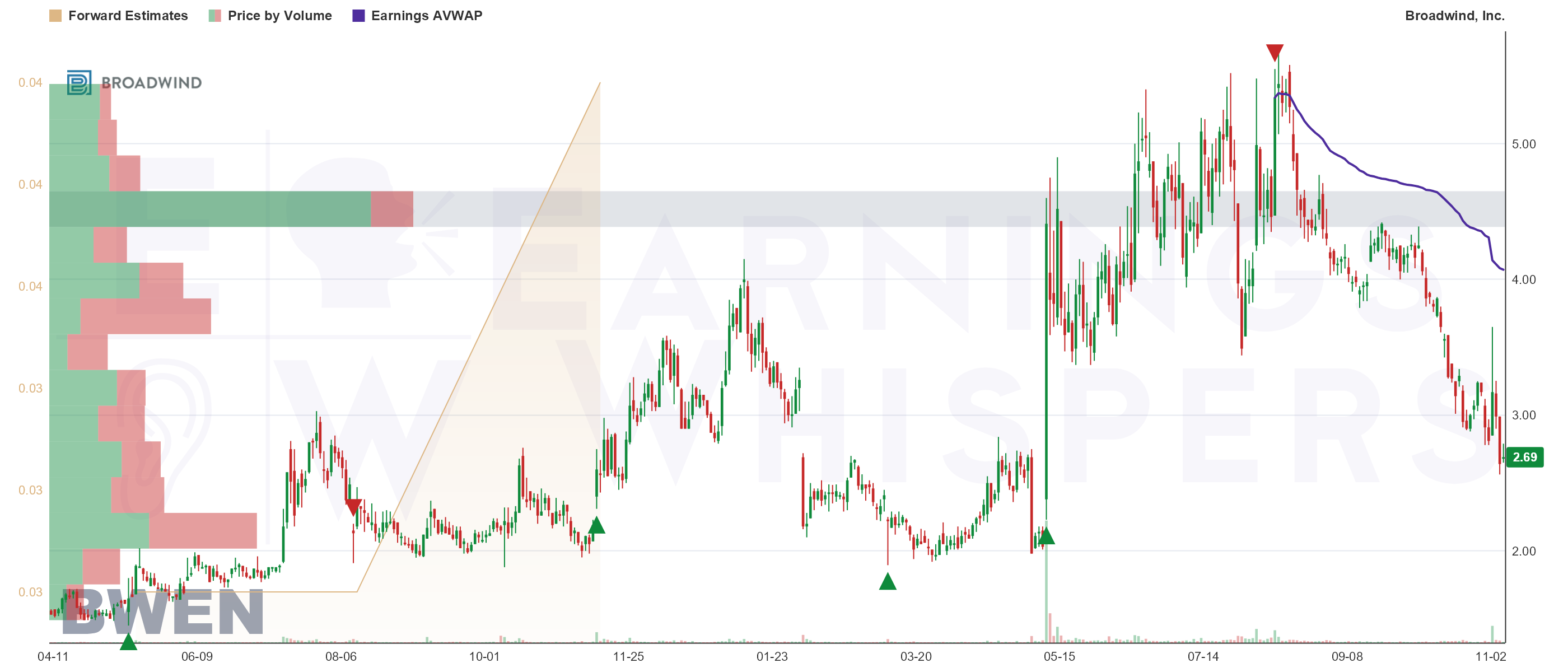
Broadwind (BWEN) steps up to the plate Thursday, November 12, 2026 at around 7:00 AM ET. Wall Street is penciling in a loss of $0.04 per share on revenue of $23.82 million, which looks ugly at first glance because it's down 46.2% from a year ago, but that drop is mostly the old wind business being shown the door. Investors are feeling upbeat heading in, though nobody is expecting fireworks on the actual numbers. Short sellers have largely packed up and left, with short interest down 56.7% since last quarter. The stock itself has been limping along, sliding 39.8% from where it opened after the last report and now sitting 23.0% below its 200 day moving average of $3.50. Here's the twist: analysts have been nudging their estimates higher, and this stock loves to swing, averaging a 30.1% move after recent reports. One more tell, on Tuesday, November 03, 2026, somebody scooped up 714 of the $5.00 calls expiring December 18, 2026, a bet that things could get interesting.
The story here is a company in the middle of a full reinvention, ditching wind to become a pure-play precision manufacturer, and the early scorecard looks good. Last quarter both core segments posted record orders, backlog and revenue, and the company flipped to positive EBITDA for the first time in a while. Management sounded the most confident they've been in four calls, talking up a multi-year spending boom in power generation, data centers and the grid, plus a shopping list of potential acquisitions. The catch to watch Thursday: management still has not put full-year guidance back on the table, waiting until the final wind-down wraps up this quarter, and they've already warned that last quarter's juicy margins won't last. Also keep an eye on their heavy reliance on one big customer, GE Vernova. If guidance comes back, this one could really move.
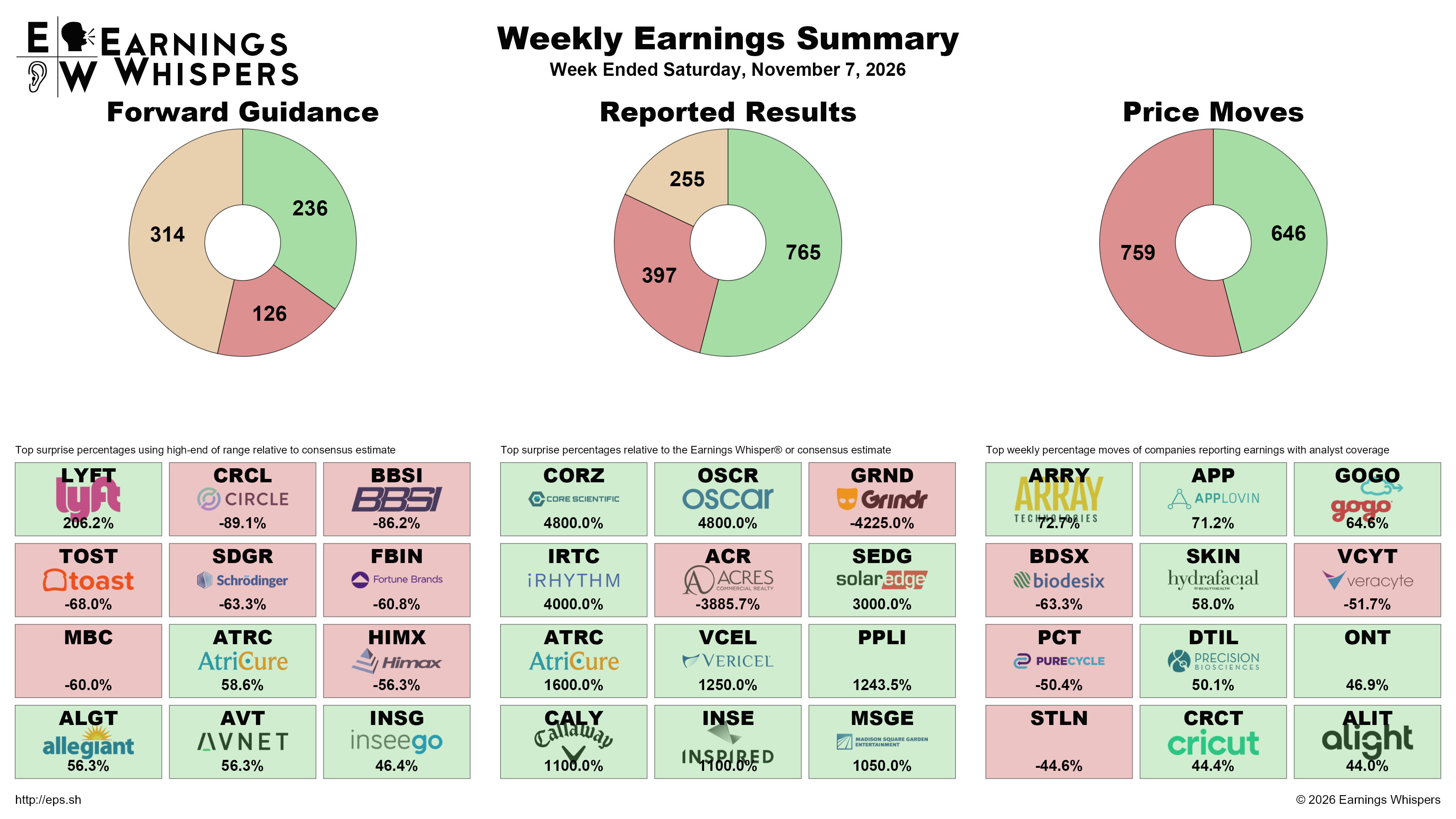
Earnings Season's Great Divide: Healthcare Hustles While Apple Hits the Brakes
Last week's earnings told a tale of two very different worlds. On one side sat the healthcare and drug-distribution crowd, which absolutely crushed it. McKesson, CVS, Cardinal Health, Cigna, Cencora and Humana all beat expectations and, in most cases, raised their forecasts for the second or third time this year. The common thread was a potent mix of booming demand for GLP-1 weight-loss drugs, aggressive deal-making and newfound confidence from management teams. McKesson lifted its profit outlook while scooping up two companies, CVS stunned investors by announcing it will split into two separate public firms and restart buying back its own stock, and Humana delivered a rare bright spot in its all-important Medicare star ratings, a score that directly affects how much the government pays it. Even the energy names joined the party, as refiner Marathon Petroleum posted record quarterly results and pipeline giant Energy Transfer raised its guidance for the third straight time while announcing a flurry of new projects, many tied to the voracious power appetite of AI data centers.
Then there was Apple, the biggest name of the bunch, which served as the week's cautionary tale. On the surface the iPhone maker finished a record year, with Mac sales jumping and China sales climbing an eye-catching 21 percent. But look under the hood and the story gets wobblier. In his first earnings call as the new chief executive, John Ternus had to explain why the company keeps dialing back its expectations: growth is slowing, its lucrative services business is cooling off, and profit margins are getting squeezed by what Apple itself called 'unprecedented' memory chip costs that show no sign of letting up. iPads and wearables actually shrank, and the company is raising prices across its lineup without knowing how shoppers will react. It was a classic case of strong results today but clear warning signs for tomorrow. The quieter laggard was agricultural giant ADM, which raised its profit outlook for a third time yet quietly admitted the good times may be peaking, as its crushing margins and nutrition business both lost steam. The takeaway for everyday investors: a rising headline number is nice, but the real story is whether a company's momentum is speeding up or, like Apple's, gradually running out of gas.
Apple's Record Year Ends With a Margin Warning Flashing
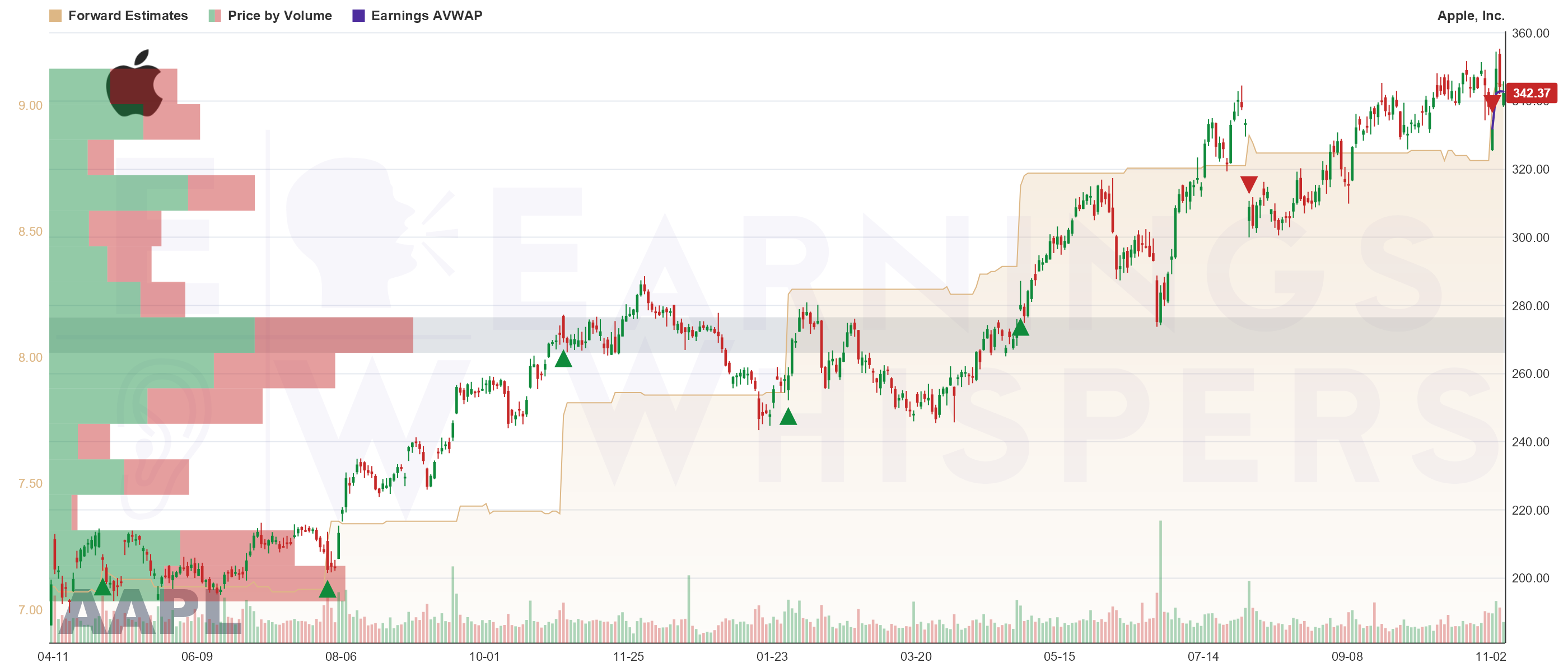
Apple (AAPL) wrapped up its best fiscal year ever with fourth quarter earnings of $2.05 per share on revenue of $114.48 billion, topping the consensus call of $1.98 per share on $112.95 billion and growing revenue nearly 12 percent from a year ago. iPhone hit a September quarter record and Services reached an all-time high. The one blemish: earnings came in just a hair under the Earnings Whisper number of $2.07, a 0.97 percent miss that is more rounding error than red flag. Guidance for the holiday quarter calls for $2.76 to $2.99 per share on revenue of $153.82 billion to $158.14 billion, which would make it the biggest revenue quarter in company history. New CEO John Ternus leaned into the story, touting the iPhone Duo foldable, the iPhone 18 Pro lineup, the first touch-enabled Mac, and the new Siri AI as the most ambitious slate the company has ever shipped into a holiday.
Here is the part you should actually care about. The headline numbers look great, but the forward dashboard is blinking yellow. Gross margin guidance dropped to 45-46 percent, the third straight step-down from the near 48 percent reported, and management flat out called memory costs "unprecedented" and still climbing past December. The tariff refund that has been padding margins is now basically used up, and running Siri in the cloud adds fresh costs on top. Revenue growth guidance also slipped again to 7-10 percent, the fourth decline in a row, while Services growth has cooled from 14 percent to a guided 8-9 percent. Toss in iPad down 10 percent and Wearables down 8 percent, and the picture is clear: the products are selling and demand is strong, but rising costs are about to take a real bite out of profitability. Record revenue, shrinking margins. Keep an eye on the squeeze.
Palantir Dazzles on Growth, But the Order Book Starts to Wobble
Palantir just posted its fastest growth yet, with third quarter revenue hitting $2.31 billion, up nearly 96% from a year ago and comfortably ahead of Wall Street's $2.17 billion estimate. The catch is earnings came in at $0.44 per share, topping the $0.40 consensus but falling short of the whisper number of $0.49, a miss of about 10%. Management raised full-year guidance for the fourth straight time and now sees fourth quarter revenue of roughly $2.65 billion, well above the $2.45 billion the Street was modeling. CEO Alex Karp leaned into his usual flair, declaring that the Sovereign AI movement is creating 'the most dramatic dichotomy between haves and have nots' he has seen in 30 years, with every institution being forced to pick a side. Palantir, for the record, builds the data platforms that let big organizations wrangle their messiest, most sensitive information.
Here is the wrinkle worth watching. For the first time in this hot streak, the leading indicators cooled off. Total new bookings grew just 6% year over year, down from 49% last quarter, and U.S. commercial bookings slowed to 11% growth from a scorching 153%. Backlog barely budged, and free cash flow margin slipped to 53% from 63%. Management blames shorter sovereign AI deals and insists it 'cannot satiate demand,' which is a nice problem to have. The reported numbers are glowing, but the pipeline that feeds future quarters got noticeably quieter. The real test is whether those smaller, faster deals balloon into bigger contracts next quarter. For now, enjoy the fireworks, but keep one eye on the order book.
AMD's AI Engine Roars as Data Center Nearly Doubles
Advanced Micro Devices (AMD) posted earnings of $2.09 per share on revenue of $13.38 billion for the third quarter ended September 2026, blowing past the $1.94 consensus and the $1.98 Earnings Whisper number. That is a 5.56% beat on the bottom line, while revenue jumped a hefty 44.68% from a year ago. The real fireworks were in the outlook: management now sees fourth quarter revenue landing between $16.49 billion and $17.51 billion, well above the $16.03 billion Wall Street was penciling in. CEO Dr. Lisa Su called it a record quarter driven by Data Center sales that nearly doubled year over year, powered by surging demand for its Instinct and EPYC chips, and she expects growth to kick into an even higher gear as the company ramps up its Helios and Venice production.
Here is the straight talk. The AI story at AMD is getting bigger every time they open their mouth. They raised their 2027 forecast across the board, with total revenue now expected to grow more than 80%, server revenue set to double, and data center making up over 80% of the business. Their new MI455X and Helios chips already started shipping to the heavy hitters like OpenAI, Meta, Microsoft, Oracle, and Anthropic, and by next quarter their AI chips will outsell their server CPUs in dollars. The one wart is the PC side, where pricier memory is cooling demand and they expect consumer and gaming chips to drop more than 20% next quarter. Cash flow also took a hit, falling to $554 million as they stocked up on inventory. Still, these are speed bumps on a rocket ship. The AI momentum is doing all the talking.
SMCI Blows the Doors Off, But One Customer Holds the Keys
Super Micro just delivered a monster quarter. Revenue hit $19.95 billion, nearly quadrupling from a year ago and crushing the $15.77 billion consensus. Earnings came in at $1.81 per share versus the $1.16 Wall Street penciled in, a 10% beat. Management isn't slowing down either, guiding Q2 to $19.5 to $21.5 billion against a $16.6 billion estimate, and lifting the full-year FY27 outlook to a chunky $72 to $82 billion, well north of the $67.7 billion the Street expected. CEO Charles Liang is leaning hard into the company's pivot to a full-stack AI datacenter shop, with new tie-ups with Cisco, NetApp and Nutanix, and first-out-the-gate shipments of NVIDIA's Vera Rubin racks. In short, the AI gold rush is paying off and Supermicro is selling the shovels.
Now for the fine print, because there's always fine print. About $2.3 billion of that revenue was catch-up from past quarters, so the real run rate is closer to $17.6 billion. Margins also slipped from 17.6% last quarter to 12.8%, and they've warned the back half of the year gets thinner as cheaper AI gear takes over the mix. The bigger thing to watch: a single customer made up 44% of the quarter's sales, way up from 28% last year. That's a lot of eggs in one basket. Add in ongoing GPU shortages and the race to get datacenters powered and ready, and you've got a company firing on all cylinders that is also riding one very big horse. Great quarter, just keep an eye on who's writing the checks.
AppLovin Bounces Back With a Blowout Quarter
Applovin Corp Cl A (APP) came roaring back this quarter, posting earnings of $4.30 per share on revenue of $2.18 billion for the third quarter ended September 2026. That blew past the consensus estimate of $3.94 per share and the $2.08 billion revenue forecast, and even topped the Earnings Whisper number of $4.05. The company beat expectations by 6.17% while revenue grew a sizzling 55.50% from a year ago. Looking ahead, management guided fourth quarter revenue to a range of $2.365 billion to $2.395 billion, comfortably above the $2.250 billion analysts were penciling in. In short, AppLovin, whose marketing platform helps developers grow their mobile apps, just answered last quarter's stumble with a mic drop.
The real story here is the comeback. After a shaky second quarter dented investor confidence, AppLovin delivered a record beat, fatter margins at 84%, and free cash flow that nearly doubled to $1.4 billion. The company also cranked up its buyback authorization by $3.2 billion to $3.6 billion and started snapping up shares at a faster clip. A new next-generation model is only partially rolled out and already has gaming growing close to 50%, so there is likely more gas in the tank. One thing to keep an eye on: the fourth quarter guide implies growth will cool a bit from quarter to quarter, and management flagged some new seasonal bumpiness as the business leans more on consumer spending. But that reads more like cautious framing than trouble, and this quarter puts the Q2 worries firmly in the rearview mirror.
The real fireworks, though, may come from the stocks where the whisper on the street has turned sharply sour. monday.com, the workplace software company, and ad-tech player The Trade Desk are both drawing unusually gloomy chatter, and the smart money appears to be bracing for turbulence. Video gaming fans will be glued to Take-Two, the studio behind Grand Theft Auto, where the stakes always run high, and the swings can be dramatic. Meanwhile, the quietly confident corners of the market are worth a look for bargain hunters: data outfit NIQ Global and miner Hudbay Minerals are among the names generating genuine optimism rather than hype. And of course, there is always one grown-up in the room. Berkshire Hathaway, Warren Buffett's sprawling empire, reports with its usual steadiness, a reminder that for all the drama swirling around AI and crypto-adjacent plays, sometimes boring is beautiful. Expect plenty of white-knuckle moves, a few genuine surprises, and more than one stock that defies whatever the crowd was betting on.
Nu Holdings: Cheap Stock, Big Growth, Grumpy Mood
Nu Holdings (NU) steps up to the plate after the bell on Thursday, November 12, 2026, with numbers expected around 5:40 PM ET. Wall Street is looking for $0.22 per share on revenue of $5.70 billion, a juicy 36.6% jump from last year, while the Earnings Whisper number nudges a touch higher at $0.24. Here is the funny part: investors are walking in bearish, yet a whopping 86.1% still expect the company to beat. So everyone is frowning while quietly betting on a win. Option traders are bracing for an 8.4% swing, a bit bigger than the 6.3% average move we have seen lately, so buckle up.
The real story is the mood going in. The stock has slid 23.6% from where it opened after last quarter's report and now sits 16.1% below its 200-day moving average of $14.34, and analysts have been quietly trimming their estimates since the last release. That is the cautious side. The hopeful side showed up on Friday, October 23, 2026, when someone scooped up 28,137 of the $14.50 calls expiring November 20, a sizable bet that this beaten-down name could bounce back fast. Growth is still strong, the price is low, and the bulls are circling. Thursday tells us who was right.
Nebius: The AI Cloud Rocket Whose Fuel Gauge Keeps Climbing
Nebius Group (NBIS) is set to report earnings before the bell on Thursday, November 12, 2026, at around 7:40 AM ET. Wall Street is bracing for a loss of $0.61 per share on revenue of $916.78 million, which would be a jaw-dropping 527.5% jump from a year ago, though our own Earnings Whisper number is a slimmer loss of $0.49. Investors are walking in nervous, yet nearly 68% of them still expect a beat, which tells you this is a crowd that is scared and hopeful at the same time. Short sellers have backed off, cutting their bets by 22% since last quarter, even as the stock has slid 42.7% from where it opened after the last report and now sits 27.2% below its 200 day average of $177.97. Analysts have been nudging estimates higher, and options traders are strapped in for a wild 19.6% swing, bigger than the stock's usual 14.5% earnings-day lurch. One eyebrow-raiser: on November 5th, someone scooped up 10,783 of the $75 puts expiring January 15, 2027, a sizable downside bet worth watching.
Here is the real story heading into the print. Last quarter, Nebius proved it is no longer just riding the coattails of Microsoft and Meta, landing four separate billion-dollar AI cloud deals with the likes of Reflection and Cohere at fatter per-megawatt prices. Revenue jumped 46% in a single quarter, annual recurring revenue hit $3 billion, and margins fattened to 41%. Its first capacity auction cleared 15% above the prior top price, so pricing power is clearly real. The one thing to keep an eye on is that management reaffirmed rather than raised full-year guidance, since those shiny new deals mostly boost 2027, not 2026. So watch two things Thursday: whether revenue clears that near-billion-dollar bar, and whether management finally lifts the numbers or hands us a first look at 2027. Given the beaten-down stock and jittery sentiment, even a confident tone could light a fire.
Rocket Lab's Earnings: Can Neutron Finally Light the Fuse?
Rocket Lab (RKLB) is set to report earnings on Monday, November 9, 2026 at roughly 4:05 PM ET. Wall Street is looking for a loss of $0.02 per share on revenue of $256.51 million, which would mark a hefty 65.4% jump from a year ago, while the whisper number is a touch brighter at a loss of just $0.01. Management had guided revenue to a range of $250 to $265 million, so they are sitting comfortably in the pocket. Investors are feeling good here, with 44.4% betting on a beat. Short interest has ticked down 1.2% since the last report, yet the stock has slid 30.4% from its post-earnings open and now sits a chilly 32.8% below its 200 day moving average of $78.98. The good news for bulls is that overall earnings estimates have been revised higher. Buckle up, because options traders are pricing in a 14.9% swing on this print, well above the 8.3% the stock has averaged recently, and someone made a notable bet with 13,332 of the $40 puts expiring December 18 getting scooped up on October 28.
Here is the real story heading in. Last quarter was a genuine step-up, with record revenue of $234 million, backlog climbing to $2.36 billion, and a monster pending Iridium acquisition that pushes Rocket Lab into the higher-margin business of actually running satellites instead of just launching them. Add in record defense wins and the tone from management got downright swaggering. But two things are keeping the champagne on ice. Margins slipped a bit and cash burn widened to over $110 million as they build out for the big Neutron rocket, and that is the whole ballgame. Neutron's first flight has been pushed back more times than a dentist appointment, now targeting a narrowing late 2026 window. If they can give a firm liftoff date on this call, the stock could stop drifting and start flying. If Neutron slips again, expect the doubters to get louder.
CoreWeave: Great Business, Battered Stock, Nervous Options Crowd
CoreWeave (CRWV) steps up to the plate after the close on Tuesday, November 10, 2026, at roughly 4:10 PM ET. Wall Street is penciling in a loss of $1.17 per share on revenue of $3.54 billion, which would be a jaw-dropping 159.4% jump from a year ago, though the Earnings Whisper number is a touch friendlier at a $1.00 loss. Management had guided revenue to $3.45 billion to $3.60 billion, so they are playing it comfortably within their own lines. The mood is upbeat with 72.0% of investors betting on a beat, and estimates have actually been nudged higher since last quarter, which is the kind of tailwind you like to see. The catch is the stock itself: it has tumbled 57.3% from where it opened after last earnings and now sits a brutal 48.5% below its 200 day moving average of $90.18, while short interest has climbed 8.4%. Option traders are bracing for a wild 21.6% swing, even bigger than the 14.8% average move of late, and on October 20 someone grabbed 42,206 of the $30.00 puts expiring November 20, so not everyone is drinking the bull punch.
Here is the real story heading in. Last quarter was the moment CoreWeave finally delivered the margin turn it had been promising for three straight calls, with adjusted operating income leaping to $128 million and management raising basically every number that matters: revenue, operating income, year-end power, and exit ARR. A roughly 25% July price hike and juicier new contracts are feeding the fire, and a brand new managed inference business rocketed from $1 million to over $100 million in booked ARR almost overnight. The flip side, and why the stock is getting whacked, is the money going out the door. Capex guidance keeps marching up to $35 to $39 billion, interest expense is swelling past $640 million, and the net loss widened to $626 million. In short, the business is firing on all cylinders while the balance sheet is doing heavy lifting, so watch whether the margin momentum keeps outrunning the mounting interest bill.
Take-Two's Big GTA VI Payday Is Finally Here
Take-Two Interactive Software (TTWO) is confirmed to report earnings on Monday, November 9, 2026 at approximately 4:05 PM ET. Wall Street is looking for $0.90 per share on revenue of $1.66 billion, a 6.4% dip from last year, though the Earnings Whisper number sits higher at $1.05 per share. Management guided revenue to a range of $1.42 billion to $1.47 billion. Investors are feeling gloomy heading in, with only 23.8% betting on a beat, and short interest has jumped 26.6% since last quarter. The stock has slid 8.0% since its last earnings reaction and now trades 1.9% below its 200 day moving average of $219.04. Here is the kicker though: overall earnings estimates have actually been revised higher. Option traders are bracing for a 10.2% swing even though the stock has only averaged a 5.1% move lately, and on Wednesday someone scooped up 10,224 of the $200 calls expiring November 20, a sizable bet that the gloom may be overdone.
The whole story here is one date: November 19, when Grand Theft Auto VI finally lands. Last quarter management stopped calling this a breakout year and started calling it an inflection point in the company's history, which tells you everything. GTA VI pre-orders were described as unprecedented and astonishing, NBA 2K26 just wrapped a record year at 12 million plus units, and the old GTA V has now sold 230 million copies and counting. Notably, the team refused to raise full-year guidance despite the beat, since pre-orders can still be cancelled and nothing is officially sold yet. So the real question is not the numbers for this quarter, which look soft on tough comps, but whether management finally cracks open that $8.0 to $8.2 billion full-year outlook and lets the GTA VI hype do the talking.
AST SpaceMobile: Satellites Soaring, Stock Snoozing
AST SpaceMobile (ASTS) is set to report earnings on Monday, November 9, 2026 at roughly 4:30 PM ET. Wall Street is bracing for a loss of $0.41 per share on revenue of $44.47 million, which would be a whopping 201.7% jump from a year ago, though the quieter Earnings Whisper number pegs the loss a bit deeper at $0.48. Investors are grumpy heading in, yet nearly half (46.7%) still expect a beat, so the mood is less doom and more cautious skepticism. The doubters have put their money where their mouth is too, with short interest climbing 11.0% since last quarter while the stock has tumbled 53.6% from where it opened after the last report, leaving it a stunning 57.4% below its 200 day moving average of $75.81. Analysts have been trimming their estimates lately, so the bar is sinking. Options traders are betting on a 20.1% swing on the news, which is a big leap over the 5.7% the stock has typically moved in recent quarters, and on Thursday, November 5, someone scooped up a notable 12,977 of the $45 calls expiring November 20, so at least a few folks are betting on fireworks.
Here is the real story heading in: last quarter was actually a good one, with revenue more than doubling to $31.5 million, the order backlog ticking up to about $1.3 billion, and more than 60 carrier partners now on board covering over 3 billion phones. The company is flush too, sitting on more than $3.7 billion after a cheap convertible deal, and it landed a big preliminary win in Japan worth up to $1 billion. The catch, and the reason the stock keeps sliding, is that management did not raise its full-year revenue guidance despite all the good news, the timeline to get its satellites in orbit quietly slipped toward early 2027, and costs are creeping higher. So the question Monday is simple: will management show real progress on launches and actual commercial revenue, or will it be another quarter of promising nothing but 'soon'? That answer, not the headline numbers, is what moves this stock.
Constellation's Big Earnings Test: Will the Data Center Deals Finally Land?
Constellation Energy (CEG) steps into the earnings spotlight on Monday, November 9, 2026 at roughly 6:45 AM ET, and Wall Street is bracing itself. The consensus and the Earnings Whisper number both sit at $3.90 per share on revenue of $8.72 billion, which would be a hefty 32.7% jump from a year ago. Investors are feeling grumpy heading in, yet a solid 64.3% still expect a beat, so it is a bit of a tug of war. The skeptics have been busy too. Short interest is up 11.6% since last quarter, the stock has slid 10.1% since its last earnings pop, and it now sits 10.3% below its 200 day moving average of $278.73. Options traders are betting on an 8.2% swing, which is spicy compared to the usual 3.7% move in recent quarters. And one trader clearly wants protection, scooping up 4,070 of the $200 puts expiring December 4 on October 23.
Here is the real story. Constellation has quietly gotten stronger under the hood. The Calpine deal is now baked in and adding around $2 a share, management is sticking to a 20% plus earnings growth plan through 2029, and they just extended their free cash flow outlook by about 45% while fattening the buyback to $5 billion. The hang-up is the big data center deals. Last year they were practically doing a victory lap, saying a marquee contract was all but signed. Then some of those hyperscaler customers hit pause, waiting on PJM to sort out the rules of the road. The good news is that clarity is coming fast, with a key FERC filing expected soon. Watch for whether a new mega deal finally gets inked. If it does, the grumpy crowd may have to change its tune.
Cerebras Heads Into Earnings Firing On All Cylinders, But The Bears Are Circling
Cerebras Systems (CBRS) is locked in to report earnings on Thursday, November 12, 2026 at roughly 4:05 PM ET. Wall Street is penciling in a loss of $0.13 per share on revenue of $215.82 million, but the Earnings Whisper number tells a rosier story at just a $0.03 loss. The company itself guided revenue to a tight $214.00 million to $216.00 million window. Here is the fun part: investors are feeling gloomy heading in, yet 71.4% still expect a beat. That is a crowd that wants to be convinced. Short interest has nearly doubled, up 90.5% since last quarter, while the stock has slid 59.2% from where it opened after the last report and now sits a brutal 53.9% below its 200-day moving average of $194.36. Still, overall earnings estimates have actually been revised higher, so the pros are not giving up. Option traders are bracing for a 22.5% swing, though the stock has typically moved around 15.7% in recent quarters. And on Monday, November 02, 2026, someone scooped up 10,533 of the $75.00 puts expiring January 15, 2027, which is a sizable bet that more pain could be coming.
Here is the catch for the skeptics: last quarter was about as clean as it gets. Core revenue hit a record $209.9 million, up 103% from a year ago, and management raised full-year guidance across revenue, gross margin, and operating margin all at once. New names poured in like Figma, Block, GSK, and CrowdStrike, plus a splashy AMD partnership that promises 5x throughput while Cerebras keeps all the rental revenue. The one soft spot everyone should watch is gross margin, which dips to a flagged low of 38% to 40% this quarter because the company is renting back its own systems before owned machines take over. Management has been loud and clear that this quarter is the bottom before margins climb again. The other nagging worry is heavy reliance on OpenAI and a data center buildout that is the single biggest limit on growth. If Cerebras shows that quarter is indeed the trough, this beaten-down stock could snap back fast.
Zeta's AI Pivot Heads Into Earnings Riding a 20-Quarter Winning Streak
Zeta Global (ZETA) is confirmed to report earnings on Monday, November 9, 2026 at approximately 4:05 PM ET. Wall Street is looking for $0.28 per share on revenue of $470.48 million, which would mark a healthy 39.5% jump from a year ago, but the whisper number is a touch higher at $0.30. Management already told us to expect revenue between $469 and $472 million, so they have boxed themselves in nicely. The crowd is feeling good here, with 58.3% betting on a beat, and they have company: short sellers have run for the exits, cutting their bets by nearly half since last quarter. The stock has quietly climbed 25.9% since the last report and now sits a hefty 36.4% above its 200 day average of $22.74, while analysts keep nudging their numbers higher. Options traders are bracing for a 16.6% swing, a bit bigger than the 11.0% average lately, and one bold trader scooped up roughly 10,000 of both the $50 calls and $25 puts expiring all the way out in January 2029.
Here is the real story: Zeta is no longer just a marketing software company, it is pitching itself as AI plumbing for big business, and the pitch is landing. Last quarter it posted its 20th straight beat and raise, lifted full-year revenue guidance by the biggest chunk all year, and cranked up both cash flow and profit targets. The new toys are the headliners, with fresh partnerships tying Zeta to OpenAI, Palantir, and Snowflake, plus a GAP win where it kicked Salesforce and three other vendors to the curb. The one wrinkle to watch is margins, since new agency deals are bringing in lower-margin social spend that nudged costs up a bit. Keep in mind guidance leaves out any upside from those shiny partnerships, so the key question Monday is whether Zeta can start turning those big-name deals into real dollars.
D-Wave's Backlog Is Booming, But Can Q4 Deliver?
D-Wave Quantum (QBTS) is set to report earnings on Tuesday, November 10, 2026 at about 7:00 AM ET. Wall Street is looking for a loss of $0.14 per share on revenue of $3.95 million, which would be 5.6% growth from a year ago, but the Earnings Whisper number is a bit gloomier at a loss of $0.16 per share. Investors are leaning bearish heading in, though a slim majority of 58.3% still expect a beat. The skeptics have been busy: short interest jumped 21.6% since last quarter, the stock has slid 42.1% from where it opened after the last report, and it now sits a painful 43.5% below its 200 day moving average of $18.90. Estimates have been trimmed across the board. Options traders are bracing for a 16.3% swing, roughly in line with the 13.5% average move of recent quarters, and on Thursday someone scooped up 7,632 of the $3.00 puts expiring in January 2028, a notable bet that someone is playing defense well into the future.
Here is the real story heading into the print: the top-line numbers look sleepy, but the plumbing underneath is getting interesting. Backlog exploded to $40.7 million from just $5.3 million a year ago, the sales pipeline is up 120% since December, and big names like AT&T, Optum, and Docomo are moving from experiments to actual production use. The catch is timing. Two annealing system deliveries slipped into the fourth quarter, management has openly warned that most of the year's revenue is crammed into the back half, and that makes this an execution test more than anything. Margins are shrinking on higher staffing costs, losses are widening, and cash is burning faster after the QCI deal. So the question clients should be asking is simple: does the heavy Q4 lifting start showing up, or does the slippage keep sliding? The commercial momentum is real, but the near-term math still has to cooperate.
Broadwind's Big Makeover: Wind's Out, Precision's In
Broadwind (BWEN) steps up to the plate Thursday, November 12, 2026 at around 7:00 AM ET. Wall Street is penciling in a loss of $0.04 per share on revenue of $23.82 million, which looks ugly at first glance because it's down 46.2% from a year ago, but that drop is mostly the old wind business being shown the door. Investors are feeling upbeat heading in, though nobody is expecting fireworks on the actual numbers. Short sellers have largely packed up and left, with short interest down 56.7% since last quarter. The stock itself has been limping along, sliding 39.8% from where it opened after the last report and now sitting 23.0% below its 200 day moving average of $3.50. Here's the twist: analysts have been nudging their estimates higher, and this stock loves to swing, averaging a 30.1% move after recent reports. One more tell, on Tuesday, November 03, 2026, somebody scooped up 714 of the $5.00 calls expiring December 18, 2026, a bet that things could get interesting.
The story here is a company in the middle of a full reinvention, ditching wind to become a pure-play precision manufacturer, and the early scorecard looks good. Last quarter both core segments posted record orders, backlog and revenue, and the company flipped to positive EBITDA for the first time in a while. Management sounded the most confident they've been in four calls, talking up a multi-year spending boom in power generation, data centers and the grid, plus a shopping list of potential acquisitions. The catch to watch Thursday: management still has not put full-year guidance back on the table, waiting until the final wind-down wraps up this quarter, and they've already warned that last quarter's juicy margins won't last. Also keep an eye on their heavy reliance on one big customer, GE Vernova. If guidance comes back, this one could really move.
Earnings Season's Great Divide: Healthcare Hustles While Apple Hits the Brakes
Last week's earnings told a tale of two very different worlds. On one side sat the healthcare and drug-distribution crowd, which absolutely crushed it. McKesson, CVS, Cardinal Health, Cigna, Cencora and Humana all beat expectations and, in most cases, raised their forecasts for the second or third time this year. The common thread was a potent mix of booming demand for GLP-1 weight-loss drugs, aggressive deal-making and newfound confidence from management teams. McKesson lifted its profit outlook while scooping up two companies, CVS stunned investors by announcing it will split into two separate public firms and restart buying back its own stock, and Humana delivered a rare bright spot in its all-important Medicare star ratings, a score that directly affects how much the government pays it. Even the energy names joined the party, as refiner Marathon Petroleum posted record quarterly results and pipeline giant Energy Transfer raised its guidance for the third straight time while announcing a flurry of new projects, many tied to the voracious power appetite of AI data centers.
Then there was Apple, the biggest name of the bunch, which served as the week's cautionary tale. On the surface the iPhone maker finished a record year, with Mac sales jumping and China sales climbing an eye-catching 21 percent. But look under the hood and the story gets wobblier. In his first earnings call as the new chief executive, John Ternus had to explain why the company keeps dialing back its expectations: growth is slowing, its lucrative services business is cooling off, and profit margins are getting squeezed by what Apple itself called 'unprecedented' memory chip costs that show no sign of letting up. iPads and wearables actually shrank, and the company is raising prices across its lineup without knowing how shoppers will react. It was a classic case of strong results today but clear warning signs for tomorrow. The quieter laggard was agricultural giant ADM, which raised its profit outlook for a third time yet quietly admitted the good times may be peaking, as its crushing margins and nutrition business both lost steam. The takeaway for everyday investors: a rising headline number is nice, but the real story is whether a company's momentum is speeding up or, like Apple's, gradually running out of gas.
Apple's Record Year Ends With a Margin Warning Flashing
Apple (AAPL) wrapped up its best fiscal year ever with fourth quarter earnings of $2.05 per share on revenue of $114.48 billion, topping the consensus call of $1.98 per share on $112.95 billion and growing revenue nearly 12 percent from a year ago. iPhone hit a September quarter record and Services reached an all-time high. The one blemish: earnings came in just a hair under the Earnings Whisper number of $2.07, a 0.97 percent miss that is more rounding error than red flag. Guidance for the holiday quarter calls for $2.76 to $2.99 per share on revenue of $153.82 billion to $158.14 billion, which would make it the biggest revenue quarter in company history. New CEO John Ternus leaned into the story, touting the iPhone Duo foldable, the iPhone 18 Pro lineup, the first touch-enabled Mac, and the new Siri AI as the most ambitious slate the company has ever shipped into a holiday.
Here is the part you should actually care about. The headline numbers look great, but the forward dashboard is blinking yellow. Gross margin guidance dropped to 45-46 percent, the third straight step-down from the near 48 percent reported, and management flat out called memory costs "unprecedented" and still climbing past December. The tariff refund that has been padding margins is now basically used up, and running Siri in the cloud adds fresh costs on top. Revenue growth guidance also slipped again to 7-10 percent, the fourth decline in a row, while Services growth has cooled from 14 percent to a guided 8-9 percent. Toss in iPad down 10 percent and Wearables down 8 percent, and the picture is clear: the products are selling and demand is strong, but rising costs are about to take a real bite out of profitability. Record revenue, shrinking margins. Keep an eye on the squeeze.
Palantir Dazzles on Growth, But the Order Book Starts to Wobble
Palantir just posted its fastest growth yet, with third quarter revenue hitting $2.31 billion, up nearly 96% from a year ago and comfortably ahead of Wall Street's $2.17 billion estimate. The catch is earnings came in at $0.44 per share, topping the $0.40 consensus but falling short of the whisper number of $0.49, a miss of about 10%. Management raised full-year guidance for the fourth straight time and now sees fourth quarter revenue of roughly $2.65 billion, well above the $2.45 billion the Street was modeling. CEO Alex Karp leaned into his usual flair, declaring that the Sovereign AI movement is creating 'the most dramatic dichotomy between haves and have nots' he has seen in 30 years, with every institution being forced to pick a side. Palantir, for the record, builds the data platforms that let big organizations wrangle their messiest, most sensitive information.
Here is the wrinkle worth watching. For the first time in this hot streak, the leading indicators cooled off. Total new bookings grew just 6% year over year, down from 49% last quarter, and U.S. commercial bookings slowed to 11% growth from a scorching 153%. Backlog barely budged, and free cash flow margin slipped to 53% from 63%. Management blames shorter sovereign AI deals and insists it 'cannot satiate demand,' which is a nice problem to have. The reported numbers are glowing, but the pipeline that feeds future quarters got noticeably quieter. The real test is whether those smaller, faster deals balloon into bigger contracts next quarter. For now, enjoy the fireworks, but keep one eye on the order book.
AMD's AI Engine Roars as Data Center Nearly Doubles
Advanced Micro Devices (AMD) posted earnings of $2.09 per share on revenue of $13.38 billion for the third quarter ended September 2026, blowing past the $1.94 consensus and the $1.98 Earnings Whisper number. That is a 5.56% beat on the bottom line, while revenue jumped a hefty 44.68% from a year ago. The real fireworks were in the outlook: management now sees fourth quarter revenue landing between $16.49 billion and $17.51 billion, well above the $16.03 billion Wall Street was penciling in. CEO Dr. Lisa Su called it a record quarter driven by Data Center sales that nearly doubled year over year, powered by surging demand for its Instinct and EPYC chips, and she expects growth to kick into an even higher gear as the company ramps up its Helios and Venice production.
Here is the straight talk. The AI story at AMD is getting bigger every time they open their mouth. They raised their 2027 forecast across the board, with total revenue now expected to grow more than 80%, server revenue set to double, and data center making up over 80% of the business. Their new MI455X and Helios chips already started shipping to the heavy hitters like OpenAI, Meta, Microsoft, Oracle, and Anthropic, and by next quarter their AI chips will outsell their server CPUs in dollars. The one wart is the PC side, where pricier memory is cooling demand and they expect consumer and gaming chips to drop more than 20% next quarter. Cash flow also took a hit, falling to $554 million as they stocked up on inventory. Still, these are speed bumps on a rocket ship. The AI momentum is doing all the talking.
SMCI Blows the Doors Off, But One Customer Holds the Keys
Super Micro just delivered a monster quarter. Revenue hit $19.95 billion, nearly quadrupling from a year ago and crushing the $15.77 billion consensus. Earnings came in at $1.81 per share versus the $1.16 Wall Street penciled in, a 10% beat. Management isn't slowing down either, guiding Q2 to $19.5 to $21.5 billion against a $16.6 billion estimate, and lifting the full-year FY27 outlook to a chunky $72 to $82 billion, well north of the $67.7 billion the Street expected. CEO Charles Liang is leaning hard into the company's pivot to a full-stack AI datacenter shop, with new tie-ups with Cisco, NetApp and Nutanix, and first-out-the-gate shipments of NVIDIA's Vera Rubin racks. In short, the AI gold rush is paying off and Supermicro is selling the shovels.
Now for the fine print, because there's always fine print. About $2.3 billion of that revenue was catch-up from past quarters, so the real run rate is closer to $17.6 billion. Margins also slipped from 17.6% last quarter to 12.8%, and they've warned the back half of the year gets thinner as cheaper AI gear takes over the mix. The bigger thing to watch: a single customer made up 44% of the quarter's sales, way up from 28% last year. That's a lot of eggs in one basket. Add in ongoing GPU shortages and the race to get datacenters powered and ready, and you've got a company firing on all cylinders that is also riding one very big horse. Great quarter, just keep an eye on who's writing the checks.
AppLovin Bounces Back With a Blowout Quarter
Applovin Corp Cl A (APP) came roaring back this quarter, posting earnings of $4.30 per share on revenue of $2.18 billion for the third quarter ended September 2026. That blew past the consensus estimate of $3.94 per share and the $2.08 billion revenue forecast, and even topped the Earnings Whisper number of $4.05. The company beat expectations by 6.17% while revenue grew a sizzling 55.50% from a year ago. Looking ahead, management guided fourth quarter revenue to a range of $2.365 billion to $2.395 billion, comfortably above the $2.250 billion analysts were penciling in. In short, AppLovin, whose marketing platform helps developers grow their mobile apps, just answered last quarter's stumble with a mic drop.
The real story here is the comeback. After a shaky second quarter dented investor confidence, AppLovin delivered a record beat, fatter margins at 84%, and free cash flow that nearly doubled to $1.4 billion. The company also cranked up its buyback authorization by $3.2 billion to $3.6 billion and started snapping up shares at a faster clip. A new next-generation model is only partially rolled out and already has gaming growing close to 50%, so there is likely more gas in the tank. One thing to keep an eye on: the fourth quarter guide implies growth will cool a bit from quarter to quarter, and management flagged some new seasonal bumpiness as the business leans more on consumer spending. But that reads more like cautious framing than trouble, and this quarter puts the Q2 worries firmly in the rearview mirror.