Upcoming Earnings
Tech Titans and Retail Warriors Headline a Thanksgiving Week Earnings Feast
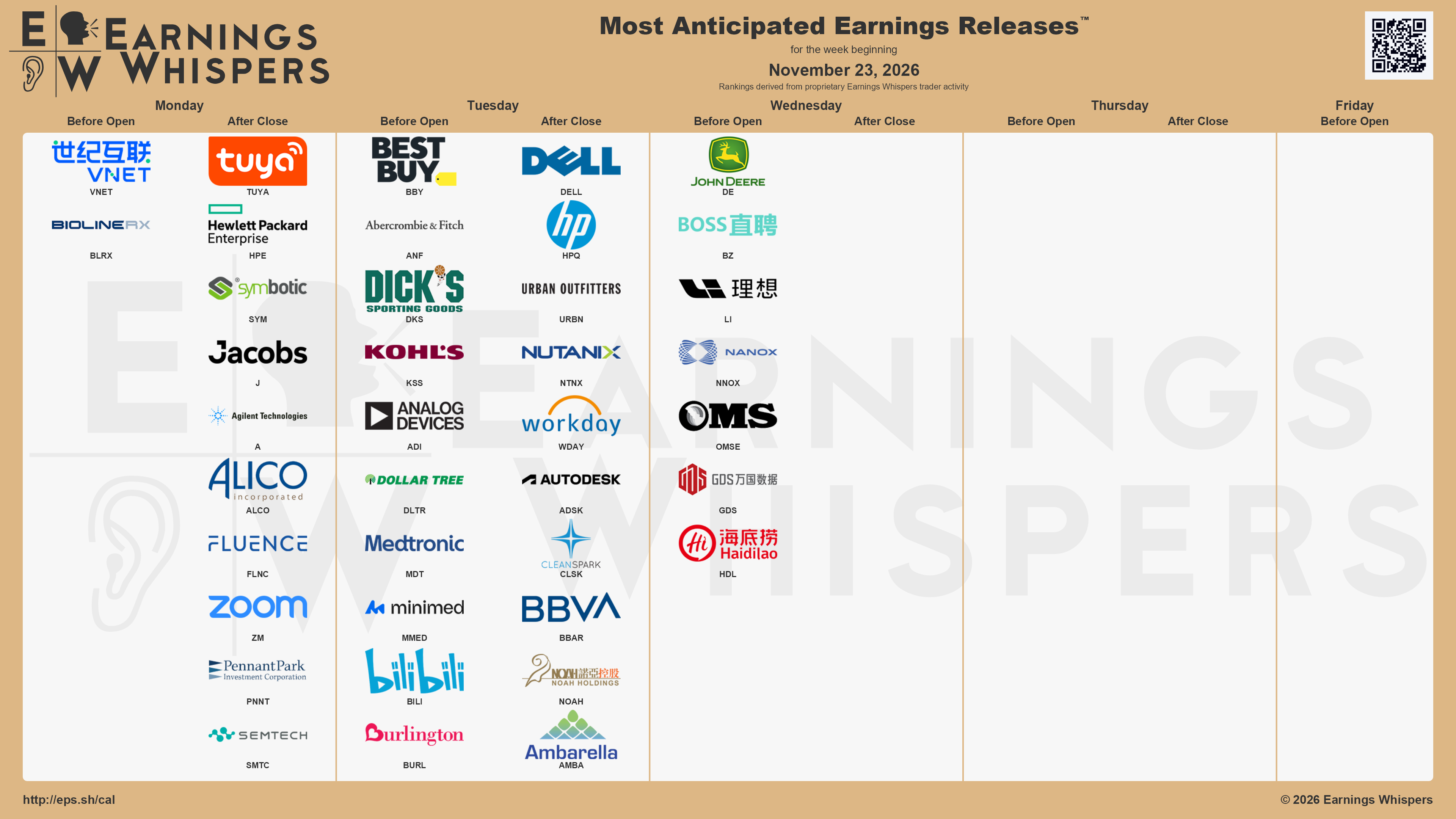
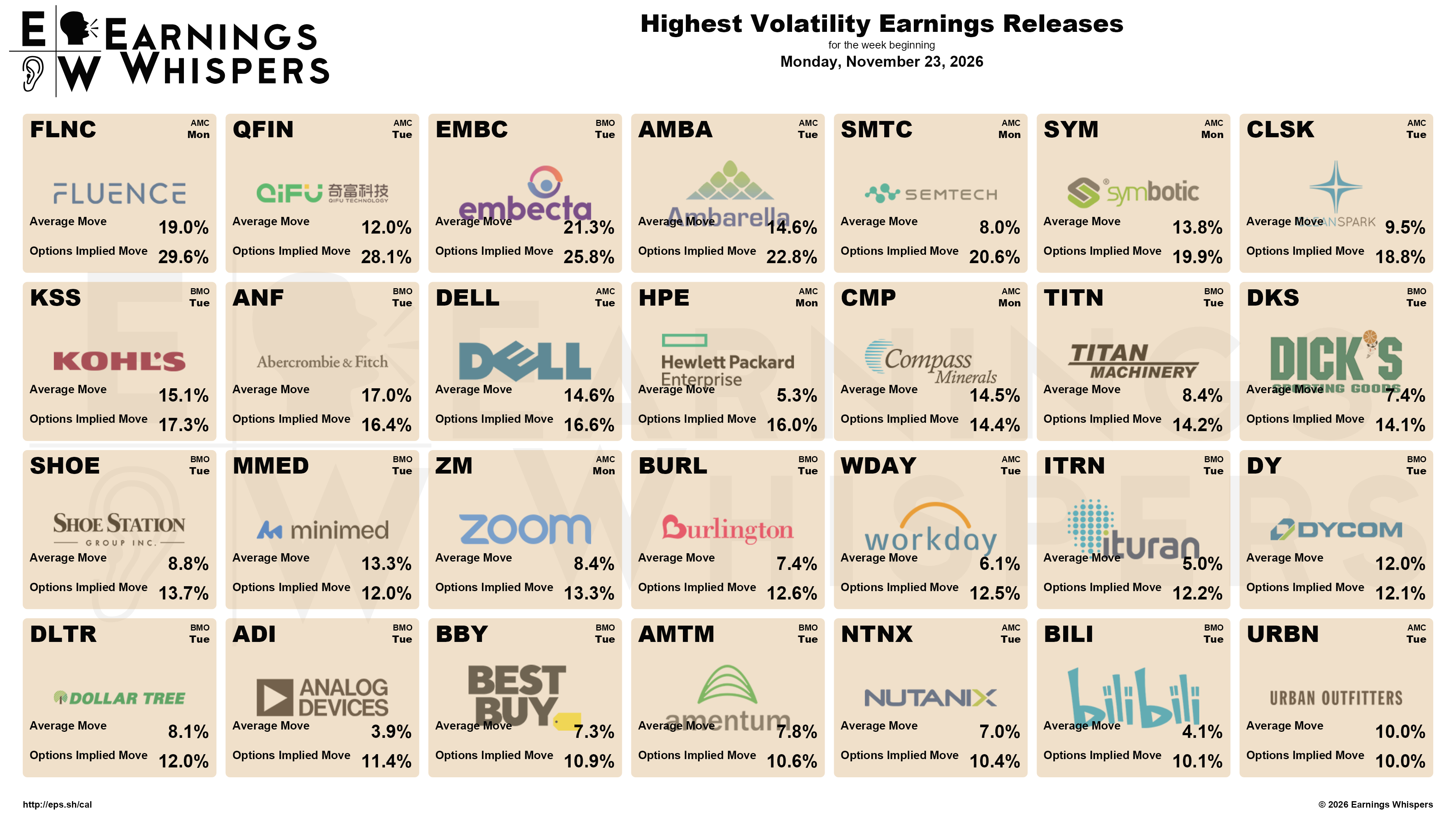
Investors loading up for a holiday-shortened week will find plenty to chew on, starting with the big beasts of the tech world. Dell and Hewlett Packard Enterprise are the marquee names, both riding strong operational momentum into their reports, though a note of caution lingers after Dell's shares slid in the weeks following its last outing. The mood around the chip and software crowd is a study in contrasts. Analog Devices and Agilent walk in with the wind at their backs and plenty of optimism, while Workday faces a decidedly frostier reception, with the smart money leaning bearish and expectations tempered. Zoom, meanwhile, is one of the more upbeat stories of the bunch, suggesting the once-pandemic darling may still have a few tricks left. Keep an eye on the smaller, jumpier names too, because stocks like Fluence Energy and CleanSpark tend to swing wildly on earnings day, and sentiment around both is running cold.
The retail aisle is where the real holiday drama unfolds, and this year the shopping-season bellwethers are delivering mixed signals. Abercrombie & Fitch struts in as one of the most beloved names on the board, with traders betting its hot streak continues, and discount kingpin Dollar Tree is also drawing warm applause. Best Buy and Urban Outfitters carry a generally friendly tone, while Dick's Sporting Goods and Burlington face more skeptical crowds that could punish any stumble. Even battered Kohl's offers an intriguing wrinkle, with signs that the worst may be behind it. Rounding out the week, consumer staples star J.M. Smucker is arguably the most adored name on the entire list, a comforting pick for anyone craving stability, and healthcare heavyweight Medtronic adds a steady, well-regarded presence. With so many household names reporting against a backdrop of holiday spending, this is the kind of week that can set the tone for the rest of the year.
Tuya Heats Up on Top-Line Growth, But Chip Costs Nibble at Margins
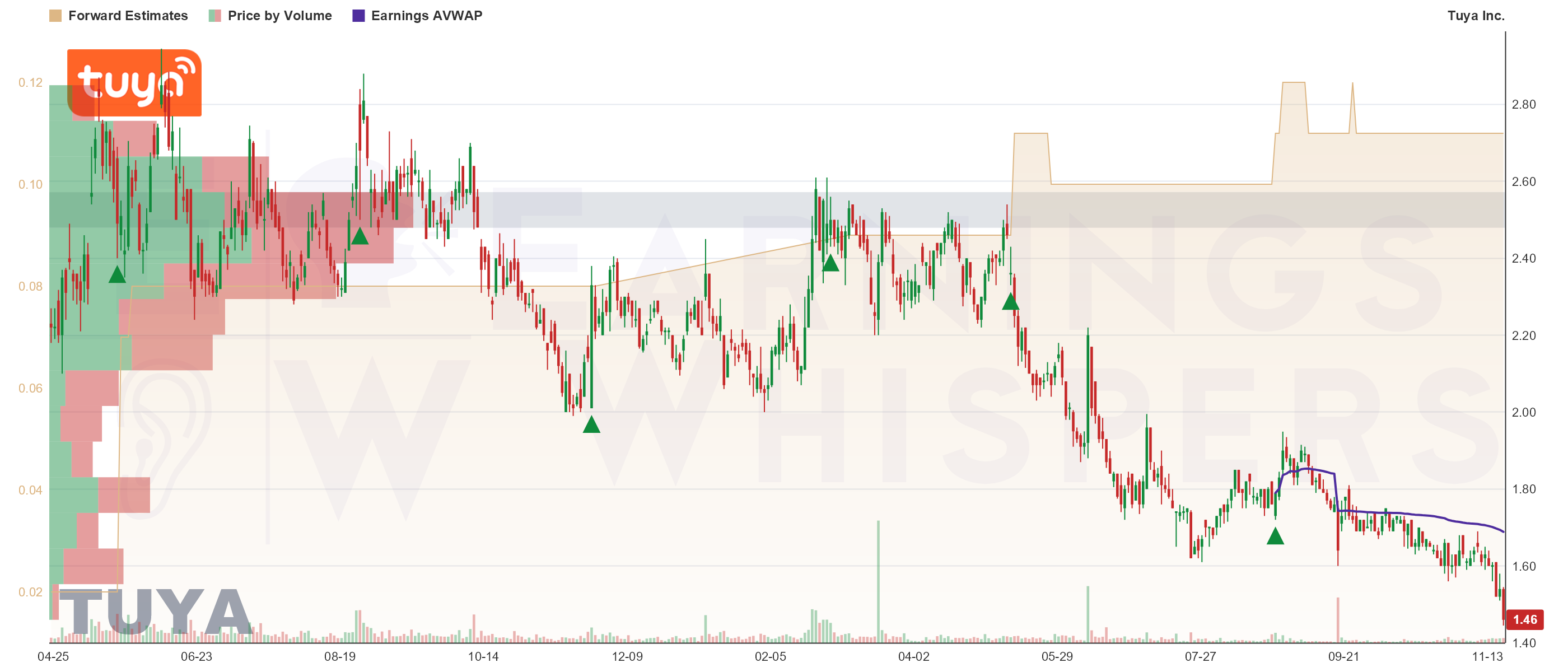
Tuya (TUYA) is on deck to report earnings Monday, November 23, 2026 at roughly 7:00 PM ET. Wall Street is looking for $0.03 per share on revenue of $94.48 million, a healthy 14.5% jump from a year ago, and the Earnings Whisper number also sits at $0.03. The crowd is feeling good here, with a whopping 94.3% betting on a beat. That said, the stock has been sulking, drifting 15.6% lower after its last report and now sitting 26.4% below its 200 day moving average of $1.98. The good news for bulls is that estimates have been creeping higher since last quarter, and shares have swung about 3.3% on recent prints, so buckle up.
Here is the real story heading in: Tuya's growth engine is genuinely revving back up. Revenue growth nearly doubled last quarter to 16% year over year, the core software business is humming, and the smart home and robot segment swung from shrinking to growing more than 23%. Management sounded noticeably more upbeat, pointing to strong European energy demand and fresh AI toys that are actually selling, including a companion gadget that topped its category on Tmall. The catch is margins. Rising chip and memory costs keep chipping away at profitability, and net profit slipped on softer financial income and currency losses. So the question Monday is simple: can the re-acceleration keep outrunning the slow margin bleed?
HPE Heads Into Earnings With Orders Pouring In Faster Than It Can Fill Them
Hewlett Packard Enterprise (HPE) steps up to the plate Monday, November 23, 2026 at around 4:05 PM ET, and the crowd is leaning bullish with 67.9% betting on a beat. Wall Street wants $1.29 per share on $14.45 billion in revenue, which would be a hefty 49.3% jump from a year ago, but the Earnings Whisper number sits higher at $1.36. Management guided to $1.12 to $1.22 per share on $13.90 to $14.80 billion. Short sellers have been heading for the exits, with short interest down 22.1% since last quarter, yet the stock has drifted 14.1% lower since its last report and now trades 4.0% under its 200 day moving average of $42.61. Overall estimates have been revised higher, option traders are bracing for a 16.0% swing versus the usual 5.3%, and on Friday someone grabbed 5,177 of the $60.00 calls expiring in March 2027, a big bet that the quiet stretch is about to end.
Here is the real story: demand is no longer the question, supply is. Last quarter HPE posted record revenue, a record 40% gross margin, and its first ever quarter above $1 in earnings, and it raised guidance for the fourth straight call while lifting the whole FY27 outlook. It landed a gigawatt-scale AI deal with Oracle and a multi-billion dollar server win with a hyperscaler, and the AMD Helios opportunity is not even baked into guidance yet. The one thing holding it back is memory and wafer shortages that keep it from turning a mountain of orders into sales, with inventory ballooning to $11.8 billion as it stockpiles parts. Watch for how fast that backlog converts, because that is the whole ballgame.
Dell's AI Rocket Meets a Jittery Crowd Ahead of Earnings
Dell Technologies (DELL) is set to report earnings after the bell on Tuesday, November 24, 2026 at around 4:05 PM ET. Wall Street is looking for $6.77 per share on revenue of $50.63 billion, which would be a staggering 87.5% jump in sales from a year ago, while the Earnings Whisper number sits higher at $7.25 per share. Management had guided for roughly $6.50 per share on about $49.00 billion, so the bar they set for themselves looks beatable. Here is the funny part: investors are feeling bearish heading in, yet 69.6% of them still expect a beat. Short sellers have backed off, cutting their bets by 25.4% since last quarter, but the stock has slid 39.8% from where it opened after last earnings and now trades 19.9% below its 200 day average of $347.04. Overall, analysts have been nudging estimates higher. Options traders are bracing for a 16.6% swing, roughly in line with the 14.6% average move of recent quarters, and on November 17 someone scooped up 7,056 of the $310 puts expiring December 18, a sizable bet that the drop is not done.
Here is what really matters: the business itself is on fire even as the stock cools off. Last quarter Dell raised its full-year outlook for the third straight time, bumping the revenue target to $192 billion and EPS to $25.50, both huge jumps from earlier calls. AI server orders hit a record $60.9 billion in a single quarter, backlog ballooned to $95 billion, and the AI customer list crossed 6,500. Even the old-school stuff is humming, with traditional servers up 122% and storage back in strong growth. The one real worry is not demand, it is supply, since memory and component shortages are capping how much Dell can actually ship. So going into this print, the question is not whether the business is strong. It clearly is. The question is whether a nervous market will finally believe it.
Deere Heads Into Earnings Riding the Bottom of the Ag Cycle
Deere (DE) is locked in to report earnings on Wednesday, November 25, 2026 at roughly 6:20 AM ET, and Wall Street is showing up ready to party. The consensus calls for $4.07 per share on $10.30 billion in revenue, a 16.9% drop from last year, but the Earnings Whisper number sits higher at $4.30. Bulls are running the show here, with 76.9% expecting a beat. The stock has slipped a hair, down 0.3% from its open after the last report, leaving it 0.9% under its 200 day moving average of $614.66. The good news for bulls is that overall earnings estimates have been nudged higher since last quarter. Option traders are bracing for an 8.9% swing, a touch bigger than the 6.7% the stock usually delivers, and on Wednesday, November 11, 2026 someone scooped up a notable 652 contracts of the $650.00 put expiring Friday, December 18, 2026, so not everyone is drinking the bull punch.
Here is the real story. Last quarter Deere basically told investors the worst of the farm slump is behind it, raising its full company profit guide to $4.75 to $5.0 billion and lifting its cash flow outlook too. The smaller farm and turf business is the surprise star, with sales guided up 15% and fat margins hitting 18.4% in the quarter, while the construction and forestry side is cruising with backlogs stretching deep into 2027. The first real sign of a turnaround showed up in early orders for next year's big tractors, which are tracking up mid single digits. The soft spot is South America and Europe, where big ag demand keeps sliding, and tariffs are set to sting a bit more next year at about $1 billion. Still, the pieces that are working are more than covering the ones that are not, and management sounded more confident than it has in a long time.
Best Buy's Comeback Is Real, But a Memory Problem Looms
Best Buy (BBY) rings up its earnings bell on Tuesday, November 24, 2026 at around 7:00 AM ET, and Wall Street is grabbing its popcorn. The crowd wants $1.48 per share on $9.84 billion in sales, which would be modest revenue growth of 1.7% from last year, but the smart-money Earnings Whisper number is reaching higher at $1.53. Nearly 7 in 10 investors are betting on a beat, and who can blame them with the stock up 21.5% since its last report and sitting a comfy 26.0% above its 200 day average of $77.76. Short sellers have nudged their bets up 8.6%, options traders are bracing for a 10.9% swing (the stock usually moves about 7.3%), and someone quietly scooped up 2,228 of the $100 puts expiring December 18. Estimates, meanwhile, keep drifting higher.
Here is the real story: Best Buy has quietly gone from limping to sprinting. Last quarter comps jumped 4.1% against a roughly 1% target, and management raised every single piece of full-year guidance, from sales to profits to earnings, which almost never happens. The turnaround engines are humming, with its exclusive RGB TV deal lighting up Home Theater, appliances finally growing again, and new toys like Meta Labs and ChatGPT shopping adding spice. The watch-out is memory chip costs pushing computer prices up while units slip, plus a fresh CEO and a brand-new CFO still learning where the coffee machine is. So the vibe is good, but keep one eye on whether the computer slowdown spoils the party.
DICK's Is Fine. Foot Locker Is the Headache.
DICK'S Sporting Goods (DKS) is confirmed to report earnings on Tuesday, November 24, 2026 at approximately 7:00 AM ET. Wall Street is looking for $1.38 per share on revenue of $5.06 billion, a healthy 21.4% jump in sales from a year ago, while the whisper number runs a bit hotter at $1.46. Here's the funny part: investors are walking in grumpy, yet 81.8% still expect a beat. The stock has slumped 7.1% from its open after the last report and now sits a painful 29.6% below its 200 day moving average of $187.96. Estimates have been trimmed since last quarter, and options traders are bracing for a 14.1% swing, well above the 7.4% the stock has actually averaged lately. And someone made a bet worth watching, scooping up 4,550 of the $105 puts and 1,069 of the $145 calls expiring December 18, so the smart money is hedging both the fall and a possible bounce.
The real story is a tale of two businesses. The core DICK'S engine is humming, comps rose 4.9% last quarter and management didn't touch its full-year sales outlook. The problem is Foot Locker, which they bought and are now trying to fix. That turnaround has stalled, Europe is weaker than hoped, and a flood of discounting across sneakers and apparel forced the team to slash full-year profit guidance to $11-$12 per share from as high as $14.50. That's a big reversal after two straight quarters of raising the bar, and the tone on the last call flipped from "playing offense" to "we're going to go through some pain." Management swears it's temporary and says this quarter should be the low point for margins. If DICK'S keeps gaining share and Foot Locker shows any sign of life, the gloom could lift fast.
A&F Heads Into Earnings Hot, But the Shorts Are Lurking
Abercrombie & Fitch (ANF) steps up to the plate Tuesday, November 24, 2026 around 7:30 AM ET, and the crowd is feeling good. Wall Street wants $3.15 per share on $1.37 billion in sales, which is 6.2% more than a year ago, but the Earnings Whisper number sits a touch higher at $3.22. Management had guided to $2.90 to $3.20 and $1.36 to $1.37 billion, so they are already bumping up against the top of their own range. A whopping 81.8% of investors are betting on a beat, and estimates have been creeping higher since last quarter. The catch? Short interest has jumped 16.9%, so not everyone is drinking the Kool-Aid. The stock has drifted up 5.0% since last report and now sits a lofty 27.1% above its 200 day average of $108.52. Buckle up, because option traders are bracing for a 16.4% swing, right in line with the roughly 17.0% lurch this stock has pulled off in recent quarters.
Last quarter was the first real victory lap of the year, with the company raising its full-year outlook across the board for the first time in FY26, lifting sales, margins, earnings and even the buyback. The A&F brand finally got its groove back with comps turning positive, while new growth engines like the Hollister x Target tie-up in 1,500 plus stores, the NFL expansion and footwear all showed early promise. The one wrinkle to watch: a good chunk of last quarter's margin pop came from a one-time tariff refund, overall comps were actually flat, and freight costs are now a back-half headwind eating into that tariff relief. So the story is real, but it is not quite as clean as the headlines looked. One trader seems cautious too, snapping up 642 of the $95.00 puts expiring December 18 back on November 10. Watch whether the underlying engine can keep humming once the one-time boosts fade.
Kohl's Cautiously Climbing Out of the Clearance Bin
Kohl's (KSS) is set to report earnings on Tuesday, November 24, 2026 at around 7:00 AM ET. Wall Street is bracing for a penny loss on revenue of $3.54 billion, down 1.0% from a year ago, but the Earnings Whisper number tells a happier tale at a profit of 6 cents. Here is the funny part: investors are feeling gloomy heading in, yet a whopping 87.5% still expect a beat. Short sellers have piled on, bumping up their bets by 12.9% since last quarter, but the stock has not cared one bit, drifting 33.6% higher since the last report and now sitting 27.7% above its 200 day average of $17.42. Earnings estimates have been nudged higher across the board, options traders are betting on a hefty 17.3% swing, and the stock has actually averaged a 15.1% move in recent quarters. Someone is clearly feeling bullish too, scooping up 1,690 of the $21.00 calls expiring January 15, 2027 on November 16.
Here is the real story: Kohl's has now strung together four straight quarters of less-bad comps, landing at -0.9% last time, and management got bold enough to raise guidance on every metric that matters, including bumping full-year earnings to a range of $1.80 to $2.40. A big chunk of that glow comes from roughly $150 million in tariff refunds, which flatters the numbers but is being funneled right back into lower prices for the holidays, so do not get too dazzled by the headline profit. The balance sheet is the genuine win, with cash nearly doubling to $821 million, debt at its lowest since 2007, and the first stock buyback since 2022. The core Kohl's card shopper finally turned positive, which is a big deal. Watch the two sore spots though: Sephora sales slipped 4% as those beauty brands show up everywhere now, and the women's department ran short on inventory. If the holiday price war and the stretched middle-income shopper hold up, the slow recovery stays on track.
HP Heads Into Earnings Riding an AI PC Wave, Dragging a Memory-Cost Anchor
HP (HPQ) is set to report earnings on Tuesday, November 24, 2026 at roughly 4:15 PM ET, and the mood is a bit of a head-scratcher. Wall Street pegs earnings at $0.74 per share on $15.47 billion in revenue, good for 5.7% growth from a year ago, but the Earnings Whisper number is a far punchier $0.90. Management's own guidance ran from $0.74 to $0.84. Investors are leaning bearish walking in, yet oddly enough 75% of them still expect a beat, so make of that what you will. Short interest has slipped 5.8% since last quarter, and the stock has quietly drifted up to sit 11% above its 200 day moving average of $25.19. Options traders are bracing for an 11.1% swing, which is a lot of drama for a stock that usually only moves 3.2% on earnings. Worth noting, on November 10 someone scooped up 15,079 of the $28.00 puts expiring January 15, so at least one trader is buying insurance.
Here is the real story heading in. HP has raised guidance two quarters in a row, posted record Q3 revenue of $15.7 billion, and its AI PC mix keeps climbing toward the magic 50% mark, so the top line has genuine momentum. The catch is margins. Cheaper inventory that padded earlier results is gone, and pricier memory chips are now flowing through the books, squeezing personal systems margins to a soft 4.6% with Q4 expected to be the low point. Print is cooling too, down 2% as offices in North America and China go quiet. Add in a CEO search that still has no finish line, and you get a company clearly improving on the AI front while limping through a well-telegraphed cost trough. Watch the margin commentary closely, because that is where this report lives or dies.
URBN Heads Into Earnings Riding Nuuly's Rental Rocket
Urban Outfitters (URBN) steps up to report after the bell on Tuesday, November 24, 2026 at roughly 4:05 PM ET. Wall Street is looking for $1.53 per share on $1.67 billion in revenue, good for 9.2% growth over last year, though the Earnings Whisper number sits higher at $1.61. The crowd is feeling good, with 85.7% betting on a beat, and estimates have been creeping up since last quarter. The stock has drifted 2.3% higher and now sits 13.9% above its 200 day average of $74.25. Short sellers have gotten a touch braver, bumping up bets by 11.1%, but option traders are the real tell here, pricing in a 10% swing, right in line with recent quarters. One trader clearly has a crush on the upside, scooping up 858 of the $80 calls on November 18 that expire December 18.
The story going in is all about Nuuly, the clothing rental arm that finally turned a real profit last quarter, hitting a 10% operating margin and blowing past 500,000 subscribers. Management lifted its outlook and is stacking the shelves with big names, adding Nike and J.Crew to the platform, so expect plenty of chatter about that momentum. The flip side is Anthropologie, which keeps limping along with soft sales and heavy markdowns, plus new fuel surcharges that are nibbling at margins. Bottom line, the engine is humming, but watch whether Anthropologie finally wakes up and whether Nuuly's slowing growth rate spooks anyone.
Fluence: Hot Orders, Cold Factories
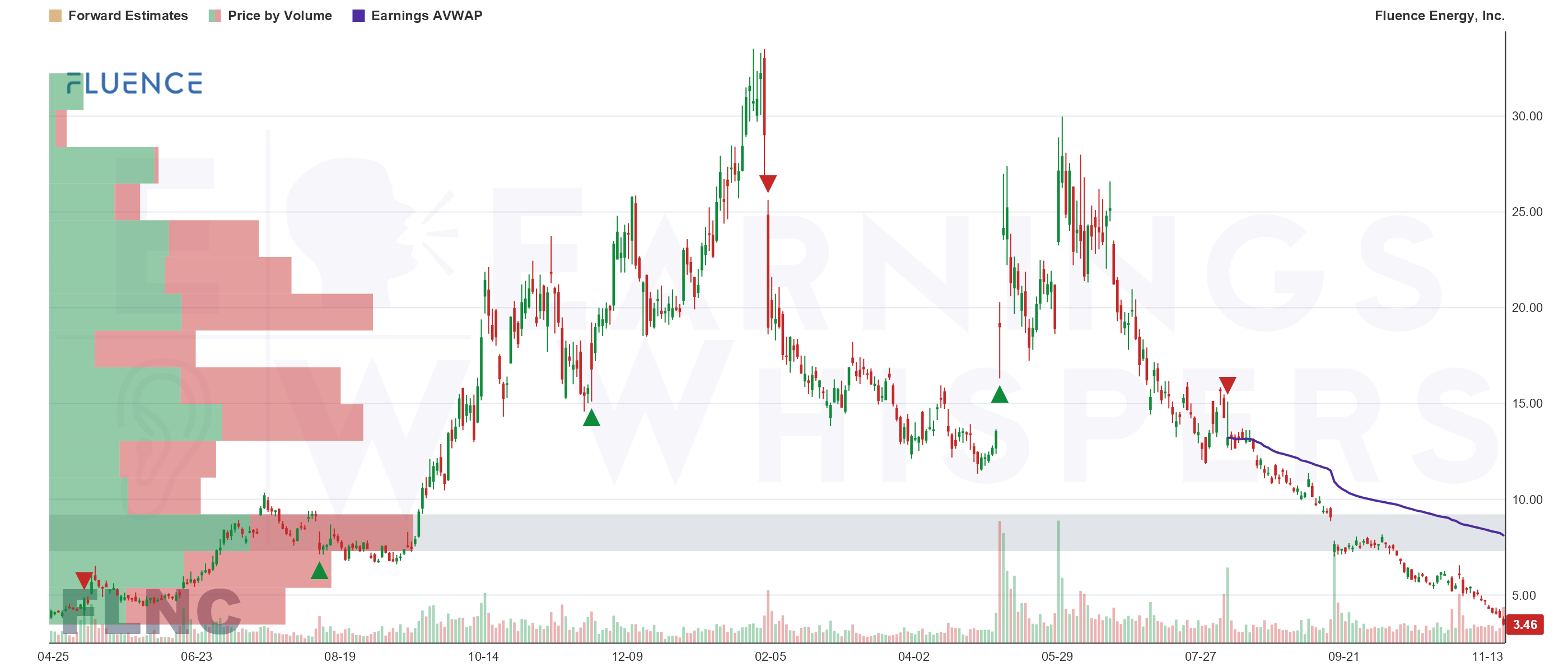
Fluence Energy (FLNC) is set to report earnings on Monday, November 23, 2026 at around 4:05 PM ET, and Wall Street is bracing for a bruise. The consensus calls for a loss of $0.54 per share on revenue of $811.53 million, down 22.1% from a year ago, while our Earnings Whisper number sits a touch worse at a loss of $0.59. Sentiment is bearish going in, though a surprising 66.7% still expect a beat. The bears have been busy too, with short interest up 40.5% since last quarter as the stock has slid 73.0% from its post-earnings open and now trades a jaw-dropping 74.9% below its 200 day moving average of $13.77. Estimates have been trimmed since the last report, and option traders are bracing for a 29.6% swing, bigger than the 19.0% average move of recent quarters. One brave soul snapped up 804 of the $7.00 calls expiring February 19, 2027 on November 18, betting the beatdown is overdone.
Here is the real story heading in: demand is on fire, but the factories are tripping over their own shoelaces. Last quarter orders nearly tripled to $1.44 billion, backlog hit a record $6.4 billion, and Fluence finally landed its first data center wins totaling $850 million, exactly the catalyst bulls have been waiting for. The problem is they cannot build fast enough. Ramp delays at new plants in Houston and China pushed roughly $400 million of revenue into next year, forcing management to cut FY26 revenue guidance to $3.0 billion from $3.4 billion and flip EBITDA from a positive $50 million to negative $10 million. After reaffirming guidance twice before yanking it, credibility is the question mark here. Watch whether the new COO can turn roaring demand into product that actually ships, because the orders are clearly there if the machines will cooperate.
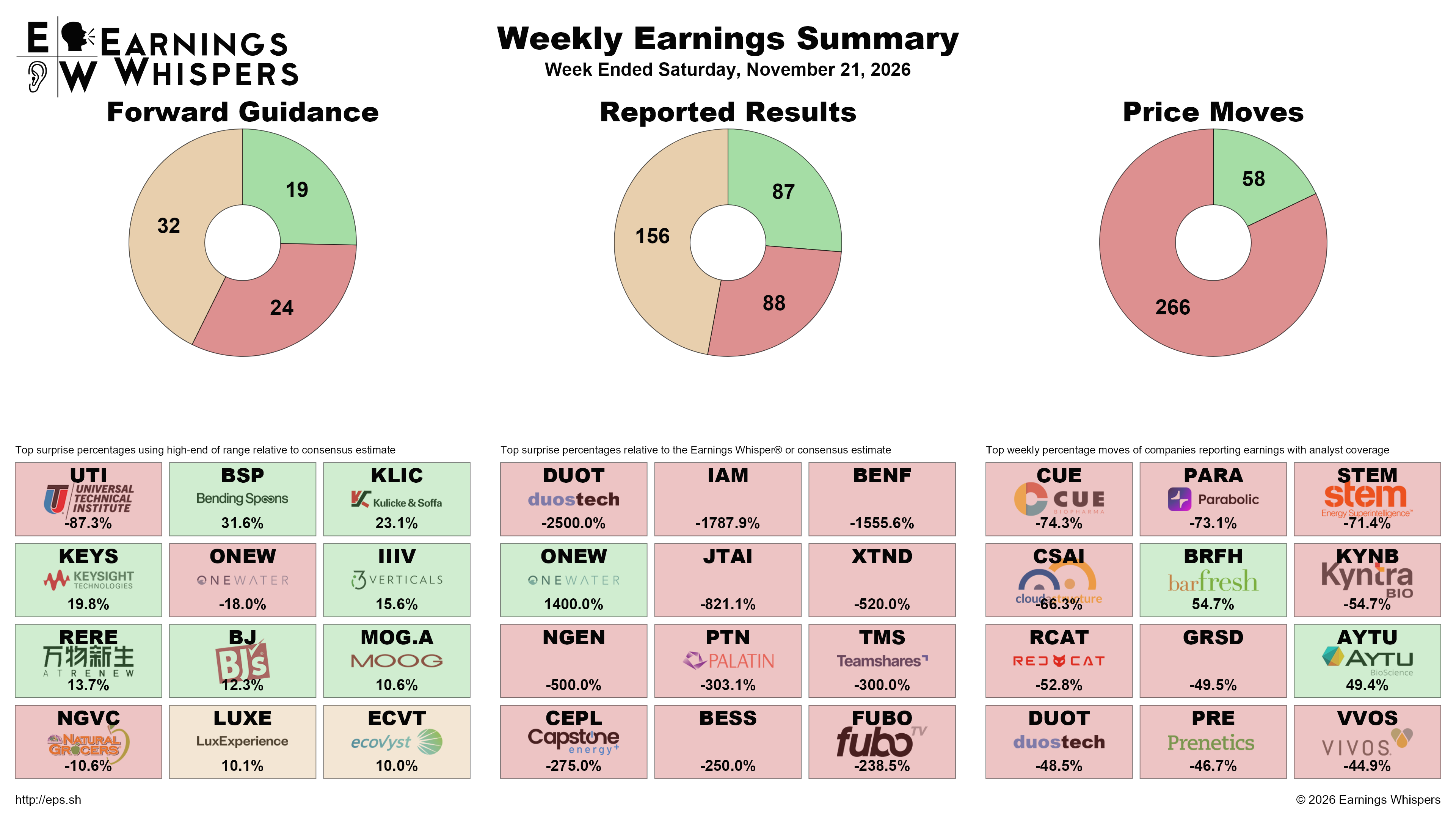
Retail Giants Shine as Walmart, Target Raise Outlooks, While Nvidia Dazzles on Numbers but Stumbles in the Boardroom
The big story last week was a tale of two consumers, with America's largest retailers proving remarkably resilient even as shoppers keep hunting for deals. Walmart topped expectations and lifted its full-year sales and profit forecasts for the second straight quarter, betting big on a new $120 combined membership bundle and an "explicitly strong" holiday season, though its online growth is cooling off from an earlier sugar high tied to tariff refunds. Target stole the spotlight with its third consecutive sales guidance hike, powered by a jump in store traffic and surprising strength in beauty, toys, and even its long-sluggish home department, while warehouse club BJ's delivered arguably the loudest quarter of the bunch, pouring a $240 million legal settlement right back into members and promotions to juice traffic to its highest level since 2020. Even the home improvement duo, Home Depot and Lowe's, posted their best top-line momentum in years, yet both quietly trimmed profit margin outlooks as fuel costs, pricey roofing materials, and a product mix shift toward cheaper appliances ate into the bottom line. TJX, the parent of T.J. Maxx, rounded out the group with a solid sales beat but shaved its holiday-quarter earnings forecast, blaming rising freight bills and an unseasonably warm autumn that left winter coats on the racks.
The common thread running through nearly every report was that revenue is climbing but profits are getting harder to come by, as companies swallow higher fuel, freight, and reinvestment costs to keep shoppers coming through the door. Nothing captured that push-and-pull better than Nvidia, which blew past Wall Street with blistering demand for its new Vera Rubin chips and actually raised its growth outlook, only to see the quarter overshadowed by the stunning resignation of CEO Jensen Huang over a conduct matter, fresh U.S. export controls, and a halt to its China sales. The result was a sharp weekly selloff despite the standout numbers, a reminder that even a juggernaut can't escape governance and policy jitters. Overseas, China's PDD was the clear sore spot, with revenue flat for the first time in memory as cross-border trade rules and new European parcel duties hammered its Temu-linked business, though aggressive cost cutting kept profits steady. Food giant Tyson also hit the reset button, warning that a bruising year ahead for chicken and pork would drag earnings lower even as its beef unit claws back from heavy losses. Disney, meanwhile, beat profit estimates but signaled a heavier spending year on content, trading near-term margin gains for long-term bets like its unified streaming app and a packed slate of blockbusters. For investors, the message was clear: in this economy, growing the top line is the easy part, and protecting the profits is where the real battle lies.
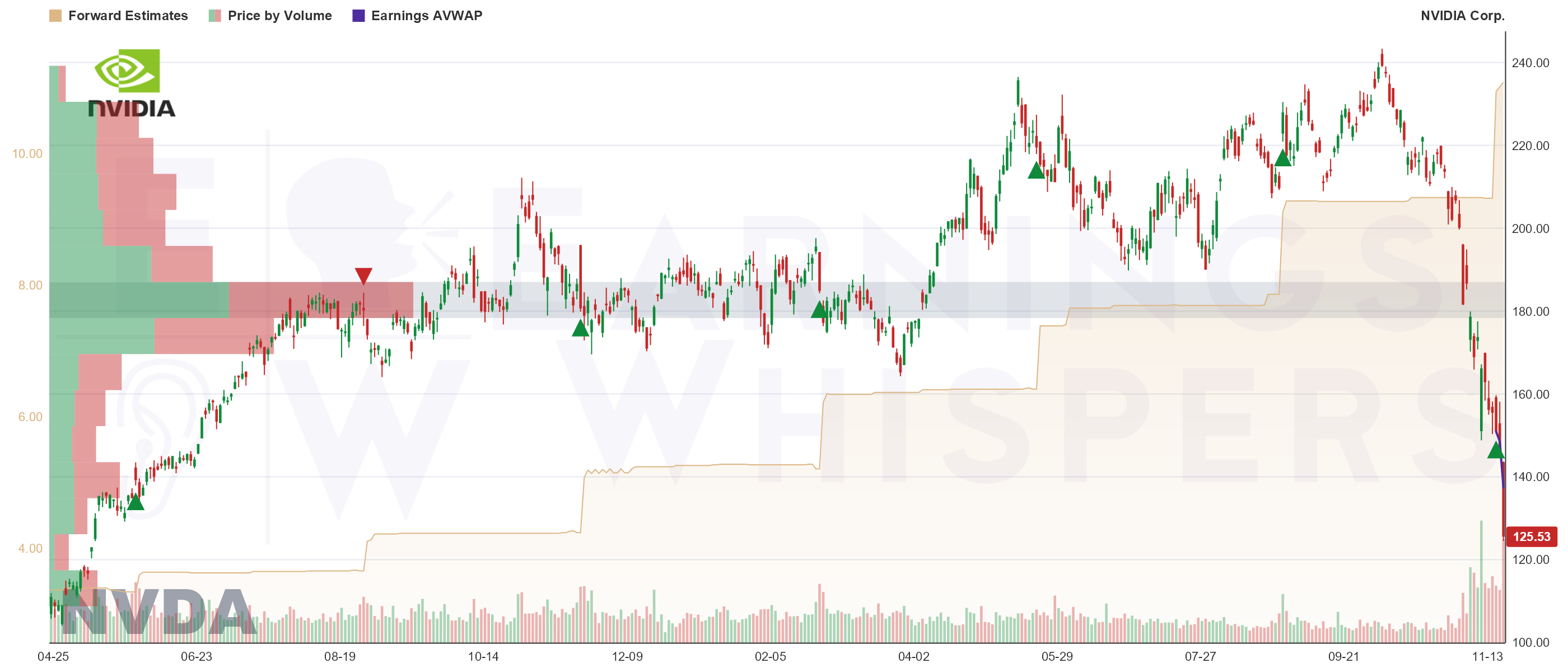
Nvidia Crushes It, But the Boss Just Walked Out the Door
Nvidia (NVDA) posted another monster quarter, earning $2.68 per share on $115.84 billion in revenue for the fiscal third quarter ended October 2026, topping the $2.47 consensus and the $2.60 whisper number. Revenue more than doubled from a year ago, jumping over 103 percent, and the beat came with a confident guide: management sees fourth quarter earnings of $2.67 to $2.91 per share on revenue of $126.1 billion to $133.9 billion, ahead of the Street's $2.74 and $123.4 billion. The new Vera Rubin chip is off to the fastest start in company history, raking in roughly $20 billion in its very first quarter, and the FY28 growth outlook got bumped up to about 75 percent. Nvidia remains the undisputed king of accelerated computing, and the business is firing on all cylinders.
Here's the catch, and it's a big one: CEO Jensen Huang resigned over a conduct matter, CFO Colette Kress is running the show on an interim basis, and there's an ongoing investigation nobody wanted to touch on the call. Add fresh U.S. export controls that just froze China Hopper sales, a gross margin dipping to a 71 to 72 percent low next quarter, and a massive $390 billion pile of purchase commitments, and you can see why the Q&A was all about leadership, money and politics instead of chips. Bottom line, the engine is roaring louder than ever, but the pilot just ejected, so keep one hand on the wheel.
Palo Alto Blows Past Estimates, Then Bets Big on AI
Palo Alto Networks (PANW) kicked off its fiscal year with a bang, posting earnings of $1.05 per share on revenue of $3.45 billion for the first quarter ended October 2026. Wall Street was looking for just $0.97 per share on $3.31 billion, so this was a clean beat of 5 percent, with revenue jumping a hefty 39 percent from a year ago. Management did not stop there, raising guidance across the board. They now see second quarter revenue of $3.53 to $3.55 billion, well above the $3.40 billion the Street expected, and lifted their full-year 2027 outlook to $14.52 to $14.57 billion, up from the previous $14.10 to $14.20 billion. CEO Nikesh Arora called it a record quarter and credited customers turning to Palo Alto to defend against what he described as an unprecedented threat environment, fueled by AI reshaping how attacks happen.
Here is the twist worth watching. Palo Alto is buying Applied Compute for $4.5 billion in stock, pushing the company into training and running secure AI models, complete with plans for 100-plus megawatts of computing muscle. That is a bold move, but it comes with a price tag. The deal is expected to nibble up to 100 basis points off operating margins this year and as much as 200 basis points next year, with recovery not expected until fiscal 2029. On top of that, Palo Alto is committing to under $3 billion in new spending on GPUs and servers through 2030, a real shift for a company that used to brag about being capital-light. Meanwhile, gross margin slipped to 75.2 percent on higher hardware costs, and a slice of the strong demand came from customers rushing to buy ahead of price hikes, which may not repeat. Bottom line, the core business is firing on all cylinders, but this is now a growth story with a side of execution risk.
Walmart Misses on the Penny, Wins on the Year
Walmart (WMT) posted earnings of $0.65 per share on revenue of $188.84 billion for the fiscal third quarter ended October 2026. That technically missed the consensus of $0.64 by, well, beating it, but came up short of the Earnings Whisper number of $0.67, which is why the stock-watchers are calling it a 2.99% miss. Still, revenue grew a healthy 5.20% year-over-year, so the cash registers are humming. More importantly, Walmart raised its full-year outlook for the second quarter in a row, now guiding fiscal 2027 earnings of $2.84 to $2.89 per share on revenue of $748.11 billion to $750.25 billion, up from its prior call of $2.80 to $2.87 and $734.66 billion to $741.72 billion. The people-led, tech-powered omnichannel giant is still doing what it does best: helping shoppers save money whether they are strolling the aisles or tapping their phones.
Here is the real story. Walmart beat its own Q3 targets, with sales up 4.4% and operating income up 5.5%, even while reinvesting its tariff refunds back into lower prices for you. Management flat-out said the strategy is working and they expect a strong holiday. The shiny new toy is a $120 combined Walmart+ and Sam's Club+ membership, which stacks up nicely against roughly $400 of separate delivery, club and streaming subscriptions, plus expanded AI shopping help from Sparky. The one wrinkle: online sales growth cooled from 23% to 17%, partly a timing quirk from Flipkart's big sale, and profit growth looks tamer next to last quarter's tariff-refund sugar high. Add in fuel costs and a squeezed lower-income shopper, and there is reason for caution, but the net read is clear. This elephant is still dancing.
PicPay Beats the Street, But the Fine Print Bites
Pics N.V. (PICS) posted earnings of $0.41 per share on revenue of $953.74 million for the third quarter ended September 2026. Wall Street was looking for $0.39, and the Earnings Whisper number sat even lower at $0.36, so the company sailed past expectations by nearly 14 percent. PicPay, for the uninitiated, is one of the biggest digital banks in Brazil measured by sheer number of customers, and this quarter it swept all nine of its own guidance targets. Not a bad flex.
Here is the catch. The headline beat comes with a side of homework. PicPay is switching to writing off unsecured personal loans after 120 days instead of 360, which triggers a one-time hit of about R$325 million and knocks full-year reported profit down to roughly R$733 million from an underlying R$1.06 billion. Capital targets got trimmed, the recently closed CAV insurance deal is contributing less in the near term, and old-style late payments are creeping up, with 90-day-plus delinquency heading toward 12.7 percent by year-end. The good news is the engine still runs hot: the credit book jumped 88 percent, small business accounts are flooding in at 126,000 a month, funding got cheaper, and management guided Q4 profit up another 20 percent. Translation for clients: the business is genuinely improving, just with more accounting noise than usual.
PDD Beats on Profit, But the Growth Engine Just Stalled
PDD Holdings (PDD) posted earnings of $3.14 per share on $16.16 billion in revenue for the third quarter ended September 2026, topping the $2.78 consensus and the $2.87 Earnings Whisper number by a healthy 9.41 percent. Here is the catch: that beat came from the bottom line, not the top. Revenue grew just 6.24 percent year-over-year and actually missed estimates of $17.30 billion. In short, PDD squeezed out more profit by spending less, not by selling more. As a reminder, Pinduoduo is a mobile-only marketplace connecting millions of Chinese farmers directly with shoppers.
The real story is that growth has flat-out stopped. Total revenue rose zero percent from a year ago, the third straight quarterly slowdown after plus 11 percent and plus 8 percent in the prior two quarters. The culprit is the cross-border business tied to Temu, where transaction services revenue swung from plus 13 percent last quarter to minus 12 percent now, hammered by new EU parcel taxes and tougher trade rules that have small merchants squeezed. So how did profit hold up? Management slashed marketing spend, pushing operating margin to a fat 30 percent. The problem is they practically begged investors not to count on that lasting, warning that heavy spending on overseas warehouses and new initiatives is coming right back. Ad revenue did perk up nicely at plus 12 percent, but with no guidance offered and competition at home described as relentless, this looks like a profitable quarter papering over a business that is clearly cooling off.
The retail aisle is where the real holiday drama unfolds, and this year the shopping-season bellwethers are delivering mixed signals. Abercrombie & Fitch struts in as one of the most beloved names on the board, with traders betting its hot streak continues, and discount kingpin Dollar Tree is also drawing warm applause. Best Buy and Urban Outfitters carry a generally friendly tone, while Dick's Sporting Goods and Burlington face more skeptical crowds that could punish any stumble. Even battered Kohl's offers an intriguing wrinkle, with signs that the worst may be behind it. Rounding out the week, consumer staples star J.M. Smucker is arguably the most adored name on the entire list, a comforting pick for anyone craving stability, and healthcare heavyweight Medtronic adds a steady, well-regarded presence. With so many household names reporting against a backdrop of holiday spending, this is the kind of week that can set the tone for the rest of the year.
Tuya Heats Up on Top-Line Growth, But Chip Costs Nibble at Margins
Tuya (TUYA) is on deck to report earnings Monday, November 23, 2026 at roughly 7:00 PM ET. Wall Street is looking for $0.03 per share on revenue of $94.48 million, a healthy 14.5% jump from a year ago, and the Earnings Whisper number also sits at $0.03. The crowd is feeling good here, with a whopping 94.3% betting on a beat. That said, the stock has been sulking, drifting 15.6% lower after its last report and now sitting 26.4% below its 200 day moving average of $1.98. The good news for bulls is that estimates have been creeping higher since last quarter, and shares have swung about 3.3% on recent prints, so buckle up.
Here is the real story heading in: Tuya's growth engine is genuinely revving back up. Revenue growth nearly doubled last quarter to 16% year over year, the core software business is humming, and the smart home and robot segment swung from shrinking to growing more than 23%. Management sounded noticeably more upbeat, pointing to strong European energy demand and fresh AI toys that are actually selling, including a companion gadget that topped its category on Tmall. The catch is margins. Rising chip and memory costs keep chipping away at profitability, and net profit slipped on softer financial income and currency losses. So the question Monday is simple: can the re-acceleration keep outrunning the slow margin bleed?
HPE Heads Into Earnings With Orders Pouring In Faster Than It Can Fill Them
Hewlett Packard Enterprise (HPE) steps up to the plate Monday, November 23, 2026 at around 4:05 PM ET, and the crowd is leaning bullish with 67.9% betting on a beat. Wall Street wants $1.29 per share on $14.45 billion in revenue, which would be a hefty 49.3% jump from a year ago, but the Earnings Whisper number sits higher at $1.36. Management guided to $1.12 to $1.22 per share on $13.90 to $14.80 billion. Short sellers have been heading for the exits, with short interest down 22.1% since last quarter, yet the stock has drifted 14.1% lower since its last report and now trades 4.0% under its 200 day moving average of $42.61. Overall estimates have been revised higher, option traders are bracing for a 16.0% swing versus the usual 5.3%, and on Friday someone grabbed 5,177 of the $60.00 calls expiring in March 2027, a big bet that the quiet stretch is about to end.
Here is the real story: demand is no longer the question, supply is. Last quarter HPE posted record revenue, a record 40% gross margin, and its first ever quarter above $1 in earnings, and it raised guidance for the fourth straight call while lifting the whole FY27 outlook. It landed a gigawatt-scale AI deal with Oracle and a multi-billion dollar server win with a hyperscaler, and the AMD Helios opportunity is not even baked into guidance yet. The one thing holding it back is memory and wafer shortages that keep it from turning a mountain of orders into sales, with inventory ballooning to $11.8 billion as it stockpiles parts. Watch for how fast that backlog converts, because that is the whole ballgame.
Dell's AI Rocket Meets a Jittery Crowd Ahead of Earnings
Dell Technologies (DELL) is set to report earnings after the bell on Tuesday, November 24, 2026 at around 4:05 PM ET. Wall Street is looking for $6.77 per share on revenue of $50.63 billion, which would be a staggering 87.5% jump in sales from a year ago, while the Earnings Whisper number sits higher at $7.25 per share. Management had guided for roughly $6.50 per share on about $49.00 billion, so the bar they set for themselves looks beatable. Here is the funny part: investors are feeling bearish heading in, yet 69.6% of them still expect a beat. Short sellers have backed off, cutting their bets by 25.4% since last quarter, but the stock has slid 39.8% from where it opened after last earnings and now trades 19.9% below its 200 day average of $347.04. Overall, analysts have been nudging estimates higher. Options traders are bracing for a 16.6% swing, roughly in line with the 14.6% average move of recent quarters, and on November 17 someone scooped up 7,056 of the $310 puts expiring December 18, a sizable bet that the drop is not done.
Here is what really matters: the business itself is on fire even as the stock cools off. Last quarter Dell raised its full-year outlook for the third straight time, bumping the revenue target to $192 billion and EPS to $25.50, both huge jumps from earlier calls. AI server orders hit a record $60.9 billion in a single quarter, backlog ballooned to $95 billion, and the AI customer list crossed 6,500. Even the old-school stuff is humming, with traditional servers up 122% and storage back in strong growth. The one real worry is not demand, it is supply, since memory and component shortages are capping how much Dell can actually ship. So going into this print, the question is not whether the business is strong. It clearly is. The question is whether a nervous market will finally believe it.
Deere Heads Into Earnings Riding the Bottom of the Ag Cycle
Deere (DE) is locked in to report earnings on Wednesday, November 25, 2026 at roughly 6:20 AM ET, and Wall Street is showing up ready to party. The consensus calls for $4.07 per share on $10.30 billion in revenue, a 16.9% drop from last year, but the Earnings Whisper number sits higher at $4.30. Bulls are running the show here, with 76.9% expecting a beat. The stock has slipped a hair, down 0.3% from its open after the last report, leaving it 0.9% under its 200 day moving average of $614.66. The good news for bulls is that overall earnings estimates have been nudged higher since last quarter. Option traders are bracing for an 8.9% swing, a touch bigger than the 6.7% the stock usually delivers, and on Wednesday, November 11, 2026 someone scooped up a notable 652 contracts of the $650.00 put expiring Friday, December 18, 2026, so not everyone is drinking the bull punch.
Here is the real story. Last quarter Deere basically told investors the worst of the farm slump is behind it, raising its full company profit guide to $4.75 to $5.0 billion and lifting its cash flow outlook too. The smaller farm and turf business is the surprise star, with sales guided up 15% and fat margins hitting 18.4% in the quarter, while the construction and forestry side is cruising with backlogs stretching deep into 2027. The first real sign of a turnaround showed up in early orders for next year's big tractors, which are tracking up mid single digits. The soft spot is South America and Europe, where big ag demand keeps sliding, and tariffs are set to sting a bit more next year at about $1 billion. Still, the pieces that are working are more than covering the ones that are not, and management sounded more confident than it has in a long time.
Best Buy's Comeback Is Real, But a Memory Problem Looms
Best Buy (BBY) rings up its earnings bell on Tuesday, November 24, 2026 at around 7:00 AM ET, and Wall Street is grabbing its popcorn. The crowd wants $1.48 per share on $9.84 billion in sales, which would be modest revenue growth of 1.7% from last year, but the smart-money Earnings Whisper number is reaching higher at $1.53. Nearly 7 in 10 investors are betting on a beat, and who can blame them with the stock up 21.5% since its last report and sitting a comfy 26.0% above its 200 day average of $77.76. Short sellers have nudged their bets up 8.6%, options traders are bracing for a 10.9% swing (the stock usually moves about 7.3%), and someone quietly scooped up 2,228 of the $100 puts expiring December 18. Estimates, meanwhile, keep drifting higher.
Here is the real story: Best Buy has quietly gone from limping to sprinting. Last quarter comps jumped 4.1% against a roughly 1% target, and management raised every single piece of full-year guidance, from sales to profits to earnings, which almost never happens. The turnaround engines are humming, with its exclusive RGB TV deal lighting up Home Theater, appliances finally growing again, and new toys like Meta Labs and ChatGPT shopping adding spice. The watch-out is memory chip costs pushing computer prices up while units slip, plus a fresh CEO and a brand-new CFO still learning where the coffee machine is. So the vibe is good, but keep one eye on whether the computer slowdown spoils the party.
DICK's Is Fine. Foot Locker Is the Headache.
DICK'S Sporting Goods (DKS) is confirmed to report earnings on Tuesday, November 24, 2026 at approximately 7:00 AM ET. Wall Street is looking for $1.38 per share on revenue of $5.06 billion, a healthy 21.4% jump in sales from a year ago, while the whisper number runs a bit hotter at $1.46. Here's the funny part: investors are walking in grumpy, yet 81.8% still expect a beat. The stock has slumped 7.1% from its open after the last report and now sits a painful 29.6% below its 200 day moving average of $187.96. Estimates have been trimmed since last quarter, and options traders are bracing for a 14.1% swing, well above the 7.4% the stock has actually averaged lately. And someone made a bet worth watching, scooping up 4,550 of the $105 puts and 1,069 of the $145 calls expiring December 18, so the smart money is hedging both the fall and a possible bounce.
The real story is a tale of two businesses. The core DICK'S engine is humming, comps rose 4.9% last quarter and management didn't touch its full-year sales outlook. The problem is Foot Locker, which they bought and are now trying to fix. That turnaround has stalled, Europe is weaker than hoped, and a flood of discounting across sneakers and apparel forced the team to slash full-year profit guidance to $11-$12 per share from as high as $14.50. That's a big reversal after two straight quarters of raising the bar, and the tone on the last call flipped from "playing offense" to "we're going to go through some pain." Management swears it's temporary and says this quarter should be the low point for margins. If DICK'S keeps gaining share and Foot Locker shows any sign of life, the gloom could lift fast.
A&F Heads Into Earnings Hot, But the Shorts Are Lurking
Abercrombie & Fitch (ANF) steps up to the plate Tuesday, November 24, 2026 around 7:30 AM ET, and the crowd is feeling good. Wall Street wants $3.15 per share on $1.37 billion in sales, which is 6.2% more than a year ago, but the Earnings Whisper number sits a touch higher at $3.22. Management had guided to $2.90 to $3.20 and $1.36 to $1.37 billion, so they are already bumping up against the top of their own range. A whopping 81.8% of investors are betting on a beat, and estimates have been creeping higher since last quarter. The catch? Short interest has jumped 16.9%, so not everyone is drinking the Kool-Aid. The stock has drifted up 5.0% since last report and now sits a lofty 27.1% above its 200 day average of $108.52. Buckle up, because option traders are bracing for a 16.4% swing, right in line with the roughly 17.0% lurch this stock has pulled off in recent quarters.
Last quarter was the first real victory lap of the year, with the company raising its full-year outlook across the board for the first time in FY26, lifting sales, margins, earnings and even the buyback. The A&F brand finally got its groove back with comps turning positive, while new growth engines like the Hollister x Target tie-up in 1,500 plus stores, the NFL expansion and footwear all showed early promise. The one wrinkle to watch: a good chunk of last quarter's margin pop came from a one-time tariff refund, overall comps were actually flat, and freight costs are now a back-half headwind eating into that tariff relief. So the story is real, but it is not quite as clean as the headlines looked. One trader seems cautious too, snapping up 642 of the $95.00 puts expiring December 18 back on November 10. Watch whether the underlying engine can keep humming once the one-time boosts fade.
Kohl's Cautiously Climbing Out of the Clearance Bin
Kohl's (KSS) is set to report earnings on Tuesday, November 24, 2026 at around 7:00 AM ET. Wall Street is bracing for a penny loss on revenue of $3.54 billion, down 1.0% from a year ago, but the Earnings Whisper number tells a happier tale at a profit of 6 cents. Here is the funny part: investors are feeling gloomy heading in, yet a whopping 87.5% still expect a beat. Short sellers have piled on, bumping up their bets by 12.9% since last quarter, but the stock has not cared one bit, drifting 33.6% higher since the last report and now sitting 27.7% above its 200 day average of $17.42. Earnings estimates have been nudged higher across the board, options traders are betting on a hefty 17.3% swing, and the stock has actually averaged a 15.1% move in recent quarters. Someone is clearly feeling bullish too, scooping up 1,690 of the $21.00 calls expiring January 15, 2027 on November 16.
Here is the real story: Kohl's has now strung together four straight quarters of less-bad comps, landing at -0.9% last time, and management got bold enough to raise guidance on every metric that matters, including bumping full-year earnings to a range of $1.80 to $2.40. A big chunk of that glow comes from roughly $150 million in tariff refunds, which flatters the numbers but is being funneled right back into lower prices for the holidays, so do not get too dazzled by the headline profit. The balance sheet is the genuine win, with cash nearly doubling to $821 million, debt at its lowest since 2007, and the first stock buyback since 2022. The core Kohl's card shopper finally turned positive, which is a big deal. Watch the two sore spots though: Sephora sales slipped 4% as those beauty brands show up everywhere now, and the women's department ran short on inventory. If the holiday price war and the stretched middle-income shopper hold up, the slow recovery stays on track.
HP Heads Into Earnings Riding an AI PC Wave, Dragging a Memory-Cost Anchor
HP (HPQ) is set to report earnings on Tuesday, November 24, 2026 at roughly 4:15 PM ET, and the mood is a bit of a head-scratcher. Wall Street pegs earnings at $0.74 per share on $15.47 billion in revenue, good for 5.7% growth from a year ago, but the Earnings Whisper number is a far punchier $0.90. Management's own guidance ran from $0.74 to $0.84. Investors are leaning bearish walking in, yet oddly enough 75% of them still expect a beat, so make of that what you will. Short interest has slipped 5.8% since last quarter, and the stock has quietly drifted up to sit 11% above its 200 day moving average of $25.19. Options traders are bracing for an 11.1% swing, which is a lot of drama for a stock that usually only moves 3.2% on earnings. Worth noting, on November 10 someone scooped up 15,079 of the $28.00 puts expiring January 15, so at least one trader is buying insurance.
Here is the real story heading in. HP has raised guidance two quarters in a row, posted record Q3 revenue of $15.7 billion, and its AI PC mix keeps climbing toward the magic 50% mark, so the top line has genuine momentum. The catch is margins. Cheaper inventory that padded earlier results is gone, and pricier memory chips are now flowing through the books, squeezing personal systems margins to a soft 4.6% with Q4 expected to be the low point. Print is cooling too, down 2% as offices in North America and China go quiet. Add in a CEO search that still has no finish line, and you get a company clearly improving on the AI front while limping through a well-telegraphed cost trough. Watch the margin commentary closely, because that is where this report lives or dies.
URBN Heads Into Earnings Riding Nuuly's Rental Rocket
Urban Outfitters (URBN) steps up to report after the bell on Tuesday, November 24, 2026 at roughly 4:05 PM ET. Wall Street is looking for $1.53 per share on $1.67 billion in revenue, good for 9.2% growth over last year, though the Earnings Whisper number sits higher at $1.61. The crowd is feeling good, with 85.7% betting on a beat, and estimates have been creeping up since last quarter. The stock has drifted 2.3% higher and now sits 13.9% above its 200 day average of $74.25. Short sellers have gotten a touch braver, bumping up bets by 11.1%, but option traders are the real tell here, pricing in a 10% swing, right in line with recent quarters. One trader clearly has a crush on the upside, scooping up 858 of the $80 calls on November 18 that expire December 18.
The story going in is all about Nuuly, the clothing rental arm that finally turned a real profit last quarter, hitting a 10% operating margin and blowing past 500,000 subscribers. Management lifted its outlook and is stacking the shelves with big names, adding Nike and J.Crew to the platform, so expect plenty of chatter about that momentum. The flip side is Anthropologie, which keeps limping along with soft sales and heavy markdowns, plus new fuel surcharges that are nibbling at margins. Bottom line, the engine is humming, but watch whether Anthropologie finally wakes up and whether Nuuly's slowing growth rate spooks anyone.
Fluence: Hot Orders, Cold Factories
Fluence Energy (FLNC) is set to report earnings on Monday, November 23, 2026 at around 4:05 PM ET, and Wall Street is bracing for a bruise. The consensus calls for a loss of $0.54 per share on revenue of $811.53 million, down 22.1% from a year ago, while our Earnings Whisper number sits a touch worse at a loss of $0.59. Sentiment is bearish going in, though a surprising 66.7% still expect a beat. The bears have been busy too, with short interest up 40.5% since last quarter as the stock has slid 73.0% from its post-earnings open and now trades a jaw-dropping 74.9% below its 200 day moving average of $13.77. Estimates have been trimmed since the last report, and option traders are bracing for a 29.6% swing, bigger than the 19.0% average move of recent quarters. One brave soul snapped up 804 of the $7.00 calls expiring February 19, 2027 on November 18, betting the beatdown is overdone.
Here is the real story heading in: demand is on fire, but the factories are tripping over their own shoelaces. Last quarter orders nearly tripled to $1.44 billion, backlog hit a record $6.4 billion, and Fluence finally landed its first data center wins totaling $850 million, exactly the catalyst bulls have been waiting for. The problem is they cannot build fast enough. Ramp delays at new plants in Houston and China pushed roughly $400 million of revenue into next year, forcing management to cut FY26 revenue guidance to $3.0 billion from $3.4 billion and flip EBITDA from a positive $50 million to negative $10 million. After reaffirming guidance twice before yanking it, credibility is the question mark here. Watch whether the new COO can turn roaring demand into product that actually ships, because the orders are clearly there if the machines will cooperate.
Retail Giants Shine as Walmart, Target Raise Outlooks, While Nvidia Dazzles on Numbers but Stumbles in the Boardroom
The big story last week was a tale of two consumers, with America's largest retailers proving remarkably resilient even as shoppers keep hunting for deals. Walmart topped expectations and lifted its full-year sales and profit forecasts for the second straight quarter, betting big on a new $120 combined membership bundle and an "explicitly strong" holiday season, though its online growth is cooling off from an earlier sugar high tied to tariff refunds. Target stole the spotlight with its third consecutive sales guidance hike, powered by a jump in store traffic and surprising strength in beauty, toys, and even its long-sluggish home department, while warehouse club BJ's delivered arguably the loudest quarter of the bunch, pouring a $240 million legal settlement right back into members and promotions to juice traffic to its highest level since 2020. Even the home improvement duo, Home Depot and Lowe's, posted their best top-line momentum in years, yet both quietly trimmed profit margin outlooks as fuel costs, pricey roofing materials, and a product mix shift toward cheaper appliances ate into the bottom line. TJX, the parent of T.J. Maxx, rounded out the group with a solid sales beat but shaved its holiday-quarter earnings forecast, blaming rising freight bills and an unseasonably warm autumn that left winter coats on the racks.
The common thread running through nearly every report was that revenue is climbing but profits are getting harder to come by, as companies swallow higher fuel, freight, and reinvestment costs to keep shoppers coming through the door. Nothing captured that push-and-pull better than Nvidia, which blew past Wall Street with blistering demand for its new Vera Rubin chips and actually raised its growth outlook, only to see the quarter overshadowed by the stunning resignation of CEO Jensen Huang over a conduct matter, fresh U.S. export controls, and a halt to its China sales. The result was a sharp weekly selloff despite the standout numbers, a reminder that even a juggernaut can't escape governance and policy jitters. Overseas, China's PDD was the clear sore spot, with revenue flat for the first time in memory as cross-border trade rules and new European parcel duties hammered its Temu-linked business, though aggressive cost cutting kept profits steady. Food giant Tyson also hit the reset button, warning that a bruising year ahead for chicken and pork would drag earnings lower even as its beef unit claws back from heavy losses. Disney, meanwhile, beat profit estimates but signaled a heavier spending year on content, trading near-term margin gains for long-term bets like its unified streaming app and a packed slate of blockbusters. For investors, the message was clear: in this economy, growing the top line is the easy part, and protecting the profits is where the real battle lies.
Nvidia Crushes It, But the Boss Just Walked Out the Door
Nvidia (NVDA) posted another monster quarter, earning $2.68 per share on $115.84 billion in revenue for the fiscal third quarter ended October 2026, topping the $2.47 consensus and the $2.60 whisper number. Revenue more than doubled from a year ago, jumping over 103 percent, and the beat came with a confident guide: management sees fourth quarter earnings of $2.67 to $2.91 per share on revenue of $126.1 billion to $133.9 billion, ahead of the Street's $2.74 and $123.4 billion. The new Vera Rubin chip is off to the fastest start in company history, raking in roughly $20 billion in its very first quarter, and the FY28 growth outlook got bumped up to about 75 percent. Nvidia remains the undisputed king of accelerated computing, and the business is firing on all cylinders.
Here's the catch, and it's a big one: CEO Jensen Huang resigned over a conduct matter, CFO Colette Kress is running the show on an interim basis, and there's an ongoing investigation nobody wanted to touch on the call. Add fresh U.S. export controls that just froze China Hopper sales, a gross margin dipping to a 71 to 72 percent low next quarter, and a massive $390 billion pile of purchase commitments, and you can see why the Q&A was all about leadership, money and politics instead of chips. Bottom line, the engine is roaring louder than ever, but the pilot just ejected, so keep one hand on the wheel.
Palo Alto Blows Past Estimates, Then Bets Big on AI
Palo Alto Networks (PANW) kicked off its fiscal year with a bang, posting earnings of $1.05 per share on revenue of $3.45 billion for the first quarter ended October 2026. Wall Street was looking for just $0.97 per share on $3.31 billion, so this was a clean beat of 5 percent, with revenue jumping a hefty 39 percent from a year ago. Management did not stop there, raising guidance across the board. They now see second quarter revenue of $3.53 to $3.55 billion, well above the $3.40 billion the Street expected, and lifted their full-year 2027 outlook to $14.52 to $14.57 billion, up from the previous $14.10 to $14.20 billion. CEO Nikesh Arora called it a record quarter and credited customers turning to Palo Alto to defend against what he described as an unprecedented threat environment, fueled by AI reshaping how attacks happen.
Here is the twist worth watching. Palo Alto is buying Applied Compute for $4.5 billion in stock, pushing the company into training and running secure AI models, complete with plans for 100-plus megawatts of computing muscle. That is a bold move, but it comes with a price tag. The deal is expected to nibble up to 100 basis points off operating margins this year and as much as 200 basis points next year, with recovery not expected until fiscal 2029. On top of that, Palo Alto is committing to under $3 billion in new spending on GPUs and servers through 2030, a real shift for a company that used to brag about being capital-light. Meanwhile, gross margin slipped to 75.2 percent on higher hardware costs, and a slice of the strong demand came from customers rushing to buy ahead of price hikes, which may not repeat. Bottom line, the core business is firing on all cylinders, but this is now a growth story with a side of execution risk.
Walmart Misses on the Penny, Wins on the Year
Walmart (WMT) posted earnings of $0.65 per share on revenue of $188.84 billion for the fiscal third quarter ended October 2026. That technically missed the consensus of $0.64 by, well, beating it, but came up short of the Earnings Whisper number of $0.67, which is why the stock-watchers are calling it a 2.99% miss. Still, revenue grew a healthy 5.20% year-over-year, so the cash registers are humming. More importantly, Walmart raised its full-year outlook for the second quarter in a row, now guiding fiscal 2027 earnings of $2.84 to $2.89 per share on revenue of $748.11 billion to $750.25 billion, up from its prior call of $2.80 to $2.87 and $734.66 billion to $741.72 billion. The people-led, tech-powered omnichannel giant is still doing what it does best: helping shoppers save money whether they are strolling the aisles or tapping their phones.
Here is the real story. Walmart beat its own Q3 targets, with sales up 4.4% and operating income up 5.5%, even while reinvesting its tariff refunds back into lower prices for you. Management flat-out said the strategy is working and they expect a strong holiday. The shiny new toy is a $120 combined Walmart+ and Sam's Club+ membership, which stacks up nicely against roughly $400 of separate delivery, club and streaming subscriptions, plus expanded AI shopping help from Sparky. The one wrinkle: online sales growth cooled from 23% to 17%, partly a timing quirk from Flipkart's big sale, and profit growth looks tamer next to last quarter's tariff-refund sugar high. Add in fuel costs and a squeezed lower-income shopper, and there is reason for caution, but the net read is clear. This elephant is still dancing.
PicPay Beats the Street, But the Fine Print Bites
Pics N.V. (PICS) posted earnings of $0.41 per share on revenue of $953.74 million for the third quarter ended September 2026. Wall Street was looking for $0.39, and the Earnings Whisper number sat even lower at $0.36, so the company sailed past expectations by nearly 14 percent. PicPay, for the uninitiated, is one of the biggest digital banks in Brazil measured by sheer number of customers, and this quarter it swept all nine of its own guidance targets. Not a bad flex.
Here is the catch. The headline beat comes with a side of homework. PicPay is switching to writing off unsecured personal loans after 120 days instead of 360, which triggers a one-time hit of about R$325 million and knocks full-year reported profit down to roughly R$733 million from an underlying R$1.06 billion. Capital targets got trimmed, the recently closed CAV insurance deal is contributing less in the near term, and old-style late payments are creeping up, with 90-day-plus delinquency heading toward 12.7 percent by year-end. The good news is the engine still runs hot: the credit book jumped 88 percent, small business accounts are flooding in at 126,000 a month, funding got cheaper, and management guided Q4 profit up another 20 percent. Translation for clients: the business is genuinely improving, just with more accounting noise than usual.
PDD Beats on Profit, But the Growth Engine Just Stalled
PDD Holdings (PDD) posted earnings of $3.14 per share on $16.16 billion in revenue for the third quarter ended September 2026, topping the $2.78 consensus and the $2.87 Earnings Whisper number by a healthy 9.41 percent. Here is the catch: that beat came from the bottom line, not the top. Revenue grew just 6.24 percent year-over-year and actually missed estimates of $17.30 billion. In short, PDD squeezed out more profit by spending less, not by selling more. As a reminder, Pinduoduo is a mobile-only marketplace connecting millions of Chinese farmers directly with shoppers.
The real story is that growth has flat-out stopped. Total revenue rose zero percent from a year ago, the third straight quarterly slowdown after plus 11 percent and plus 8 percent in the prior two quarters. The culprit is the cross-border business tied to Temu, where transaction services revenue swung from plus 13 percent last quarter to minus 12 percent now, hammered by new EU parcel taxes and tougher trade rules that have small merchants squeezed. So how did profit hold up? Management slashed marketing spend, pushing operating margin to a fat 30 percent. The problem is they practically begged investors not to count on that lasting, warning that heavy spending on overseas warehouses and new initiatives is coming right back. Ad revenue did perk up nicely at plus 12 percent, but with no guidance offered and competition at home described as relentless, this looks like a profitable quarter papering over a business that is clearly cooling off.