Upcoming Earnings
The Most Anticipated Earnings Releases for the Week of July 27, 2026
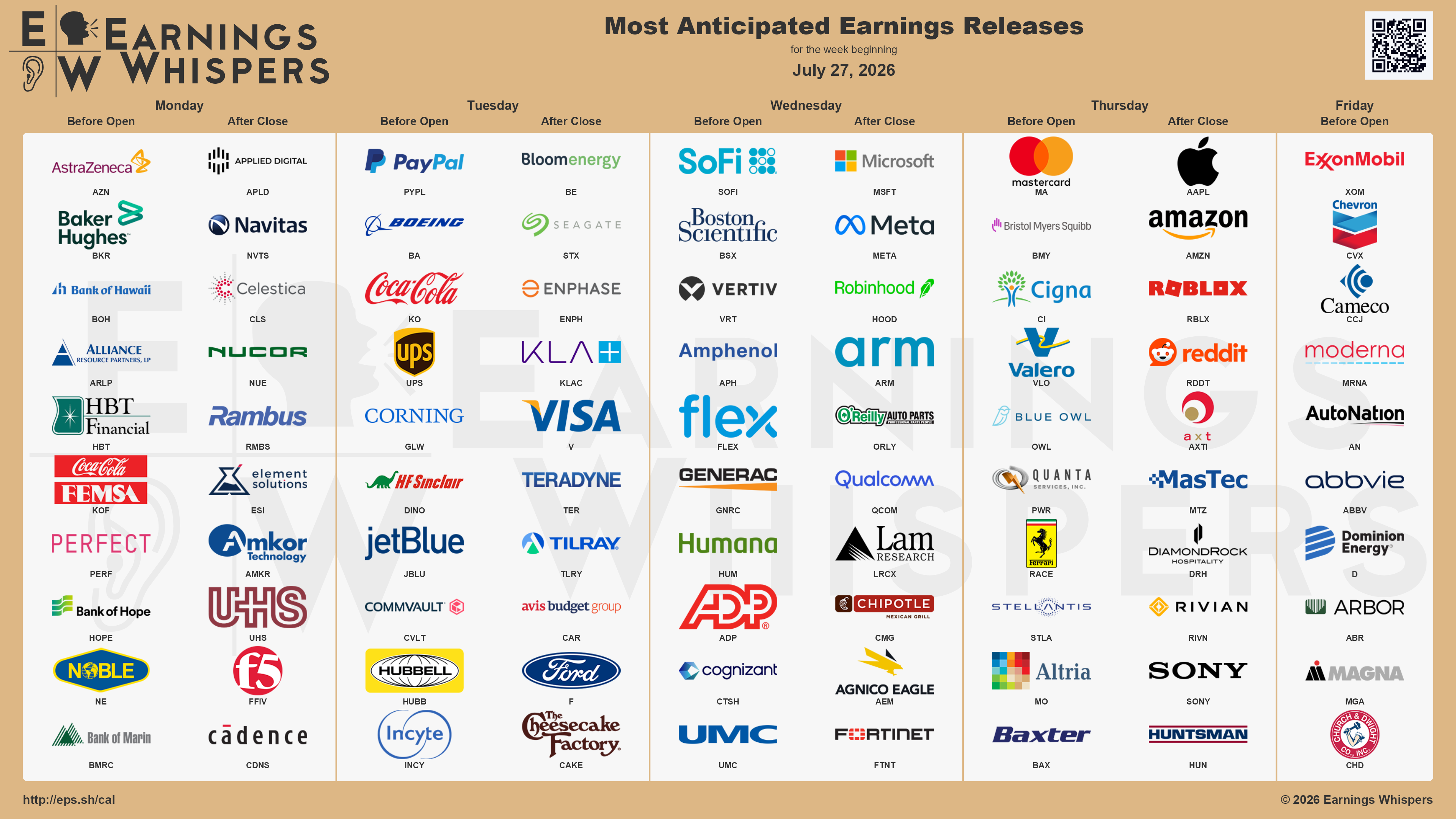
Big Tech and a Parade of Earnings Set the Stage for a Blockbuster Week
Buckle up, because this week hands investors a firehose of results, and the biggest names in tech are front and center. Microsoft, Apple, Amazon, and Meta all step into the spotlight, and they are the stocks traders can least afford to ignore. Yet the mood heading in is surprisingly cautious for some of these giants. Microsoft and Amazon in particular are drawing a wary eye, with expectations running hot and little room left for anything short of a knockout. Apple looks steadier, riding a bit more goodwill into its report, while Meta carries a touch of optimism but has a history of swinging hard in either direction once the numbers hit. Options traders are bracing for outsized moves across the board, so even a small surprise could translate into fireworks. The semiconductor and chip-gear crowd, including Lam Research, KLA, Seagate, and Qualcomm, adds another layer of drama, with several of them looking genuinely strong going in and others quietly flashing warning signs.
Beyond the tech titans, the week is a smorgasbord of sectors that touches nearly every corner of the market. On the bright side, names like F5 Networks, AutoNation, Chevron, and Ferrari's cousins in the auto world are riding real momentum and upbeat vibes, and a few under-the-radar picks like Bloom Energy and Nucor could reward patient believers if the tailwinds hold. On the flip side, keep a skeptical eye on SoFi, PayPal, JetBlue, and Vulcan Materials, where the setup looks shaky and the crowd is leaning bearish. The financial and payments giants Visa and Mastercard, along with healthcare heavyweights Bristol Myers Squibb, Humana, and AbbVie, round out a lineup that promises plenty of surprises. The bottom line is simple. This is one of those weeks where fortunes can shift in a single afternoon, so whether you are a long-term holder or just here for the show, there will be no shortage of moments worth watching.
Microsoft's AI Engine Roars, But the Bill Is Coming Due
Microsoft (MSFT) is confirmed to report earnings on Wednesday, July 29, 2026 at approximately 4:10 PM ET. Wall Street is looking for $4.21 per share on revenue of $87.44 billion, a healthy 14.4% jump from a year ago, though the smart money whisper is a touch higher at $4.34. Management itself guided to $4.10 to $4.25 per share on $86.70 to $87.80 billion. Here is the funny part: investors are actually bearish walking in, yet nearly seven in ten still expect a beat. Short sellers have piled on 6.8% more since last quarter, and the stock has slid 7.1% since its last report to sit 12.6% below its 200 day average of $436.58. But the option crowd isn't buying the gloom, they're pricing in a 7.3% swing (versus the usual 5.8%), and last Thursday someone snapped up 10,797 of the $435 calls expiring July 31. Someone is betting on fireworks.
The real story is a tug of war. On one side, the AI machine is humming: AI ARR hit $37 billion, up a staggering 123%, Copilot paid seats jumped past 20 million (helped by a monster 740,000 seat deal with Accenture), and Azure guidance got bumped up to 39 to 40%. Management even took the rare step of promising double-digit growth into next year and cleaned up the OpenAI relationship, removing a big overhang. On the other side, all this AI muscle costs a fortune. Capex is exploding past $40 billion a quarter and toward $190 billion for the year, which crushed free cash flow down to $15.8 billion from $25.7 billion earlier. Cloud margins are drifting lower, headline bookings actually went negative as those giant OpenAI deals lap, and the consumer side (gaming and Windows PCs) looks soft. The bottom line: demand is so strong they literally can't build fast enough, so watch whether the spending story reads as smart investment or a margin headache.

Apple's Demand Party Meets a Memory-Cost Hangover
Apple (AAPL) steps up to the plate after the bell on Thursday, July 30, 2026 at roughly 4:30 PM ET. Wall Street is looking for $1.88 per share on $108.79 billion in revenue, a punchy 15.7% jump from last year, though the Earnings Whisper number sits a touch higher at $1.97. Management had guided to $1.81 to $1.97 per share on $107.21 billion to $110.03 billion, so they've left themselves room to shine. The crowd is leaning bullish with 59.0% betting on a beat, and it's easy to see why: the stock has drifted 19.4% higher since last quarter and now sits 20.7% above its 200 day average of $275.88. Short sellers nudged their bets up 4.5%, but they look outnumbered. Estimates have been revised higher across the board, option traders are pricing in a 4.4% swing even though Apple usually only wiggles about 1.8%, and on July 15 someone scooped up 81,288 of the $360 calls expiring in October, a sizable vote of confidence.
Here's the real story going in. Demand is on fire and guidance has been raised four quarters running, now sitting at 14 to 17% growth. The iPhone 17 family is the strongest cycle Apple has ever had, China roared back to record levels, and Services keeps setting all-time highs. The MacBook Neo is selling so fast Apple literally can't make enough of them. The catch is margins. Memory costs are climbing fast, moving from a minor nuisance to a significantly higher drag baked into the June guide, and management pointedly refused to say whether they'll raise prices to offset it. Gross margin guidance has quietly slipped lower, and there's a CEO handoff underway with John Ternus taking the reins from Tim Cook on September 1. So the setup is simple: rock-solid demand versus a softening margin picture. Watch what they say about memory costs and pricing, because that's the swing factor everyone will be listening for.
Amazon's AI Engine Is Roaring, But Watch the Cash Bill
Amazon (AMZN) is set to report earnings on Thursday, July 30, 2026 at around 4:00 PM ET. Wall Street is looking for $1.81 per share on revenue of $196.85 billion, which would be a healthy 17.4% jump from a year ago, and the whisper number sits a touch higher at $1.87. Management had guided revenue to a range of $194 billion to $199 billion, so they are playing right in their own strike zone. Here is the funny part: investors are walking in grumpy, with short interest up 7.9% and the stock drifting 15% lower since last quarter to sit just below its 200 day average of $234.52, yet 72.3% of them still expect a beat. That is a lot of people betting against a horse they think is going to win. Estimates have actually been revised higher, options traders are bracing for a 7.3% swing versus the usual 4.7%, and someone dropped serious money on 25,951 of the $280 calls on July 21. Not exactly bearish behavior.
The real story is AWS, which has hit the gas four quarters in a row, going from 17.5% growth to a blistering 28% last quarter, the fastest in nearly four years. Backlog exploded to $364 billion, the custom chip business jumped from a $10 billion pace to over $20 billion with $225 billion in commitments locked up, and demand for its AI tools more than doubled in a single quarter. Company margins hit a record 13.1% and next quarter's profit guidance stepped up nicely. The one thing to keep your eye on is spending. Amazon burned $43.2 billion on capital projects last quarter alone, and management is upfront that free cash flow will stay squeezed while they build. If they keep proving that money is buying real growth, the grumpy crowd may not stay grumpy for long.
Meta's AI Bets Meet Wall Street's Wallet
Meta Platforms (META) is confirmed to report earnings on Wednesday, July 29, 2026 at approximately 4:00 PM ET. Wall Street is looking for $7.13 per share on revenue of $60.18 billion, which would be a hefty 26.7% jump from a year ago, but the whisper crowd is aiming higher at $7.61. Meta's own guidance called for $58.00 billion to $61.00 billion, so it is bumping right up against the top of its own range. The mood is upbeat, with 72.1% of investors betting on a beat. Still, the doubters have shown up too, as short interest has climbed 30.3% since last quarter while the stock has slipped 3.9% from where it opened after the last report, leaving it 6.8% below its 200 day average of $638.46. Estimates have been ticking higher across the board. Options traders are bracing for an 8.5% swing, roughly in line with the 7.9% average move lately, and on Thursday, July 16, someone scooped up 39,527 of the $800.00 calls expiring November 20, which is a bold bet the party keeps going.
Here is the real story heading in: Meta has flipped from talking about building AI to actually shipping it. Last quarter it launched MuseSpark, its first Superintelligence Labs model, and it now powers Meta AI across all the apps with people spending noticeably more time using it. The ad machine is the star though, with Family of Apps ad revenue accelerating to plus 33% and ad prices reheating to plus 12%. The catch is spending. Meta raised its capital budget yet again to $125 to $145 billion, and a big chunk of that is simply pricier memory chips rather than pure demand, which is squeezing free cash flow. Toss in soft Quest hardware sales and the usual regulatory headaches, and the question for Wednesday is simple: is the money pouring into AI paying off fast enough to keep the bulls happy?
SoFi's Growth Engine Roars While Bears Circle
SoFi (SOFI) is confirmed to report earnings on Wednesday, July 29, 2026 at around 7:00 AM ET. Wall Street is looking for $0.11 per share on revenue of $1.11 billion, which would mark a healthy 29.8% jump in sales from a year ago, and the Earnings Whisper number is a penny better at $0.12. Investors are walking in grumpy and bearish, yet oddly enough 74.5% of them still expect a beat, so go figure. The doubters have been busy too, with short interest climbing 18.9% since last quarter while the stock has slipped 0.5% from its post-earnings open and now sits a chilly 23.9% below its 200 day moving average of $21.62. The good news for bulls is that overall earnings estimates have actually been nudged higher since the last report. Options traders are betting on a 10.8% swing this time around, a bit bigger than the 7.5% average move of late, and someone made a splashy bet on Monday, July 13, scooping up 56,558 of the $20.00 calls expiring Friday, July 31.
Here is the real story going into the print. Last quarter was a classic good news, but hold your horses affair. Revenue accelerated to 41% growth, originations hit a record $12.2 billion, members jumped 35% to 14.7 million, and management even bumped up full-year lending growth guidance to at least 30%. On top of that, the new toys are piling up, from the SoFiUSD stablecoin and a Mastercard settlement deal to the SoFi Plus paid subscription relaunch and a big business banking push. The catch is that the tech platform took a hit from a large customer walking out the door, so watch that segment closely. Management also flipped its playbook to assume no rate cuts this year, and with seasonal payroll taxes plus front-loaded marketing weighing on the second quarter, EPS is expected to dip to the 10 to 11 cent range. In short, the growth story is firing on all cylinders, but the near-term profit picture has a few speed bumps, so the market's reaction will hinge on whether the flashy new businesses can outshine the tech platform drag.
Bloom Energy: Riding the AI Power Tsunami Into Earnings
Bloom Energy (BE) is confirmed to report earnings on Tuesday, July 28, 2026 at approximately 4:05 PM ET. Wall Street is looking for $0.40 per share on revenue of $766.88 million, which would be a whopping 91.1% jump from a year ago, but the Earnings Whisper number is a spicier $0.49 per share. Here is the odd part: investors are feeling bearish heading in, yet a full 82.0% still expect a beat. Short sellers seem to agree the easy money is gone, cutting their bets by 16.6% since last quarter, even as the stock has slid 33.1% from where it opened after the last report. That leaves it just 5.1% above its 200 day moving average of $175.90. Analysts have been nudging their numbers higher, and option traders are bracing for a big 27.9% swing, well above the roughly 10.7% move Bloom usually makes. One trader made a real statement on July 14, scooping up 24,382 of the $450.00 calls expiring August 21, a clear bet that the sky is the limit.
Here is what really matters. Last quarter Bloom hit a milestone, posting its first ever revenue quarter that more than doubled year over year, and management practically sprinted to the podium to raise guidance across the board. Full year revenue is now pegged at $3.4 to $3.8 billion, with fatter margins and operating income guided to $600 to $750 million. The star of the show is Oracle's Project Jupiter, a massive 2.45 gigawatt AI factory in New Mexico running entirely on Bloom, which validates the whole become the standard story as data centers scramble for power. Watch three things: whether that Oracle timeline stays on track, how the steep manufacturing ramp is holding up, and how the new CFO settles in. If the AI power boom keeps roaring, this one could light up.
APLD's Machine Is Humming, But the Big Leases Still Won't Sign
Applied Digital (APLD) is confirmed to report earnings on Monday, July 27, 2026 at approximately 4:05 PM ET. Wall Street is bracing for a loss of $0.18 per share on revenue of $81.95 million, which would still be a whopping 115.6% jump in sales from a year ago, though our own Earnings Whisper number sits a touch gloomier at a loss of $0.23. Investors are leaning bearish heading in, yet a slim majority (54.2%) still expect a beat, so the mood is more nervous than doomed. Short sellers have backed off 9.8% since last quarter while the stock quietly climbed 4.4% and now trades 16.9% below its 200 day moving average of $32.73. Estimates have been trimmed lower overall, and this thing loves to move: options traders are pricing in a 17.3% swing, right in line with the 16.8% average lurch of recent quarters. One tell worth noting, on Friday there was some notable buying of 5,238 contracts of the $30.00 calls expiring July 31, so somebody is betting on fireworks.
Here is the real story. The operating engine has finally roared to life, with adjusted EBITDA leaping to $44.1 million last quarter from basically nothing a year ago as the first data center building started collecting rent. Better still, the CoreWeave lease got a credit upgrade all the way to investment grade, which meaningfully de-risks the existing book and should cut borrowing costs. That is the good news, and it is genuinely good. The catch is the elephant that has been sitting in the room for three straight quarters: the giant 900MW pipeline of new leases everyone keeps talking about still has not been signed, and management is now openly admitting the whole industry is re-signing deals slower than hoped. Toss in a messy cloud write-down that widened losses last quarter, and you get a company that is clearly firing on its core cylinders but has yet to close the one deal that would truly light the fuse. Watch for any hint that the big leases are finally getting inked.
Boston Scientific's Growth Engines Just Threw a Rod
Boston Scientific (BSX) is confirmed to report earnings on Wednesday, July 29, 2026 at approximately 6:30 AM ET. Wall Street is looking for $0.83 per share on revenue of $5.39 billion, which would be 6.5% growth from a year ago, and the Earnings Whisper number matches at $0.83. Management already told us to expect $0.82 to $0.84, so the bar is set. Investors are walking in nervous even though a whopping 85.7% still expect a beat. The nerves show up in the numbers: short interest has jumped 18.7% since last quarter, the stock has slid 29.2% from where it opened after the last report, and it now sits a stunning 40.6% below its 200 day moving average of $74.53. Analysts have been quietly trimming their estimates too. Options traders are bracing for a 10.1% swing, even though the stock usually moves about 6.7% on earnings day. And on Friday, July 24, someone scooped up 8,307 of the $43.00 puts expiring July 31, a bet that things could get bumpier.
Here is the real story. Last quarter Boston Scientific did something it had not done in years: it cut its full-year forecast, dropping organic growth guidance from 10 to 11% down to 6.5 to 8% and EPS from around $3.46 to about $3.38. The trouble is coming from its three star performers all at once. Watchman, its heart device that was flying at 29% growth, suddenly cooled off in February on hospital capacity and reimbursement snags. Its heart-rhythm business is losing more market share to rivals than expected, plus it took a $35 million hit from dropping a problem catheter. And urology stayed stuck. Even the usually upbeat CEO admitted this was 'not my happiest moment.' The silver lining: the buyback got bumped up by $4 billion, margins are still expanding, double-digit EPS growth is intact, and promising new products could spark a comeback in 2027. This quarter, everyone wants to know if the bleeding has stopped or if there is another cut coming.
PayPal's Turnaround Story Meets Its Toughest Quarter
PayPal (PYPL) is confirmed to report earnings on Tuesday, July 28, 2026 at approximately 7:00 AM ET. Wall Street is looking for $1.28 per share on revenue of $8.51 billion, which would be 2.7% more revenue than a year ago, and the Earnings Whisper number is a touch higher at $1.33 per share. The company itself guided to roughly $1.27. Investors are walking in nervous, though 63.0% still expect a beat. Short sellers have piled in, with short interest up 21.6% since last quarter, yet the stock has quietly climbed 23.8% since its last report and now sits 6.7% above its 200 day average of $52.61. Estimates overall have been trimmed since last time. Option traders are betting on a 9.4% swing, right in line with the 9.3% average move of recent quarters, and on July 21 someone scooped up 15,148 of the $62.50 calls expiring August 21, a clear bet the pop keeps going.
Here is the real story: new CEO Enrique Loris is mid-way through a full-blown makeover, splitting the company into three units and chasing $1.5 billion in cost cuts, so this is a turnaround still being written. The good stuff keeps humming, as Venmo, enterprise payments, and Buy Now Pay Later all sped up, but the crown jewel, branded checkout, is barely growing at 2% while Europe and travel drag. The bigger worry is profit, since earnings growth has slid from 18% to just 1%, and management already warned Q2 earnings could drop about 9% against the hardest comparison of the year. Add in withdrawn long-term targets and a strategy review that is not finished, and the setup is simple: strong side businesses, a weak core, and a management team asking for patience.
Seagate: The Boring Hard Drive Guy Just Became a Growth Story
Seagate Technology plc (STX) drops earnings after the bell on Tuesday, July 28, 2026 at roughly 4:05 PM ET. Wall Street is looking for $5.09 per share on $3.49 billion in revenue, which would be a hefty 42.8% jump in sales from a year ago, and the Earnings Whisper number sits higher at $5.37. Management guided to $4.80 to $5.20 per share on $3.35 to $3.55 billion, so they set the bar and the crowd expects them to clear it, with 76.9% betting on a beat. Sentiment is downright cheerful heading in: short sellers have run for the exits, cutting their bets by 22.0% since last quarter, while the stock has drifted 27.5% higher and now trades a whopping 69.5% above its 200 day average of $502.37. Options traders are bracing for a big 15.5% swing, which is right in line with the roughly 11.9% moves this stock has been throwing lately. One thing worth flagging: on July 7 someone scooped up 3,155 of the $410 puts expiring August 21, so not everyone is fully drinking the punch.
Here is the real story. Seagate has quietly turned itself from a sleepy hard drive maker into an AI infrastructure play, and last quarter was its coming-out party. Gross margins have climbed four quarters straight from 38% to a stunning 47%, free cash flow hit $953 million (the best in over a decade), and management actually raised its long-term growth target to at least 20% a year. The kicker is that they are now getting paid more per terabyte instead of less, a real trend reversal. Demand is so strong that their high-capacity drives are nearly sold out through the end of 2027, the big cloud giants are locking in orders, and Fitch just handed them an investment-grade credit rating. The main things to watch are whether they can smoothly ramp their new Mosaic drives without hiccups, and whether tight supply of memory chips keeps pinching the consumer side. But make no mistake, the momentum here is loud, and the whisper number tells you the market wants even more.

Integra's Comeback Tour: Margins Up, CEO Back, Skeptics Slowly Backing Off
Integra LifeSciences (IART) reports earnings before the bell on Wednesday, July 29, 2026, at around 6:00 AM ET. Wall Street is looking for $0.48 per share on revenue of $419.60 million, which would be a modest 1.0% bump from a year ago. The company itself guided to $0.44 to $0.52 in earnings on $410 to $425 million in sales, so nobody is expecting fireworks on the top line. Investors are leaning bearish heading in but mostly anticipate results that land right in the strike zone. Here is the interesting part: the doubters are quietly heading for the exits, with short interest down 30.2% since last quarter, while the stock has quietly ripped 61.8% higher since that report and now sits 49.5% above its 200 day moving average of $13.23. Analysts have been nudging estimates higher too, and this stock likes to move, averaging a 14.9% swing in recent quarters.
Here is what actually matters. Last quarter Integra beat on both revenue and earnings and raised full year EPS guidance by a dime to $2.40 to $2.50, though that boost was largely a tariff refund benefit rather than the business suddenly firing on all cylinders. The real story is the margins, which are finally healing nicely, with gross margin climbing to 64.1% and profitability trending up across the board. The wildcard is leadership: CEO Mojdeh Pohl left over strategic differences and longtime insider Stuart Essig stepped back into the top job, promising to double down commercially now that supply headaches are easing. Watch whether management finally raises the full year revenue outlook they only reaffirmed last time, and keep an eye on Specialty Surgery, which slipped slightly and remains the soft spot in an otherwise improving picture.


Earnings Season's Quiet Signal: America's Giants Are Spending Big and Raising the Bar
If there was one thread running through last week's parade of blue-chip earnings, it was confidence backed by cash. Across telecom, defense, autos and finance, management teams did not just beat expectations, they raised the goalposts for the rest of the year. Defense contractor RTX was the poster child, lifting its sales, profit and cash-flow forecasts for the second time in a row while landing splashy new orders like a 150-plane deal from AirAsia, sending its stock up nearly 10 percent to a fresh peak. Rival Lockheed Martin one-upped it, raising guidance across every single metric on the back of a monster 35 billion dollar missile-defense contract, and the stock rocketed almost 15 percent. Old-economy names got in on the act too: General Motors bumped its profit outlook for the second time this year as North American margins climbed back into target range, even as it swallowed another 2.3 billion in charges winding down its money-losing electric-vehicle bets. The telecom trio of Verizon, AT&T and T-Mobile all played the same tune, pairing steady subscriber wins with juicier shareholder payouts, including Verizon's first stock buyback in over a decade.
But the week was also a reminder that Wall Street rewards the future and punishes the present, especially when the bill for growth comes due. Tesla was the cautionary tale, tumbling nearly 18 percent despite record deliveries and encouraging robotaxi progress, as investors zeroed in on shrinking profit margins and a swing to burning cash while it embarks on a massive multi-year spending spree. Hospital operator HCA slipped after cutting its own forecast, blaming the expiration of enhanced health-insurance subsidies that pushed far more patients into the uninsured column than the company had modeled, a stark example of how Washington policy can blindside even well-run businesses. Even the strong performers showed the trade-offs beneath the surface: American Express raised its revenue outlook on the back of the highest U.S. consumer spending since 2018, yet chose to plow that windfall back into acquisitions and perks rather than fatten earnings, and its shares dipped anyway. Capital One, still digesting its Discover takeover, delivered improving credit trends but held its guidance steady. The takeaway for the layman is simple: corporate America is opening its wallet to invest for tomorrow, and the market is busy sorting the disciplined spenders from the ones simply hoping it pays off.
Alphabet's Cloud Rocket Ship Blasts Past Everything
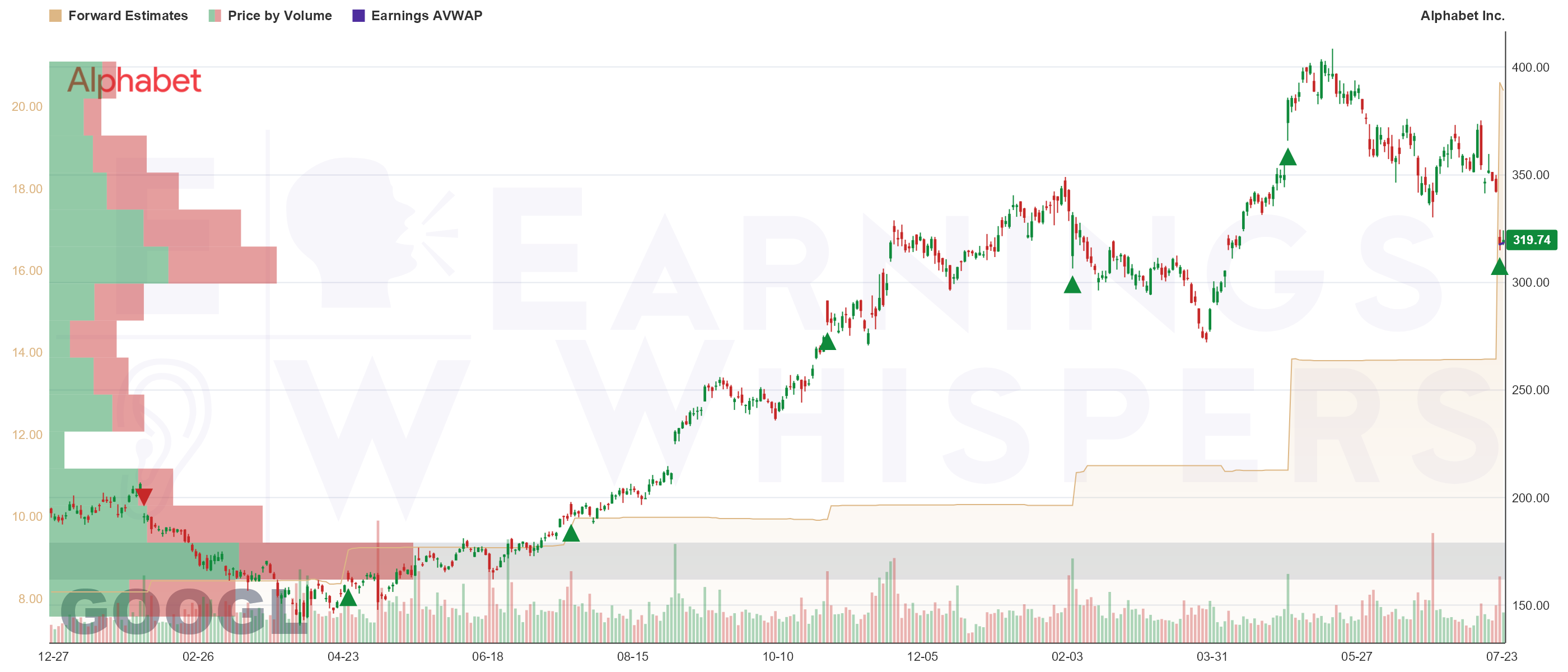
Alphabet Class A (GOOGL) just crushed it, posting earnings of $9.11 per share on revenue of $119.80 billion for the second quarter ended June 2026. Wall Street was bracing for a measly $2.88 per share, so beating estimates by a jaw-dropping 216.32% is the kind of thing that makes analysts spill their coffee. Revenue jumped 24.23% from a year ago, proving the search and advertising giant behind Google, Android, and its enterprise and hardware lineup still knows how to print money.
The real headline here is Cloud, and it is on fire. Growth rocketed to 82% this quarter, up from 63% last quarter, while the order backlog swelled to a stunning $514 billion. Margins are fattening up too, and the Gemini app now has 950 million people using it every month. Management is so confident in demand that they raised their spending plans yet again, now aiming to pour up to $205 billion into building capacity. The only smudge on the report card is that all that spending pushed free cash flow into the red at negative $5.9 billion, and search growth cooled slightly to 17%. But make no mistake, these are the aches of a company sprinting to keep up with customers banging down the door, not signs of trouble.
Tesla Sells More, Earns Less: The Big Spend Begins
Tesla (TSLA) posted earnings of just $0.33 per share on revenue of $28.24 billion for the quarter ended June 2026, and that number stings. Wall Street wanted $0.53 per share, the whisper crowd was hoping for $0.55, and the company came up short by a painful 40%. The one bright spot? Revenue actually grew a healthy 25.52% versus last year, so this isn't a demand problem. Tesla, for those just joining us, designs and builds high-performance electric cars and the guts that make them go, plus a growing pile of energy and AI ventures.
Here's the real story. People are buying Teslas again, with record second-quarter deliveries, the biggest order backlog since 2023, and about 1.5 million drivers now paying for Full Self-Driving. Robotaxi is quietly racking up over 380,000 miles across seven cities with no drama. So why the miss? Profit margins got squeezed hard, energy margins nearly cut in half thanks to a $240 million warranty hit and stiffer competition, and free cash flow flipped negative for the first time in a while. The bottom line is that Tesla is opening the checkbook, with capital spending topping $25 billion and up to $30 billion in new debt lined up to fund a multi-year building spree. In short, they are selling more but earning less right now because they are betting big on what comes next. Buckle up.
Intel Finally Shows Up: AI Server Boom Powers Blowout Quarter
Intel (INTC) reported earnings of $0.42 per share on revenue of $16.13 billion for the second quarter ended June 2026, and it wasn't close. Wall Street was looking for just $0.21 per share on $14.42 billion in sales, and even the whisper number of $0.29 got left in the dust. That's a 44.83% earnings beat with revenue jumping 25.42% from a year ago, the fastest top-line growth Intel has posted in over fifteen years. Looking ahead, the company guided third quarter earnings to roughly $0.38 per share on revenue between $15.80 billion and $16.80 billion, well above the $0.27 and $15.03 billion the Street had penciled in. CEO Lip-Bu Tan summed it up plainly: "AI is driving unprecedented demand for compute," and Intel is positioned to grab it across its CPU business, custom chips, packaging, and foundry network. In short, the sleeping giant just hit the alarm clock.
The engine here is the data center, where AI-hungry customers are buying chips faster than Intel can make them. That business hit $6.3 billion in the quarter, up 59% from last year, and management now sees strong server demand running all the way into 2028. Even better, profit margins jumped to 41.8% when the company had earlier warned they'd shrink, and Tan is now spending aggressively, raising this year's investment budget above $20 billion because he sees the demand as real. The one wart is the PC side, which is soft and squeezed by rising memory prices, but that's a footnote next to the server story. The only nag for traders is that next quarter's $0.38 guide sits just under this quarter's $0.42, mostly a cost-and-mix quirk rather than a warning sign. Bottom line: this is the healthiest Intel has looked in years.
ServiceNow Steps on the Gas: Growth Re-Accelerates and AI Crosses the Billion Mark
ServiceNow (NOW) posted earnings of $0.90 per share on revenue of $3.99 billion for the second quarter ended June 2026, matching the Earnings Whisper of $0.90 and edging past the $0.86 consensus while revenue climbed a hearty 24% year over year. Here's the color that matters: after a couple of quarters where growth had been coasting in the high teens, subscription growth actually sped back up to 23%, which for a company this size is like watching a freight train hit the accelerator. Management, who spent last quarter playing defense against the whole "AI is going to eat software" narrative, showed up this time swaggering and basically saying "we told you so."
On guidance, the company now sees third quarter subscription revenue of $3.975 to $3.980 billion and nudged its full-year 2026 subscription outlook up to $15.76 to $15.78 billion, a small but confident bump from the prior $15.735 to $15.775 billion. The real story is the AI business crossing $1 billion in annual contract value ahead of schedule and a fast-growing cybersecurity arm, freshly juiced by the Armis and Vesa deals, that management wants to take from eighth place to number one. Watch two things: gross margins are getting squeezed a bit as more AI runs on cloud partners' hardware, and roughly half of the quarter's beat came from government deals that simply arrived early rather than being brand new. Still, this is a clean beat-and-raise with a company that clearly likes where it's standing.
AMC Roars Back: Best Quarter in 106 Years
AMC Entertainment (AMC) just delivered the best quarter in its entire 106-year run, and the numbers back up the bragging. The company earned $0.14 per share on revenue of $1.60 billion for the second quarter ended June 2026, crushing the consensus estimate of $0.01 per share and blowing past the $0.03 Earnings Whisper number. That is a beat of nearly 367%, while revenue climbed 14.2% from a year ago. CEO Adam Aron could barely contain himself, calling the quarter "nothing short of extraordinary" and pointing out that AMC topped $300 million in Adjusted EBITDA for the first time ever, landing at $321.4 million, up 70%. Free cash flow hit $190.1 million. In short, people are going back to the movies, and AMC is finally cashing in.
Here is what really matters. This was not a one-off pop, it was the payoff of a slow build that finally broke wide open, powered by a booming box office (The Odyssey alone opened to $124 million and 4.3 million weekend guests) and a much cleaner balance sheet after AMC refinanced debt, swapped some for equity, and cut annual interest costs by roughly $67 million. Margins jumped to 20.1% and leverage dropped from double digits to under 6.5x. The catch: a small slice of the beat came from one-time items like an insurance credit and a currency tailwind, and AMC still is not free cash flow positive for the full year. Aron is banking on a strong 2027 movie slate to close that gap, so the story is great but not fully finished.
Buckle up, because this week hands investors a firehose of results, and the biggest names in tech are front and center. Microsoft, Apple, Amazon, and Meta all step into the spotlight, and they are the stocks traders can least afford to ignore. Yet the mood heading in is surprisingly cautious for some of these giants. Microsoft and Amazon in particular are drawing a wary eye, with expectations running hot and little room left for anything short of a knockout. Apple looks steadier, riding a bit more goodwill into its report, while Meta carries a touch of optimism but has a history of swinging hard in either direction once the numbers hit. Options traders are bracing for outsized moves across the board, so even a small surprise could translate into fireworks. The semiconductor and chip-gear crowd, including Lam Research, KLA, Seagate, and Qualcomm, adds another layer of drama, with several of them looking genuinely strong going in and others quietly flashing warning signs.
Beyond the tech titans, the week is a smorgasbord of sectors that touches nearly every corner of the market. On the bright side, names like F5 Networks, AutoNation, Chevron, and Ferrari's cousins in the auto world are riding real momentum and upbeat vibes, and a few under-the-radar picks like Bloom Energy and Nucor could reward patient believers if the tailwinds hold. On the flip side, keep a skeptical eye on SoFi, PayPal, JetBlue, and Vulcan Materials, where the setup looks shaky and the crowd is leaning bearish. The financial and payments giants Visa and Mastercard, along with healthcare heavyweights Bristol Myers Squibb, Humana, and AbbVie, round out a lineup that promises plenty of surprises. The bottom line is simple. This is one of those weeks where fortunes can shift in a single afternoon, so whether you are a long-term holder or just here for the show, there will be no shortage of moments worth watching.
Microsoft's AI Engine Roars, But the Bill Is Coming Due
Microsoft (MSFT) is confirmed to report earnings on Wednesday, July 29, 2026 at approximately 4:10 PM ET. Wall Street is looking for $4.21 per share on revenue of $87.44 billion, a healthy 14.4% jump from a year ago, though the smart money whisper is a touch higher at $4.34. Management itself guided to $4.10 to $4.25 per share on $86.70 to $87.80 billion. Here is the funny part: investors are actually bearish walking in, yet nearly seven in ten still expect a beat. Short sellers have piled on 6.8% more since last quarter, and the stock has slid 7.1% since its last report to sit 12.6% below its 200 day average of $436.58. But the option crowd isn't buying the gloom, they're pricing in a 7.3% swing (versus the usual 5.8%), and last Thursday someone snapped up 10,797 of the $435 calls expiring July 31. Someone is betting on fireworks.
The real story is a tug of war. On one side, the AI machine is humming: AI ARR hit $37 billion, up a staggering 123%, Copilot paid seats jumped past 20 million (helped by a monster 740,000 seat deal with Accenture), and Azure guidance got bumped up to 39 to 40%. Management even took the rare step of promising double-digit growth into next year and cleaned up the OpenAI relationship, removing a big overhang. On the other side, all this AI muscle costs a fortune. Capex is exploding past $40 billion a quarter and toward $190 billion for the year, which crushed free cash flow down to $15.8 billion from $25.7 billion earlier. Cloud margins are drifting lower, headline bookings actually went negative as those giant OpenAI deals lap, and the consumer side (gaming and Windows PCs) looks soft. The bottom line: demand is so strong they literally can't build fast enough, so watch whether the spending story reads as smart investment or a margin headache.
Apple's Demand Party Meets a Memory-Cost Hangover
Apple (AAPL) steps up to the plate after the bell on Thursday, July 30, 2026 at roughly 4:30 PM ET. Wall Street is looking for $1.88 per share on $108.79 billion in revenue, a punchy 15.7% jump from last year, though the Earnings Whisper number sits a touch higher at $1.97. Management had guided to $1.81 to $1.97 per share on $107.21 billion to $110.03 billion, so they've left themselves room to shine. The crowd is leaning bullish with 59.0% betting on a beat, and it's easy to see why: the stock has drifted 19.4% higher since last quarter and now sits 20.7% above its 200 day average of $275.88. Short sellers nudged their bets up 4.5%, but they look outnumbered. Estimates have been revised higher across the board, option traders are pricing in a 4.4% swing even though Apple usually only wiggles about 1.8%, and on July 15 someone scooped up 81,288 of the $360 calls expiring in October, a sizable vote of confidence.
Here's the real story going in. Demand is on fire and guidance has been raised four quarters running, now sitting at 14 to 17% growth. The iPhone 17 family is the strongest cycle Apple has ever had, China roared back to record levels, and Services keeps setting all-time highs. The MacBook Neo is selling so fast Apple literally can't make enough of them. The catch is margins. Memory costs are climbing fast, moving from a minor nuisance to a significantly higher drag baked into the June guide, and management pointedly refused to say whether they'll raise prices to offset it. Gross margin guidance has quietly slipped lower, and there's a CEO handoff underway with John Ternus taking the reins from Tim Cook on September 1. So the setup is simple: rock-solid demand versus a softening margin picture. Watch what they say about memory costs and pricing, because that's the swing factor everyone will be listening for.
Amazon's AI Engine Is Roaring, But Watch the Cash Bill
Amazon (AMZN) is set to report earnings on Thursday, July 30, 2026 at around 4:00 PM ET. Wall Street is looking for $1.81 per share on revenue of $196.85 billion, which would be a healthy 17.4% jump from a year ago, and the whisper number sits a touch higher at $1.87. Management had guided revenue to a range of $194 billion to $199 billion, so they are playing right in their own strike zone. Here is the funny part: investors are walking in grumpy, with short interest up 7.9% and the stock drifting 15% lower since last quarter to sit just below its 200 day average of $234.52, yet 72.3% of them still expect a beat. That is a lot of people betting against a horse they think is going to win. Estimates have actually been revised higher, options traders are bracing for a 7.3% swing versus the usual 4.7%, and someone dropped serious money on 25,951 of the $280 calls on July 21. Not exactly bearish behavior.
The real story is AWS, which has hit the gas four quarters in a row, going from 17.5% growth to a blistering 28% last quarter, the fastest in nearly four years. Backlog exploded to $364 billion, the custom chip business jumped from a $10 billion pace to over $20 billion with $225 billion in commitments locked up, and demand for its AI tools more than doubled in a single quarter. Company margins hit a record 13.1% and next quarter's profit guidance stepped up nicely. The one thing to keep your eye on is spending. Amazon burned $43.2 billion on capital projects last quarter alone, and management is upfront that free cash flow will stay squeezed while they build. If they keep proving that money is buying real growth, the grumpy crowd may not stay grumpy for long.
Meta's AI Bets Meet Wall Street's Wallet
Meta Platforms (META) is confirmed to report earnings on Wednesday, July 29, 2026 at approximately 4:00 PM ET. Wall Street is looking for $7.13 per share on revenue of $60.18 billion, which would be a hefty 26.7% jump from a year ago, but the whisper crowd is aiming higher at $7.61. Meta's own guidance called for $58.00 billion to $61.00 billion, so it is bumping right up against the top of its own range. The mood is upbeat, with 72.1% of investors betting on a beat. Still, the doubters have shown up too, as short interest has climbed 30.3% since last quarter while the stock has slipped 3.9% from where it opened after the last report, leaving it 6.8% below its 200 day average of $638.46. Estimates have been ticking higher across the board. Options traders are bracing for an 8.5% swing, roughly in line with the 7.9% average move lately, and on Thursday, July 16, someone scooped up 39,527 of the $800.00 calls expiring November 20, which is a bold bet the party keeps going.
Here is the real story heading in: Meta has flipped from talking about building AI to actually shipping it. Last quarter it launched MuseSpark, its first Superintelligence Labs model, and it now powers Meta AI across all the apps with people spending noticeably more time using it. The ad machine is the star though, with Family of Apps ad revenue accelerating to plus 33% and ad prices reheating to plus 12%. The catch is spending. Meta raised its capital budget yet again to $125 to $145 billion, and a big chunk of that is simply pricier memory chips rather than pure demand, which is squeezing free cash flow. Toss in soft Quest hardware sales and the usual regulatory headaches, and the question for Wednesday is simple: is the money pouring into AI paying off fast enough to keep the bulls happy?
SoFi's Growth Engine Roars While Bears Circle
SoFi (SOFI) is confirmed to report earnings on Wednesday, July 29, 2026 at around 7:00 AM ET. Wall Street is looking for $0.11 per share on revenue of $1.11 billion, which would mark a healthy 29.8% jump in sales from a year ago, and the Earnings Whisper number is a penny better at $0.12. Investors are walking in grumpy and bearish, yet oddly enough 74.5% of them still expect a beat, so go figure. The doubters have been busy too, with short interest climbing 18.9% since last quarter while the stock has slipped 0.5% from its post-earnings open and now sits a chilly 23.9% below its 200 day moving average of $21.62. The good news for bulls is that overall earnings estimates have actually been nudged higher since the last report. Options traders are betting on a 10.8% swing this time around, a bit bigger than the 7.5% average move of late, and someone made a splashy bet on Monday, July 13, scooping up 56,558 of the $20.00 calls expiring Friday, July 31.
Here is the real story going into the print. Last quarter was a classic good news, but hold your horses affair. Revenue accelerated to 41% growth, originations hit a record $12.2 billion, members jumped 35% to 14.7 million, and management even bumped up full-year lending growth guidance to at least 30%. On top of that, the new toys are piling up, from the SoFiUSD stablecoin and a Mastercard settlement deal to the SoFi Plus paid subscription relaunch and a big business banking push. The catch is that the tech platform took a hit from a large customer walking out the door, so watch that segment closely. Management also flipped its playbook to assume no rate cuts this year, and with seasonal payroll taxes plus front-loaded marketing weighing on the second quarter, EPS is expected to dip to the 10 to 11 cent range. In short, the growth story is firing on all cylinders, but the near-term profit picture has a few speed bumps, so the market's reaction will hinge on whether the flashy new businesses can outshine the tech platform drag.
Bloom Energy: Riding the AI Power Tsunami Into Earnings
Bloom Energy (BE) is confirmed to report earnings on Tuesday, July 28, 2026 at approximately 4:05 PM ET. Wall Street is looking for $0.40 per share on revenue of $766.88 million, which would be a whopping 91.1% jump from a year ago, but the Earnings Whisper number is a spicier $0.49 per share. Here is the odd part: investors are feeling bearish heading in, yet a full 82.0% still expect a beat. Short sellers seem to agree the easy money is gone, cutting their bets by 16.6% since last quarter, even as the stock has slid 33.1% from where it opened after the last report. That leaves it just 5.1% above its 200 day moving average of $175.90. Analysts have been nudging their numbers higher, and option traders are bracing for a big 27.9% swing, well above the roughly 10.7% move Bloom usually makes. One trader made a real statement on July 14, scooping up 24,382 of the $450.00 calls expiring August 21, a clear bet that the sky is the limit.
Here is what really matters. Last quarter Bloom hit a milestone, posting its first ever revenue quarter that more than doubled year over year, and management practically sprinted to the podium to raise guidance across the board. Full year revenue is now pegged at $3.4 to $3.8 billion, with fatter margins and operating income guided to $600 to $750 million. The star of the show is Oracle's Project Jupiter, a massive 2.45 gigawatt AI factory in New Mexico running entirely on Bloom, which validates the whole become the standard story as data centers scramble for power. Watch three things: whether that Oracle timeline stays on track, how the steep manufacturing ramp is holding up, and how the new CFO settles in. If the AI power boom keeps roaring, this one could light up.
APLD's Machine Is Humming, But the Big Leases Still Won't Sign
Applied Digital (APLD) is confirmed to report earnings on Monday, July 27, 2026 at approximately 4:05 PM ET. Wall Street is bracing for a loss of $0.18 per share on revenue of $81.95 million, which would still be a whopping 115.6% jump in sales from a year ago, though our own Earnings Whisper number sits a touch gloomier at a loss of $0.23. Investors are leaning bearish heading in, yet a slim majority (54.2%) still expect a beat, so the mood is more nervous than doomed. Short sellers have backed off 9.8% since last quarter while the stock quietly climbed 4.4% and now trades 16.9% below its 200 day moving average of $32.73. Estimates have been trimmed lower overall, and this thing loves to move: options traders are pricing in a 17.3% swing, right in line with the 16.8% average lurch of recent quarters. One tell worth noting, on Friday there was some notable buying of 5,238 contracts of the $30.00 calls expiring July 31, so somebody is betting on fireworks.
Here is the real story. The operating engine has finally roared to life, with adjusted EBITDA leaping to $44.1 million last quarter from basically nothing a year ago as the first data center building started collecting rent. Better still, the CoreWeave lease got a credit upgrade all the way to investment grade, which meaningfully de-risks the existing book and should cut borrowing costs. That is the good news, and it is genuinely good. The catch is the elephant that has been sitting in the room for three straight quarters: the giant 900MW pipeline of new leases everyone keeps talking about still has not been signed, and management is now openly admitting the whole industry is re-signing deals slower than hoped. Toss in a messy cloud write-down that widened losses last quarter, and you get a company that is clearly firing on its core cylinders but has yet to close the one deal that would truly light the fuse. Watch for any hint that the big leases are finally getting inked.
Boston Scientific's Growth Engines Just Threw a Rod
Boston Scientific (BSX) is confirmed to report earnings on Wednesday, July 29, 2026 at approximately 6:30 AM ET. Wall Street is looking for $0.83 per share on revenue of $5.39 billion, which would be 6.5% growth from a year ago, and the Earnings Whisper number matches at $0.83. Management already told us to expect $0.82 to $0.84, so the bar is set. Investors are walking in nervous even though a whopping 85.7% still expect a beat. The nerves show up in the numbers: short interest has jumped 18.7% since last quarter, the stock has slid 29.2% from where it opened after the last report, and it now sits a stunning 40.6% below its 200 day moving average of $74.53. Analysts have been quietly trimming their estimates too. Options traders are bracing for a 10.1% swing, even though the stock usually moves about 6.7% on earnings day. And on Friday, July 24, someone scooped up 8,307 of the $43.00 puts expiring July 31, a bet that things could get bumpier.
Here is the real story. Last quarter Boston Scientific did something it had not done in years: it cut its full-year forecast, dropping organic growth guidance from 10 to 11% down to 6.5 to 8% and EPS from around $3.46 to about $3.38. The trouble is coming from its three star performers all at once. Watchman, its heart device that was flying at 29% growth, suddenly cooled off in February on hospital capacity and reimbursement snags. Its heart-rhythm business is losing more market share to rivals than expected, plus it took a $35 million hit from dropping a problem catheter. And urology stayed stuck. Even the usually upbeat CEO admitted this was 'not my happiest moment.' The silver lining: the buyback got bumped up by $4 billion, margins are still expanding, double-digit EPS growth is intact, and promising new products could spark a comeback in 2027. This quarter, everyone wants to know if the bleeding has stopped or if there is another cut coming.
PayPal's Turnaround Story Meets Its Toughest Quarter
PayPal (PYPL) is confirmed to report earnings on Tuesday, July 28, 2026 at approximately 7:00 AM ET. Wall Street is looking for $1.28 per share on revenue of $8.51 billion, which would be 2.7% more revenue than a year ago, and the Earnings Whisper number is a touch higher at $1.33 per share. The company itself guided to roughly $1.27. Investors are walking in nervous, though 63.0% still expect a beat. Short sellers have piled in, with short interest up 21.6% since last quarter, yet the stock has quietly climbed 23.8% since its last report and now sits 6.7% above its 200 day average of $52.61. Estimates overall have been trimmed since last time. Option traders are betting on a 9.4% swing, right in line with the 9.3% average move of recent quarters, and on July 21 someone scooped up 15,148 of the $62.50 calls expiring August 21, a clear bet the pop keeps going.
Here is the real story: new CEO Enrique Loris is mid-way through a full-blown makeover, splitting the company into three units and chasing $1.5 billion in cost cuts, so this is a turnaround still being written. The good stuff keeps humming, as Venmo, enterprise payments, and Buy Now Pay Later all sped up, but the crown jewel, branded checkout, is barely growing at 2% while Europe and travel drag. The bigger worry is profit, since earnings growth has slid from 18% to just 1%, and management already warned Q2 earnings could drop about 9% against the hardest comparison of the year. Add in withdrawn long-term targets and a strategy review that is not finished, and the setup is simple: strong side businesses, a weak core, and a management team asking for patience.
Seagate: The Boring Hard Drive Guy Just Became a Growth Story
Seagate Technology plc (STX) drops earnings after the bell on Tuesday, July 28, 2026 at roughly 4:05 PM ET. Wall Street is looking for $5.09 per share on $3.49 billion in revenue, which would be a hefty 42.8% jump in sales from a year ago, and the Earnings Whisper number sits higher at $5.37. Management guided to $4.80 to $5.20 per share on $3.35 to $3.55 billion, so they set the bar and the crowd expects them to clear it, with 76.9% betting on a beat. Sentiment is downright cheerful heading in: short sellers have run for the exits, cutting their bets by 22.0% since last quarter, while the stock has drifted 27.5% higher and now trades a whopping 69.5% above its 200 day average of $502.37. Options traders are bracing for a big 15.5% swing, which is right in line with the roughly 11.9% moves this stock has been throwing lately. One thing worth flagging: on July 7 someone scooped up 3,155 of the $410 puts expiring August 21, so not everyone is fully drinking the punch.
Here is the real story. Seagate has quietly turned itself from a sleepy hard drive maker into an AI infrastructure play, and last quarter was its coming-out party. Gross margins have climbed four quarters straight from 38% to a stunning 47%, free cash flow hit $953 million (the best in over a decade), and management actually raised its long-term growth target to at least 20% a year. The kicker is that they are now getting paid more per terabyte instead of less, a real trend reversal. Demand is so strong that their high-capacity drives are nearly sold out through the end of 2027, the big cloud giants are locking in orders, and Fitch just handed them an investment-grade credit rating. The main things to watch are whether they can smoothly ramp their new Mosaic drives without hiccups, and whether tight supply of memory chips keeps pinching the consumer side. But make no mistake, the momentum here is loud, and the whisper number tells you the market wants even more.
Integra's Comeback Tour: Margins Up, CEO Back, Skeptics Slowly Backing Off
Integra LifeSciences (IART) reports earnings before the bell on Wednesday, July 29, 2026, at around 6:00 AM ET. Wall Street is looking for $0.48 per share on revenue of $419.60 million, which would be a modest 1.0% bump from a year ago. The company itself guided to $0.44 to $0.52 in earnings on $410 to $425 million in sales, so nobody is expecting fireworks on the top line. Investors are leaning bearish heading in but mostly anticipate results that land right in the strike zone. Here is the interesting part: the doubters are quietly heading for the exits, with short interest down 30.2% since last quarter, while the stock has quietly ripped 61.8% higher since that report and now sits 49.5% above its 200 day moving average of $13.23. Analysts have been nudging estimates higher too, and this stock likes to move, averaging a 14.9% swing in recent quarters.
Here is what actually matters. Last quarter Integra beat on both revenue and earnings and raised full year EPS guidance by a dime to $2.40 to $2.50, though that boost was largely a tariff refund benefit rather than the business suddenly firing on all cylinders. The real story is the margins, which are finally healing nicely, with gross margin climbing to 64.1% and profitability trending up across the board. The wildcard is leadership: CEO Mojdeh Pohl left over strategic differences and longtime insider Stuart Essig stepped back into the top job, promising to double down commercially now that supply headaches are easing. Watch whether management finally raises the full year revenue outlook they only reaffirmed last time, and keep an eye on Specialty Surgery, which slipped slightly and remains the soft spot in an otherwise improving picture.
Earnings Season's Quiet Signal: America's Giants Are Spending Big and Raising the Bar
If there was one thread running through last week's parade of blue-chip earnings, it was confidence backed by cash. Across telecom, defense, autos and finance, management teams did not just beat expectations, they raised the goalposts for the rest of the year. Defense contractor RTX was the poster child, lifting its sales, profit and cash-flow forecasts for the second time in a row while landing splashy new orders like a 150-plane deal from AirAsia, sending its stock up nearly 10 percent to a fresh peak. Rival Lockheed Martin one-upped it, raising guidance across every single metric on the back of a monster 35 billion dollar missile-defense contract, and the stock rocketed almost 15 percent. Old-economy names got in on the act too: General Motors bumped its profit outlook for the second time this year as North American margins climbed back into target range, even as it swallowed another 2.3 billion in charges winding down its money-losing electric-vehicle bets. The telecom trio of Verizon, AT&T and T-Mobile all played the same tune, pairing steady subscriber wins with juicier shareholder payouts, including Verizon's first stock buyback in over a decade.
But the week was also a reminder that Wall Street rewards the future and punishes the present, especially when the bill for growth comes due. Tesla was the cautionary tale, tumbling nearly 18 percent despite record deliveries and encouraging robotaxi progress, as investors zeroed in on shrinking profit margins and a swing to burning cash while it embarks on a massive multi-year spending spree. Hospital operator HCA slipped after cutting its own forecast, blaming the expiration of enhanced health-insurance subsidies that pushed far more patients into the uninsured column than the company had modeled, a stark example of how Washington policy can blindside even well-run businesses. Even the strong performers showed the trade-offs beneath the surface: American Express raised its revenue outlook on the back of the highest U.S. consumer spending since 2018, yet chose to plow that windfall back into acquisitions and perks rather than fatten earnings, and its shares dipped anyway. Capital One, still digesting its Discover takeover, delivered improving credit trends but held its guidance steady. The takeaway for the layman is simple: corporate America is opening its wallet to invest for tomorrow, and the market is busy sorting the disciplined spenders from the ones simply hoping it pays off.
Alphabet's Cloud Rocket Ship Blasts Past Everything
Alphabet Class A (GOOGL) just crushed it, posting earnings of $9.11 per share on revenue of $119.80 billion for the second quarter ended June 2026. Wall Street was bracing for a measly $2.88 per share, so beating estimates by a jaw-dropping 216.32% is the kind of thing that makes analysts spill their coffee. Revenue jumped 24.23% from a year ago, proving the search and advertising giant behind Google, Android, and its enterprise and hardware lineup still knows how to print money.
The real headline here is Cloud, and it is on fire. Growth rocketed to 82% this quarter, up from 63% last quarter, while the order backlog swelled to a stunning $514 billion. Margins are fattening up too, and the Gemini app now has 950 million people using it every month. Management is so confident in demand that they raised their spending plans yet again, now aiming to pour up to $205 billion into building capacity. The only smudge on the report card is that all that spending pushed free cash flow into the red at negative $5.9 billion, and search growth cooled slightly to 17%. But make no mistake, these are the aches of a company sprinting to keep up with customers banging down the door, not signs of trouble.
Tesla Sells More, Earns Less: The Big Spend Begins
Tesla (TSLA) posted earnings of just $0.33 per share on revenue of $28.24 billion for the quarter ended June 2026, and that number stings. Wall Street wanted $0.53 per share, the whisper crowd was hoping for $0.55, and the company came up short by a painful 40%. The one bright spot? Revenue actually grew a healthy 25.52% versus last year, so this isn't a demand problem. Tesla, for those just joining us, designs and builds high-performance electric cars and the guts that make them go, plus a growing pile of energy and AI ventures.
Here's the real story. People are buying Teslas again, with record second-quarter deliveries, the biggest order backlog since 2023, and about 1.5 million drivers now paying for Full Self-Driving. Robotaxi is quietly racking up over 380,000 miles across seven cities with no drama. So why the miss? Profit margins got squeezed hard, energy margins nearly cut in half thanks to a $240 million warranty hit and stiffer competition, and free cash flow flipped negative for the first time in a while. The bottom line is that Tesla is opening the checkbook, with capital spending topping $25 billion and up to $30 billion in new debt lined up to fund a multi-year building spree. In short, they are selling more but earning less right now because they are betting big on what comes next. Buckle up.
Intel Finally Shows Up: AI Server Boom Powers Blowout Quarter
Intel (INTC) reported earnings of $0.42 per share on revenue of $16.13 billion for the second quarter ended June 2026, and it wasn't close. Wall Street was looking for just $0.21 per share on $14.42 billion in sales, and even the whisper number of $0.29 got left in the dust. That's a 44.83% earnings beat with revenue jumping 25.42% from a year ago, the fastest top-line growth Intel has posted in over fifteen years. Looking ahead, the company guided third quarter earnings to roughly $0.38 per share on revenue between $15.80 billion and $16.80 billion, well above the $0.27 and $15.03 billion the Street had penciled in. CEO Lip-Bu Tan summed it up plainly: "AI is driving unprecedented demand for compute," and Intel is positioned to grab it across its CPU business, custom chips, packaging, and foundry network. In short, the sleeping giant just hit the alarm clock.
The engine here is the data center, where AI-hungry customers are buying chips faster than Intel can make them. That business hit $6.3 billion in the quarter, up 59% from last year, and management now sees strong server demand running all the way into 2028. Even better, profit margins jumped to 41.8% when the company had earlier warned they'd shrink, and Tan is now spending aggressively, raising this year's investment budget above $20 billion because he sees the demand as real. The one wart is the PC side, which is soft and squeezed by rising memory prices, but that's a footnote next to the server story. The only nag for traders is that next quarter's $0.38 guide sits just under this quarter's $0.42, mostly a cost-and-mix quirk rather than a warning sign. Bottom line: this is the healthiest Intel has looked in years.
ServiceNow Steps on the Gas: Growth Re-Accelerates and AI Crosses the Billion Mark
ServiceNow (NOW) posted earnings of $0.90 per share on revenue of $3.99 billion for the second quarter ended June 2026, matching the Earnings Whisper of $0.90 and edging past the $0.86 consensus while revenue climbed a hearty 24% year over year. Here's the color that matters: after a couple of quarters where growth had been coasting in the high teens, subscription growth actually sped back up to 23%, which for a company this size is like watching a freight train hit the accelerator. Management, who spent last quarter playing defense against the whole "AI is going to eat software" narrative, showed up this time swaggering and basically saying "we told you so."
On guidance, the company now sees third quarter subscription revenue of $3.975 to $3.980 billion and nudged its full-year 2026 subscription outlook up to $15.76 to $15.78 billion, a small but confident bump from the prior $15.735 to $15.775 billion. The real story is the AI business crossing $1 billion in annual contract value ahead of schedule and a fast-growing cybersecurity arm, freshly juiced by the Armis and Vesa deals, that management wants to take from eighth place to number one. Watch two things: gross margins are getting squeezed a bit as more AI runs on cloud partners' hardware, and roughly half of the quarter's beat came from government deals that simply arrived early rather than being brand new. Still, this is a clean beat-and-raise with a company that clearly likes where it's standing.
AMC Roars Back: Best Quarter in 106 Years
AMC Entertainment (AMC) just delivered the best quarter in its entire 106-year run, and the numbers back up the bragging. The company earned $0.14 per share on revenue of $1.60 billion for the second quarter ended June 2026, crushing the consensus estimate of $0.01 per share and blowing past the $0.03 Earnings Whisper number. That is a beat of nearly 367%, while revenue climbed 14.2% from a year ago. CEO Adam Aron could barely contain himself, calling the quarter "nothing short of extraordinary" and pointing out that AMC topped $300 million in Adjusted EBITDA for the first time ever, landing at $321.4 million, up 70%. Free cash flow hit $190.1 million. In short, people are going back to the movies, and AMC is finally cashing in.
Here is what really matters. This was not a one-off pop, it was the payoff of a slow build that finally broke wide open, powered by a booming box office (The Odyssey alone opened to $124 million and 4.3 million weekend guests) and a much cleaner balance sheet after AMC refinanced debt, swapped some for equity, and cut annual interest costs by roughly $67 million. Margins jumped to 20.1% and leverage dropped from double digits to under 6.5x. The catch: a small slice of the beat came from one-time items like an insurance credit and a currency tailwind, and AMC still is not free cash flow positive for the full year. Aron is banking on a strong 2027 movie slate to close that gap, so the story is great but not fully finished.