Upcoming Earnings
Earnings Week Kicks Off with Snacks, Spirits, and a Few Jittery Tech Bets
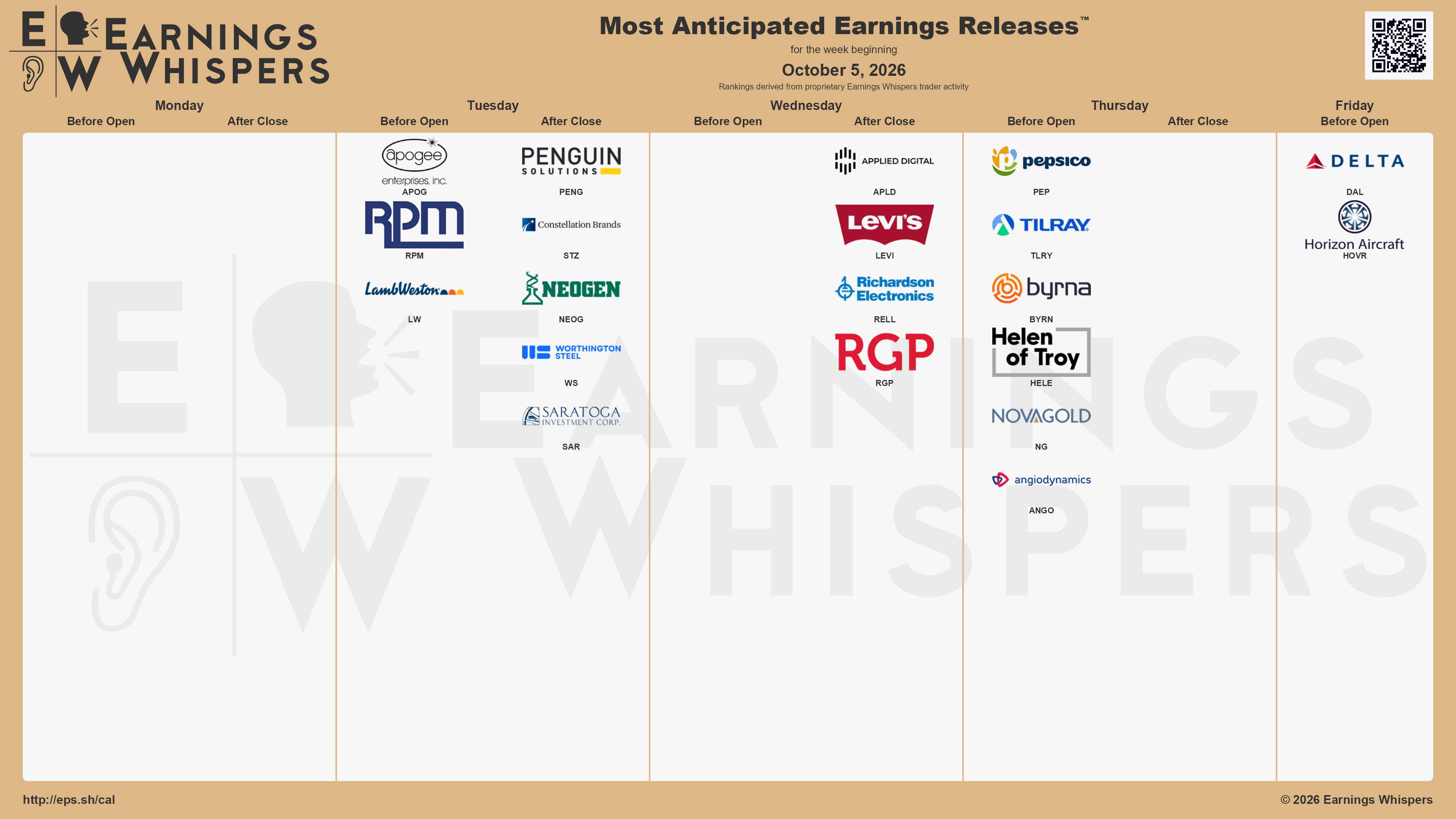
The coming week serves up a classic American lineup, and the mood in the room is decidedly mixed. PepsiCo and Constellation Brands, the makers of your favorite fizzy drinks and cold ones, head into their reports with Wall Street looking distinctly nervous. Both have seen enthusiasm cool noticeably, with analysts quietly trimming expectations and the smart money bracing for a rough reception. Lamb Weston, the french fry king, finds itself in similar company, suggesting that even comfort food can't comfort traders right now. On the brighter side, the week's early darling looks to be Penguin Solutions, a tech name that has been building serious buzz and strength going into its number, while Neogen in the healthcare corner is riding a wave of genuine optimism after a solid run.
Don't overlook the drama at the edges of the schedule. Delta Air Lines will test whether travelers are still splurging on getaways, and the stock has a reputation for taking passengers on a wild ride when results hit. Jeans maker Levi Strauss struts in with a confident swagger and a track record of pleasant surprises, making it one of the week's more hopeful stories in the consumer aisle. Meanwhile, keep an eye on the smaller, scrappier names where sentiment has turned sour, including stun-gun maker Byrna Technologies, which has stumbled badly of late, and aviation upstart New Horizon Aircraft, which heads into its report under a heavy cloud of doubt. Add in cannabis player Tilray, where hopes are quietly perking up despite a bumpy sector, and you have a week that promises plenty of fireworks for anyone watching the tape.
Penguin's AI Rocket Ship Faces Its Next Big Test
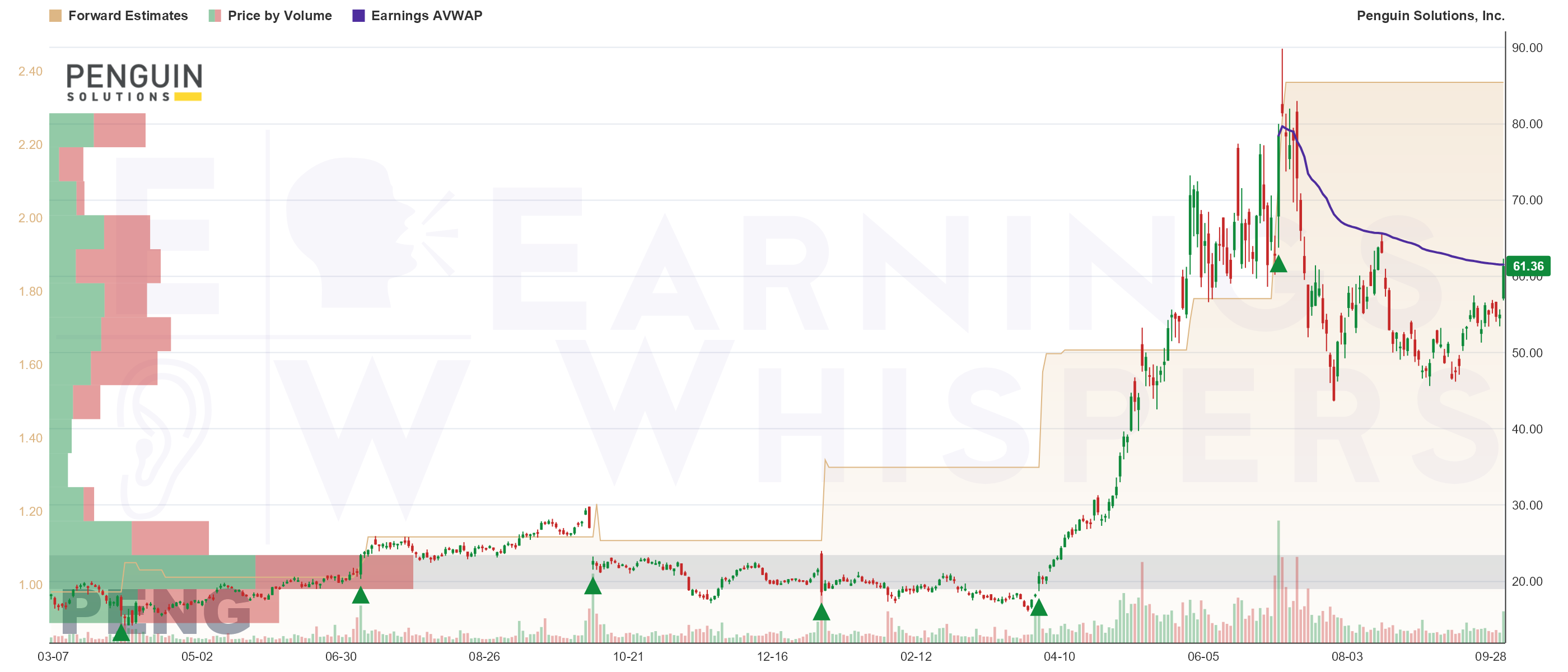
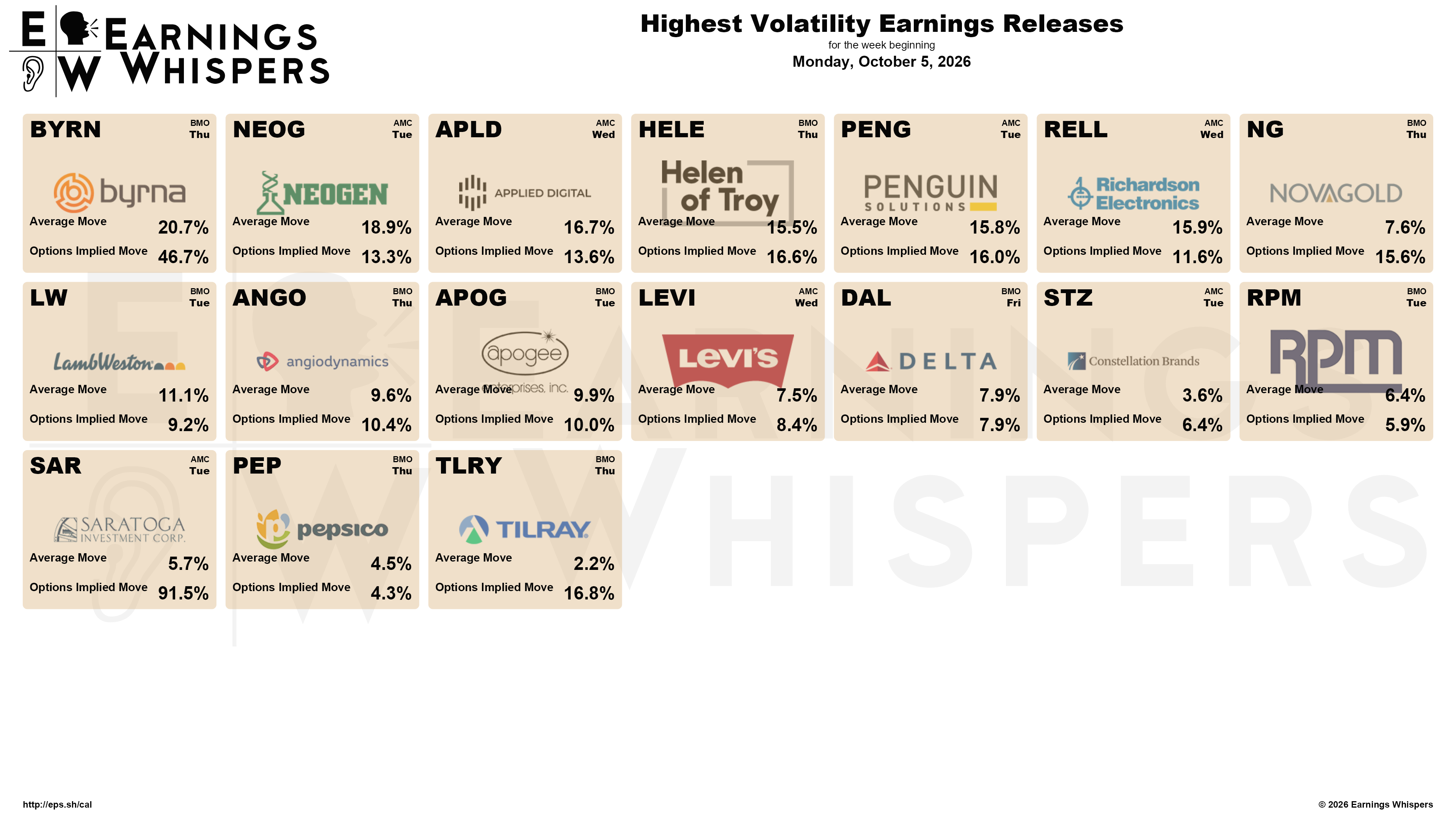
Penguin Solutions (PENG) is confirmed to report earnings on Tuesday, October 6, 2026 at approximately 4:05 PM ET. Wall Street is looking for $0.75 per share on revenue of $512.50 million, which would mark a hefty 51.7% jump in sales from a year ago, but the whisper number is higher at $0.84 per share. Investors are feeling good heading in, with 76.0% betting on a beat. Short sellers have been running for the exits too, cutting their bets by 30.5% since last quarter. The stock has cooled 9.6% from where it opened after the last report, yet it still sits a lofty 54.8% above its 200 day moving average of $39.63. Analysts have been nudging their numbers up, and the options crowd placed a notable bet on September 15 with 811 contracts of the $50.00 calls expiring October 16.
Here is the real story: this company has turned into an AI memory machine, and the last call was practically a victory lap. Management raised its full-year sales growth outlook for the second straight quarter, hiked profit targets, and for the first time teased roughly 30% growth in both sales and earnings next year. Fresh wins keep piling up, including a prized NVIDIA partner badge and Dell's AI Partner of the Year award. The memory business alone more than doubled, and AI now makes up nearly three quarters of total sales. The one thing to watch is profit margins, which slipped a bit on product mix, plus a cash crunch from stocking up on inventory and a new interim CFO settling into the chair. None of that has dimmed the demand story, so the question this quarter is simple: can Penguin keep the momentum flying without the margin bumps clipping its wings?
APLD: A $36 Billion Backlog Says the Doubters Are Looking in the Wrong Place
Applied Digital (APLD) is locked in to report earnings on Wednesday, October 7, 2026 at roughly 4:05 PM ET. Wall Street is penciling in a loss of $0.25 per share on revenue of $134.10 million, which would be a chunky 108.8% jump from a year ago, though the Earnings Whisper number sits a touch gloomier at a loss of $0.31. The mood heading in is bearish, yet here is the funny part: two out of three folks still expect a beat. Short sellers have quietly backed off, trimming their bets by 17.2% since last quarter, even as the stock has slid 5.3% from where it opened after the last report and now sits 20.9% below its 200 day moving average of $32.07. Estimates have been nudged lower across the board, and on October 1st someone scooped up 6,805 of the $20.00 puts expiring October 30th, so a few traders are clearly bracing for a bumpy ride.
Here is what actually matters. Last quarter was a genuine turning point. Applied Digital signed three new campuses worth about $20 billion with a single top tier cloud giant, which helped balloon its total contracted lease value from $16 billion to a staggering $36 billion in a single quarter. Management got so confident they yanked their $1 billion profit run-rate goal forward by three years, now saying it is roughly a year away. Borrowing got cheaper too, with new notes pricing well below the earlier round. The catch? The headline net loss widened to $111.6 million, but almost all of that was stock-based comp rather than anything wrong with the business. The real debates are whether those big new leases earn enough return and whether the company can finance a massive build-out against $5 billion in debt. Bottom line: demand is not the problem here, execution is the story to watch.
Delta Takes Off, But Fuel's Still Riding Along
Delta Air Lines (DAL) is cleared for takeoff Friday, October 9, 2026, with earnings landing around 6:30 AM ET. Wall Street is penciling in $1.96 per share on revenue of $17.70 billion, a tidy 6.2% jump from a year ago, though that top line sits well shy of Delta's own guidance of roughly $19.17 billion. Even so, the mood in the cabin is upbeat, with 42.9% of investors betting on a beat. The stock has drifted 4.4% lower since last quarter's report but still cruises 11.0% above its 200 day moving average of $75.78. Short sellers have piled in, pushing short interest up 13.3%, yet overall earnings estimates have been nudged higher, and on October 1 someone scooped up 7,672 of the $87.00 calls expiring October 9. Somebody clearly thinks this plane has altitude left.
Here is the real story heading in: Delta is a genuinely improving business, but record fuel prices are hiding just how good the engines are running. Last quarter revenue growth accelerated to 14% and unit revenue climbed 12.4%, with premium, loyalty, and cargo all firing. Management guided this quarter to an 11% to 13% operating margin and $2.00 to $2.50 per share, a big step up from last year, and promised a return to double-digit margins and earnings growth in the back half of the year. The catch is the roughly $4 billion yearly fuel hit, plus a lingering refinery outage and soft travel to Mexico and Latin America, which squeezed last quarter's bottom line down to $1.56. The key thing to watch Friday is whether Delta delivers on those richer margin promises, because if fuel behaves, the real earnings power finally gets to show itself.
PepsiCo's Comeback Is Finally Showing Up in the Bag
PepsiCo (PEP) is set to report earnings before the sun is fully up on Thursday, October 8, 2026, at around 6:00 AM ET. Wall Street is looking for $2.29 per share on $24.88 billion in revenue, which would be 3.9% more sales than a year ago, while the whisper number sneaks in a touch higher at $2.32. The mood heading in is gloomy, yet oddly hopeful, as 57.1% of folks still expect a beat. Short sellers have backed off by 17.8% since last quarter, but that has not saved the stock, which has slid 8.2% since its last earnings day and now sits 14.5% below its 200 day average of $147.28. Analysts have been trimming their estimates, so the bar is lower. Still, somebody is feeling lucky, because on September 23 a trader scooped up 39,583 of the $140 calls expiring December 18.
Here is the real story: the turnaround PepsiCo kept promising is finally showing up in the numbers, not just the slides. Last quarter, snacks swung back to growth with volume up 2% and Lay's back on the shelf in people's carts, and the company even started winning on value, not just volume. Drinks popped 9% thanks to new energy brands like Celsius and Poppi, and international kept humming along. The catch is that management only reaffirmed its guidance instead of raising it, margins are basically flat, and there is a new wrinkle: cost inflation tied to the Middle East conflict. They say they can handle it within this year's plan, likely by tweaking prices and package sizes, but it is worth watching. Add in the World Cup marketing blitz heating up for the back half, and this quarter is less about fireworks and more about proof that the plan keeps working.
Constellation's New Captain Steadies the Ship, But the Seas Are Still Choppy
Constellation Brands (STZ) uncorks its earnings on Tuesday, October 6, 2026 at around 4:05 PM ET. Wall Street is looking for $3.62 per share on revenue of $2.57 billion, which would be a 3.2% slide from a year ago, while the Earnings Whisper number sits a touch lower at $3.55. Investors are walking in cautious, though nearly 7 in 10 still expect a beat. The skeptics have been busy too, with short interest climbing 13.5% since last quarter, and the stock has slumped 20.9% from where it opened after the last report, leaving it 21.2% under its 200 day moving average of $143.25. Estimates have been trimmed across the board. One bright spot for the bulls: on Friday, September 18, 2026, someone scooped up 5,231 of the $190 call contracts expiring in March 2027, a sizable wager that the clouds eventually lift.
Here is the real story heading in. New CEO Nick Fink's first act last quarter was the least-bad print in a while, with beer shipments up 1.8% and beer margins landing near 39%, both better than the gloomy bar management set earlier. The catch is that none of that good news made it into the guidance, which was left flat, not raised. Blame a gas-price spike of more than 50% that kept shoppers home and persistent softness among Hispanic consumers in Texas and Florida. The World Cup gave sales a nudge, but that boost smells like a one-time party, not a lasting trend. Add in heavier marketing spend topping 10% of sales and the Veracruz brewery still soaking up costs before it even opens, and this is a company treading water while the new skipper gets his bearings. Steadier hands, same rough waters.
Levi's Is on a Winning Streak, But Wall Street Is Second-Guessing
Levi Strauss (LEVI) steps up to report earnings Wednesday, October 7, 2026, right around 4:10 PM ET. The Street is looking for $0.36 per share on $1.61 billion in revenue, which would be a respectable 4.3% bump in sales from a year ago, though our Earnings Whisper number sits a touch higher at $0.39. Investors are split down the middle, with exactly half betting on a beat. Here's the head-scratcher: short interest has climbed 7.9% since last quarter and the stock has slid 15.3% from where it opened after the last report, leaving it 8.8% below its 200-day moving average of $21.78. Estimates have also been trimmed lower across the board. Still, somebody is feeling optimistic, because on September 17 a chunk of buyers scooped up 1,017 of the $23.00 calls expiring October 16.
The disconnect is strange because the actual business has been firing on all cylinders. Last quarter Levi raised its full-year outlook for the second straight time, bumped the dividend, grew margins, and saw free cash flow jump about 60%. Demand was broad, with direct-to-consumer up for the 17th quarter in a row, China finally turning positive, and the premium BlueTab line growing 40%. The one catch is management's cautious second-half forecast, which they flat-out called conservatism rather than any real slowdown, plus some lingering noise from a warehouse closure and tariffs. So the setup is a genuinely humming company trading like the market expects trouble. Worth watching whether Wednesday closes that gap.
Tilray: Big Swings, Bigger Questions Before the Bell
Tilray reports before the market opens, and Wall Street is bracing for a loss of $0.18 per share on revenue of $264.90 million. That top line would be a healthy 26.4% jump from a year ago. Investors are feeling hopeful, with 40.0% betting on a beat, but the smart money looks skeptical. Short interest has climbed 19.7% since last quarter, the stock has slid 10.4% from where it opened after the last report, and it now sits a painful 41.7% below its 200 day moving average of $6.20. Overall earnings estimates have been trimmed since the last release. And here is the kicker: on Wednesday, September 30, 2026, someone scooped up 2,052 of the $3.50 puts expiring October 09, 2026, a sizable bet that the pain is not over.
Here is the real story. Last quarter management finally put a stake in the ground, giving its first ever forward guidance of $68 to 75 million in adjusted EBITDA for FY2027, a double-digit step up from FY26. They closed the BrewDog deal, snagging a $200 million-plus revenue business for roughly $54 million, and a Carlsberg US partnership kicks off in January. International cannabis is on fire, up 34% for the year, and they nearly wiped out net debt, slashing it about 95% to under $1 million. But watch the soft spots: US beer is still limping along with organic sales down roughly 17%, Canadian adult-use growth has cooled to just 3.2%, free cash flow is still negative $86 million, and a new Veterans Affairs change takes a $4 million bite next year. The tone has shifted from fixing the plumbing to flexing earnings power. The question tonight is whether the numbers back up the swagger.
Apogee's Earnings: All Eyes on the Glass That's Half Empty
Apogee Enterprises (APOG) is set to report earnings before the bell on Tuesday, October 6, 2026, at around 6:30 AM ET. Wall Street is looking for $0.59 per share on revenue of $362.61 million, which would be a modest 1.2% bump in sales from a year ago, while the Earnings Whisper number sits a touch lower at $0.57. Investors are feeling optimistic, with 44.4% betting on a beat, but there is a crowd rooting against them too. Short interest has jumped a hefty 47.0% since last quarter, the stock has slid 22.6% from where it opened after the last report, and it now trades 6.4% below its 200 day moving average of $38.07. Analysts, meanwhile, have not touched their estimates one bit.
Here is the real story heading in. Last quarter was a tale of two companies under one roof. Metals is quietly firing on all cylinders, with margins nearly doubling and the Services backlog hitting $735 million on its ninth straight quarter of growth. Management also bolted on the CalWall acquisition, a deal that pays off in year one and nudged the full-year sales target higher. But then there is Glass, the clear problem child, where sales fell and profits caved in, prompting a formal fix-it plan and a brand new segment boss. The year is back-half loaded, so do not be shocked if this quarter looks soft on the surface. The question clients should watch is simple: is the Glass turnaround starting to stick, or is it still cracking?
Byrna's Pepper-Spray Empire Hits a Rough Patch
Byrna Technologies (BYRN) is set to report earnings on Thursday, October 8, 2026 at about 8:00 AM ET, and the mood is tense. Wall Street is bracing for a loss of $0.14 per share on revenue of $16.04 million, a painful 43.1% drop from a year ago, while the whisper number is even gloomier at a loss of $0.18. Investors are leaning bearish, though a stubborn 28.6% still think the company can pull off a surprise. Here is the twist: short interest has been cut in half, down 51.4% since last quarter, even as the stock has slid 25.8% since its last report and now sits a jaw-dropping 57.7% below its 200 day moving average of $8.22. Analysts have been quietly trimming their numbers lower.
Last quarter was less of a stumble and more of a full-on hard reset. Management flat out admitted fiscal 2026 will not be a growth year, a complete U-turn from the swagger of past calls that touted margin expansion and big ambitions. Sales fell across the board, with e-commerce, domestic dealers, and international all down more than 35%, and website traffic is now shrinking too. Gross margins cratered to 11% after roughly $10.4 million in write-downs tied to shutting the Fort Wayne ammo plant. A new CEO, Conn Davis, has replaced founder Brian Ganz, and the tone has shifted from dreamy to damage control. The bright spots, like the Try Before You Buy program converting at 30% and a new budget-friendly product line from the Hero Defense deal, are real but still too small to move the needle. Expect Q3 to be another transition quarter, with any real rebound pinned on the holiday season.
Neogen Flips From Defense to Offense Ahead of Q4
Neogen (NEOG) is set to report earnings on Tuesday, October 6, 2026 at about 6:10 PM ET. Wall Street is looking for $0.04 per share on revenue of $208.09 million, which would be a slight dip of 0.5% from a year ago, but the Earnings Whisper number is a touch higher at $0.06 per share. Management had guided revenue to a range of $207.00 million to $209.00 million, so expectations are tightly clustered. The crowd is leaning optimistic, with two out of three investors betting on a beat. Short sellers have nudged their positions up 3.5% since last quarter, yet the stock has climbed 15.7% from where it opened after the last report and now sits a healthy 21.8% above its 200 day moving average of $9.98. Analysts have been sharpening their pencils and nudging estimates higher, and on September 17 someone stepped up to buy 5,025 of the $15.00 calls expiring in January 2027, a sizable bullish wager.
Here is the real story: Neogen has quietly turned the corner. Food safety growth has accelerated for four straight quarters, hitting its best pace since 2023, while the animal safety business clawed back from an ugly stumble to post positive growth again. Cash flow flipped from bleeding red to a tidy $26 million, inventory is way down, and the tricky Petri film transition cleared its toughest hurdle in August. Management's tone has shifted from nervously saying turnarounds are never linear to flat out declaring they are moving to offense. The one wrinkle to watch is profit. They are deliberately pouring money into research and sales muscle this year, so near-term margins stay flat even as sales grow. In short, the top line is firing and confidence is high, but patient investors should know the real payoff from all this spending lands later rather than now.
Helen of Troy: Turnaround Finally Shows Up, But Margins Still Playing Catch-Up
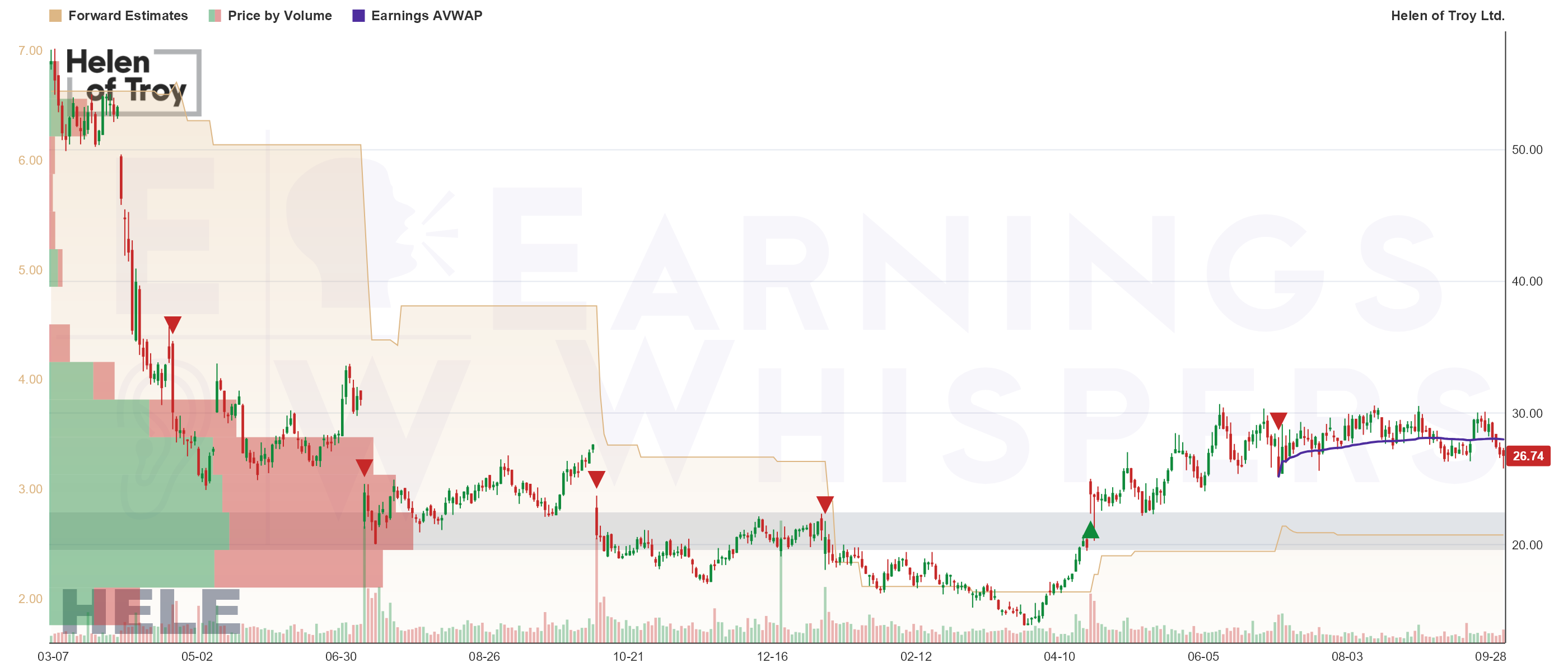
Helen of Troy (HELE) is confirmed to report earnings on Thursday, October 8, 2026 at approximately 6:45 AM ET. Wall Street is looking for $0.51 per share on revenue of $441.45 million, a modest 2.2% bump from a year ago, while the Earnings Whisper number sits a touch higher at $0.55. Here is the fun part: investors are walking in grumpy, yet a full 80% still expect a beat, so the glass is apparently both half empty and half full. Short interest has jumped 17.3% since last quarter, and the stock has barely budged, drifting up just 0.2% since its last report to sit 15.8% above its 200 day moving average of $23.10. Estimates have been trimmed since last time, and on September 18 someone bought 500 of the $30.00 puts expiring October 16, so a few folks are betting the bounce runs out of gas.
Here is the real story heading in. Last quarter was the first genuine proof that the turnaround has legs, with sales swinging to +8.2% growth after four straight quarters of declines, and both the home and outdoor and beauty and wellness segments finally in the green thanks to Osprey, OXO, Olive and June, and a healthier balance sheet that saw debt cut by $716 million. The catch is margins are still going the wrong way, with gross margin down 110 basis points, because new cost inflation from commodities, freight, a weak yuan, and Middle East supply snags is eating up the tariff refund benefit. Management nudged the full year sales outlook higher but only reaffirmed earnings, and they are still guiding the back half to a slight decline. Translation: the top line is healing, but the bottom line needs more time, so watch the margin commentary and whether this quarter's growth is real momentum or just easy comparisons and Prime Day borrowing from next quarter.
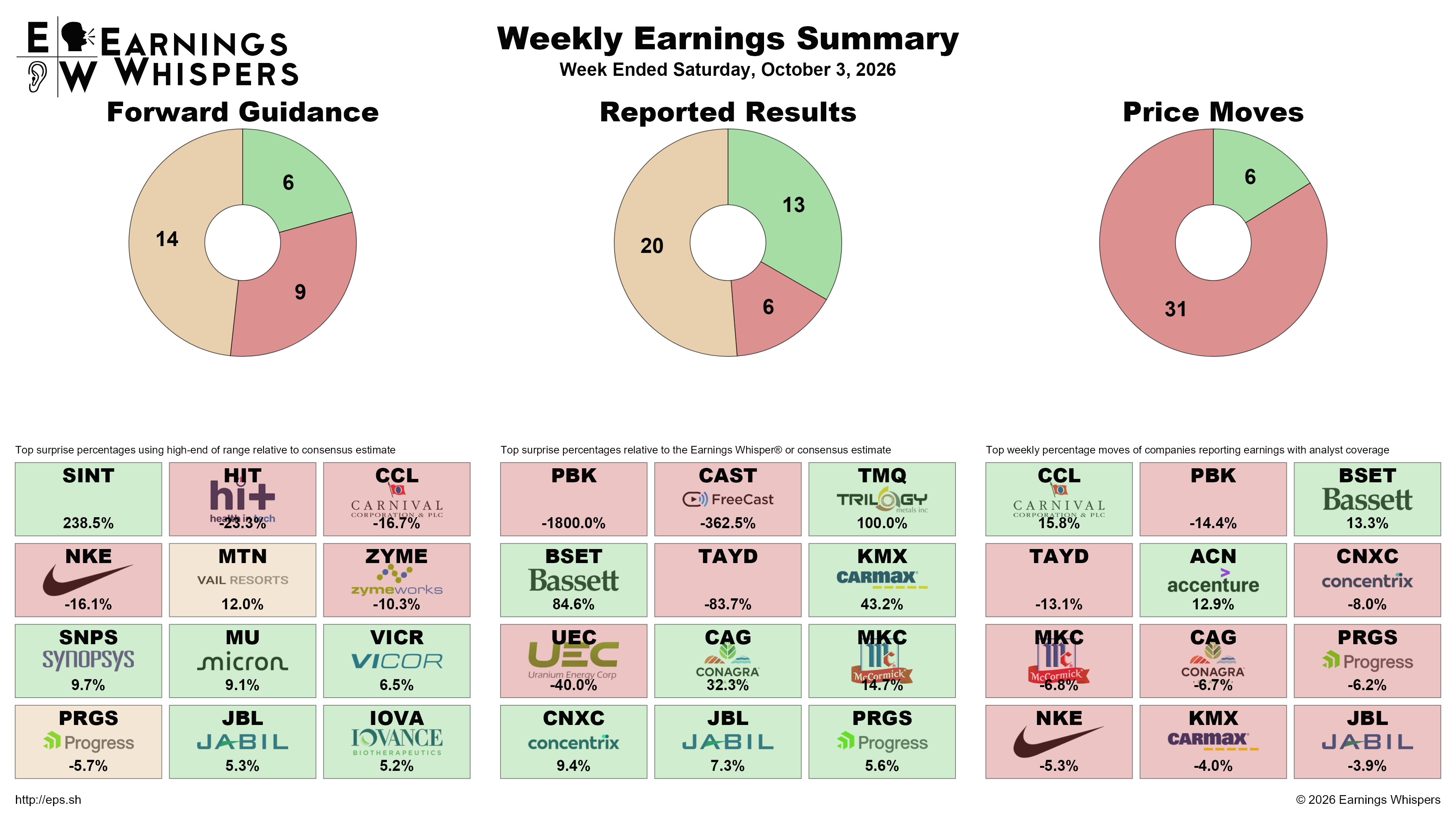
AI's Boom Lifts Chipmakers and Factory Floors, While Nike and the Grocery Aisle Feel the Squeeze
Last week's earnings told a tale of two economies, split right down the middle by one letter: AI. Memory maker Micron stole the show, blowing past its own forecasts with sales that jumped a staggering 379% from a year ago, as it locked in customers for next-generation chips well into 2028 and signaled that supply will stay 'much tighter' for years to come. The only wrinkle was some rising costs that nicked next quarter's profit margins, but investors shrugged at a company printing cash. The AI gold rush spilled over into less obvious places too. Factory-services giant Jabil guided to its fourth straight quarter of raised expectations, now expecting its AI-related business to grow 54% as a second big cloud customer joins the billion-dollar club. Even lighting company Acuity leaned into the trend, rolling out fixtures built specifically for data centers, though it warned that the same memory-chip shortage fueling Micron's windfall will pinch its own margins next year. Accenture rounded out the winners with a surprise sales rebound and a fresh $1 billion bet on AI safety, even as it quietly admitted that next year's growth will lean heavily on acquisitions rather than its own steam.
For companies selling to everyday shoppers, the mood was far gloomier. Nike delivered the week's hardest gut-punch, with its new finance chief essentially clearing the decks and warning that sales will fall by high single digits this year, breaking an earlier promise of steady profits. The culprits are a brutal 26% collapse in China, slumping Jordan sneakers, and fading casual styles, with executives bluntly promising 'pain before gain.' Over in the pantry, spice maker McCormick and Conagra both saw their margins hold up but their sales momentum fizzle, as cash-strapped shoppers pulled back and transportation and packaging costs climbed faster than planned. There were bright spots in the bargain hunt, however. CarMax roared back to life with used-car sales up 13% and profits up 81%, helped partly by new federal rules forcing rivals to advertise honest, all-in prices. Carnival's cruise ships kept sailing full despite a Middle East hiccup, and call-center operator Concentrix beat on profits even as its old-line business keeps shrinking under the weight of the very AI automation that is minting fortunes elsewhere. The message from the week was clear: if you sell the picks and shovels for artificial intelligence, business is booming, but if you sell sneakers or seasonings, the consumer is tapping the brakes.
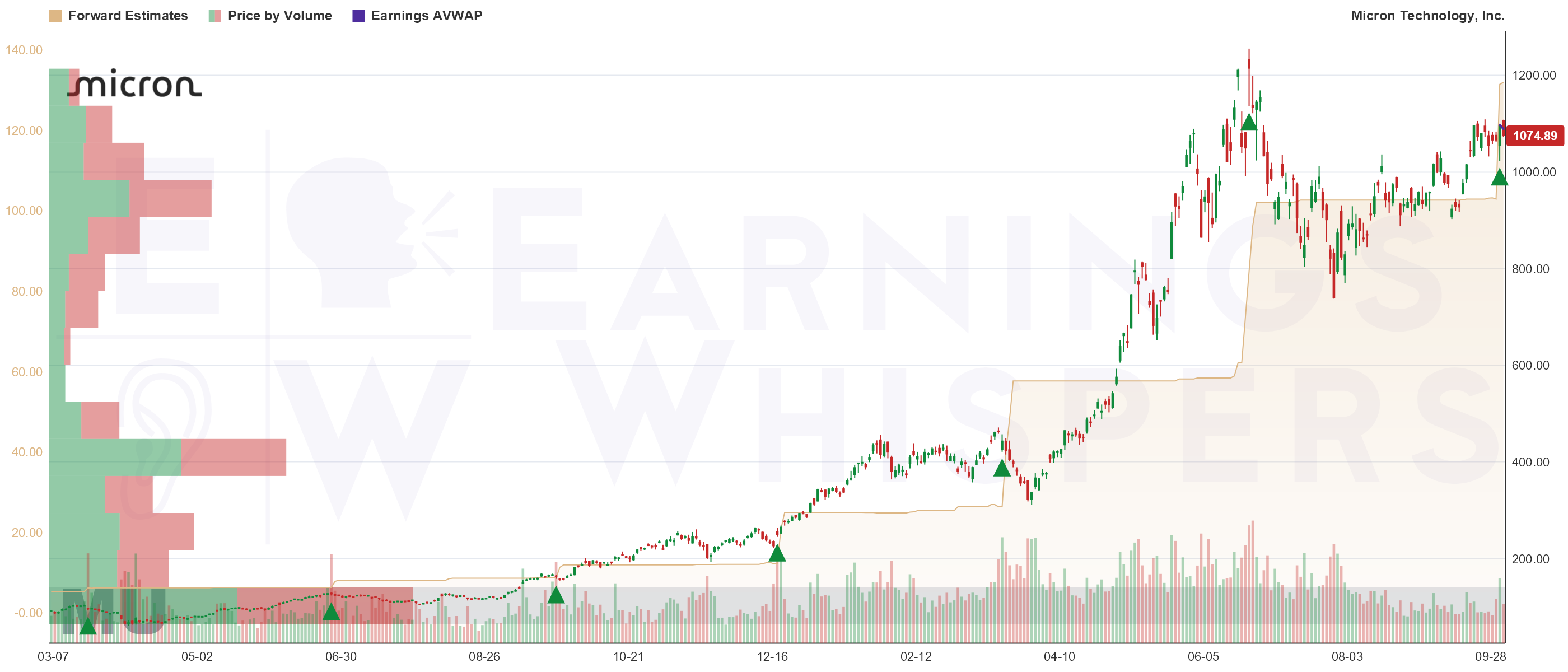
Micron's AI Memory Boom: Nitpick the Miss, Love the Backlog
Micron Technology (MU) posted fiscal fourth quarter earnings of $33.19 per share on revenue of $54.23 billion for the period ended August 2026. That topped the Wall Street consensus of $31.41 per share and $50.86 billion in revenue, but it came in just under the whisper number of $34.14, a 2.78% shortfall that counts as the only blemish on the page. Revenue, meanwhile, exploded 379.27% from a year ago, which is the kind of number you usually only see in a typo. Looking ahead, management guided first quarter earnings of $37.15 to $39.15 per share on revenue of $60.0 billion to $63.0 billion, sailing past the $34.83 and $56.6 billion analysts were penciling in. As Chairman and CEO Sanjay Mehrotra put it, AI is becoming Super Intelligence, memory is the fuel, and Micron's Strategic Customer Agreements give it a clearer view of the road ahead. Micron makes DRAM, NAND flash memory, and image sensors, and right now the whole world wants all of it.
The real story is the backlog, not the whisper miss. Micron's strategic customer deals jumped from 16 to 26 in a single quarter, locked-in commitments climbed from $22 billion to $32 billion, and total contracted work on the books swelled to roughly $150 billion. More than 75% of next year's output is already spoken for, the supply-demand picture is now described as much tighter through 2027 and 2028, and free cash flow nearly doubled to $33.2 billion, leaving the company sitting on $73.5 billion in cash with a bigger buyback on the way starting December 9. The only speed bumps are cost-related: a tiny dip in next quarter's gross margin to about 86.25%, higher operating expenses, and a sharp rise in capital spending as Micron builds to meet demand. Translation: they are spending more because customers are lined up out the door, which is about the best reason a chipmaker can have.
Nike's New CFO Rips Off the Band-Aid
Nike (NKE) posted first quarter earnings of $0.48 per share on revenue of $11.21 billion for the fiscal quarter ended August 2026, beating the $0.43 consensus and matching the Earnings Whisper number right on the nose. But the top line told a sadder story, with revenue slipping 4.33% from a year ago. The real gut-punch was the outlook. Management now sees fiscal 2027 earnings of just $1.15 to $1.35 per share on roughly $42.92 billion in revenue, miles below Wall Street's hopes of $1.61 per share and $45.62 billion. CEO Elliott Hill talked up the "Sport Offense" and a new effort called Pace, while admitting there is "more work to do" in Sportswear, Jordan Brand and Greater China. Translation: things get worse before they get better.
Think of this as the new CFO's spring cleaning, and he brought a big trash bag. Dave Denton took the podium and tossed out the old "flattish earnings" promise, rebasing the year to a high single digit revenue decline with profit falling even faster. China is the ugliest spot, down 26% and expected to keep sliding as Nike scrubs its digital channels. Jordan dropped mid-teens and classic Sportswear sneakers like the Dunk are being yanked off shelves on purpose. The bright spots are real, with performance gear like running and football growing double digits and a $2.5 billion cost-cutting program on the way, but none of it fills the hole fast enough. Any clear path back to growth is being punted to the November Investor Day, so investors will have to lace up and wait.
Conagra Beats on Earnings, But the Diet Stays the Same
Conagra Brands (CAG) served up a tasty quarter, posting earnings of $0.41 per share on revenue of $2.60 billion for its fiscal first quarter ending August 2026. That blew past the $0.31 per share Wall Street was expecting, a 32% beat, though revenue slipped 1.39% from a year ago while landing just ahead of estimates. The company stuck with its full-year 2027 outlook of $1.40 to $1.50 per share on revenue of $10.94 to $11.17 billion, right in line with what analysts were already penciling in. New CEO John Brase called it a solid start, saying the company is making real progress on fixing margins, spending smarter, cutting clutter, and reshaping how it uses cash, all in a tough environment.
Here is the catch though. The big beat leaned on a few lucky bounces, think one-time savings, a nice pop from the Ardent Mills grain business riding wheat price swings, cheaper meat costs, and a small tariff refund. The headache is shipping. Transportation costs are running at double what the company planned thanks to a driver shortage and pricey oil, which is why Conagra reaffirmed guidance rather than raised it. Shoppers are tight-fisted and picky, frozen and refrigerated volumes dropped about 10%, and meat snacks are getting squeezed as high gas prices keep folks out of convenience stores. In short, this is a repair year, and so far the company is tracking its plan without actually topping it. Keep an eye on the next update at the halfway mark.
Carnival Beats, But the Middle East Rains on the Deck
Carnival (CCL) posted a beat for its fiscal third quarter, earning $1.43 per share on $8.44 billion in revenue, topping both the $1.36 consensus and the $1.37 Earnings Whisper number. Earnings came in 4.38% ahead of expectations while revenue rose 3.46% from a year ago. The catch is in the forecast: management guided to roughly $0.20 per share for the fourth quarter ending November 30, 2026, below the $0.24 Wall Street was penciling in. CEO Josh Weinstein leaned into the good news, touting another quarter of record top and bottom line results, accelerating demand, and tighter cost control, plus the company's long run of same-ship yield growth. Carnival remains the biggest cruise company on the planet and one of the largest leisure travel outfits around.
Here is the real story under the deck chairs. Conflict in the Middle East scrambled European sailings, especially in the Mediterranean, forcing Carnival to trim its full-year yield outlook by about a point, a roughly $0.14 hit to earnings. The saving grace is cost discipline, which management calls structural and worth about $0.06 a share, so full-year earnings guidance barely moved at $2.22. Elsewhere there is plenty to like: customer deposits hit a record $9 billion, the balance sheet keeps getting healthier, over $450 million of a $2.5 billion buyback is done, and 2027 bookings are at all-time highs on both price and occupancy. Management says booking trends turned back up in June and calls the Middle East drag temporary. Bottom line, this is a solid cruise with a bit of choppy water, not a leak in the hull.
Accenture Beats Big, But 2027 Leans on the Deal Machine
Accenture closed its fiscal fourth quarter (ended August 2026) with earnings of $3.29 per share on revenue of $18.68 billion, topping the $3.19 consensus and the $3.27 whisper, while revenue climbed a healthy 6.15% from a year ago. The quarter was a genuine reacceleration story: growth hit 7% in local currency across every geography, bookings bounced back to $22.2 billion, and the company notched a record 141 client deals worth $100 million or more. Full-year adjusted EPS rose 8% to $13.97 and a record $11.5 billion went back to shareholders. For fiscal 2027, management guided to $14.39 to $14.81 per share on revenue of $76.43 billion to $78.65 billion, right in line with the $14.63 and $76.45 billion the Street was looking for. Credit CEO leadership for a confident tone and a quarter that beat every target it set a year ago.
Here is the catch worth watching. That 2027 outlook lets the company's shopping spree do a lot of the heavy lifting. Roughly 2 to 2.5 points of next year's growth comes from acquisitions, which means organic growth actually slows to about 1 to 3.5%, and EPS growth cools to 3 to 6% from this year's 8%. Management also admitted pricing came down in many parts of the business amid fierce competition, the Middle East got worse, dividend growth is being cut to 5% from 10%, and shareholder payouts step down to at least $9.5 billion. Perhaps most telling, Accenture kept buying back its own stock at falling prices, from $246 earlier in the year to $132 last quarter, a quiet signal the market has questions. Bottom line: demand and execution are clearly improving, but the growth is increasingly bought rather than earned. Keep an eye on the October 14 Investor Day for the fuller picture.
Don't overlook the drama at the edges of the schedule. Delta Air Lines will test whether travelers are still splurging on getaways, and the stock has a reputation for taking passengers on a wild ride when results hit. Jeans maker Levi Strauss struts in with a confident swagger and a track record of pleasant surprises, making it one of the week's more hopeful stories in the consumer aisle. Meanwhile, keep an eye on the smaller, scrappier names where sentiment has turned sour, including stun-gun maker Byrna Technologies, which has stumbled badly of late, and aviation upstart New Horizon Aircraft, which heads into its report under a heavy cloud of doubt. Add in cannabis player Tilray, where hopes are quietly perking up despite a bumpy sector, and you have a week that promises plenty of fireworks for anyone watching the tape.
Penguin's AI Rocket Ship Faces Its Next Big Test
Penguin Solutions (PENG) is confirmed to report earnings on Tuesday, October 6, 2026 at approximately 4:05 PM ET. Wall Street is looking for $0.75 per share on revenue of $512.50 million, which would mark a hefty 51.7% jump in sales from a year ago, but the whisper number is higher at $0.84 per share. Investors are feeling good heading in, with 76.0% betting on a beat. Short sellers have been running for the exits too, cutting their bets by 30.5% since last quarter. The stock has cooled 9.6% from where it opened after the last report, yet it still sits a lofty 54.8% above its 200 day moving average of $39.63. Analysts have been nudging their numbers up, and the options crowd placed a notable bet on September 15 with 811 contracts of the $50.00 calls expiring October 16.
Here is the real story: this company has turned into an AI memory machine, and the last call was practically a victory lap. Management raised its full-year sales growth outlook for the second straight quarter, hiked profit targets, and for the first time teased roughly 30% growth in both sales and earnings next year. Fresh wins keep piling up, including a prized NVIDIA partner badge and Dell's AI Partner of the Year award. The memory business alone more than doubled, and AI now makes up nearly three quarters of total sales. The one thing to watch is profit margins, which slipped a bit on product mix, plus a cash crunch from stocking up on inventory and a new interim CFO settling into the chair. None of that has dimmed the demand story, so the question this quarter is simple: can Penguin keep the momentum flying without the margin bumps clipping its wings?
APLD: A $36 Billion Backlog Says the Doubters Are Looking in the Wrong Place
Applied Digital (APLD) is locked in to report earnings on Wednesday, October 7, 2026 at roughly 4:05 PM ET. Wall Street is penciling in a loss of $0.25 per share on revenue of $134.10 million, which would be a chunky 108.8% jump from a year ago, though the Earnings Whisper number sits a touch gloomier at a loss of $0.31. The mood heading in is bearish, yet here is the funny part: two out of three folks still expect a beat. Short sellers have quietly backed off, trimming their bets by 17.2% since last quarter, even as the stock has slid 5.3% from where it opened after the last report and now sits 20.9% below its 200 day moving average of $32.07. Estimates have been nudged lower across the board, and on October 1st someone scooped up 6,805 of the $20.00 puts expiring October 30th, so a few traders are clearly bracing for a bumpy ride.
Here is what actually matters. Last quarter was a genuine turning point. Applied Digital signed three new campuses worth about $20 billion with a single top tier cloud giant, which helped balloon its total contracted lease value from $16 billion to a staggering $36 billion in a single quarter. Management got so confident they yanked their $1 billion profit run-rate goal forward by three years, now saying it is roughly a year away. Borrowing got cheaper too, with new notes pricing well below the earlier round. The catch? The headline net loss widened to $111.6 million, but almost all of that was stock-based comp rather than anything wrong with the business. The real debates are whether those big new leases earn enough return and whether the company can finance a massive build-out against $5 billion in debt. Bottom line: demand is not the problem here, execution is the story to watch.
Delta Takes Off, But Fuel's Still Riding Along
Delta Air Lines (DAL) is cleared for takeoff Friday, October 9, 2026, with earnings landing around 6:30 AM ET. Wall Street is penciling in $1.96 per share on revenue of $17.70 billion, a tidy 6.2% jump from a year ago, though that top line sits well shy of Delta's own guidance of roughly $19.17 billion. Even so, the mood in the cabin is upbeat, with 42.9% of investors betting on a beat. The stock has drifted 4.4% lower since last quarter's report but still cruises 11.0% above its 200 day moving average of $75.78. Short sellers have piled in, pushing short interest up 13.3%, yet overall earnings estimates have been nudged higher, and on October 1 someone scooped up 7,672 of the $87.00 calls expiring October 9. Somebody clearly thinks this plane has altitude left.
Here is the real story heading in: Delta is a genuinely improving business, but record fuel prices are hiding just how good the engines are running. Last quarter revenue growth accelerated to 14% and unit revenue climbed 12.4%, with premium, loyalty, and cargo all firing. Management guided this quarter to an 11% to 13% operating margin and $2.00 to $2.50 per share, a big step up from last year, and promised a return to double-digit margins and earnings growth in the back half of the year. The catch is the roughly $4 billion yearly fuel hit, plus a lingering refinery outage and soft travel to Mexico and Latin America, which squeezed last quarter's bottom line down to $1.56. The key thing to watch Friday is whether Delta delivers on those richer margin promises, because if fuel behaves, the real earnings power finally gets to show itself.
PepsiCo's Comeback Is Finally Showing Up in the Bag
PepsiCo (PEP) is set to report earnings before the sun is fully up on Thursday, October 8, 2026, at around 6:00 AM ET. Wall Street is looking for $2.29 per share on $24.88 billion in revenue, which would be 3.9% more sales than a year ago, while the whisper number sneaks in a touch higher at $2.32. The mood heading in is gloomy, yet oddly hopeful, as 57.1% of folks still expect a beat. Short sellers have backed off by 17.8% since last quarter, but that has not saved the stock, which has slid 8.2% since its last earnings day and now sits 14.5% below its 200 day average of $147.28. Analysts have been trimming their estimates, so the bar is lower. Still, somebody is feeling lucky, because on September 23 a trader scooped up 39,583 of the $140 calls expiring December 18.
Here is the real story: the turnaround PepsiCo kept promising is finally showing up in the numbers, not just the slides. Last quarter, snacks swung back to growth with volume up 2% and Lay's back on the shelf in people's carts, and the company even started winning on value, not just volume. Drinks popped 9% thanks to new energy brands like Celsius and Poppi, and international kept humming along. The catch is that management only reaffirmed its guidance instead of raising it, margins are basically flat, and there is a new wrinkle: cost inflation tied to the Middle East conflict. They say they can handle it within this year's plan, likely by tweaking prices and package sizes, but it is worth watching. Add in the World Cup marketing blitz heating up for the back half, and this quarter is less about fireworks and more about proof that the plan keeps working.
Constellation's New Captain Steadies the Ship, But the Seas Are Still Choppy
Constellation Brands (STZ) uncorks its earnings on Tuesday, October 6, 2026 at around 4:05 PM ET. Wall Street is looking for $3.62 per share on revenue of $2.57 billion, which would be a 3.2% slide from a year ago, while the Earnings Whisper number sits a touch lower at $3.55. Investors are walking in cautious, though nearly 7 in 10 still expect a beat. The skeptics have been busy too, with short interest climbing 13.5% since last quarter, and the stock has slumped 20.9% from where it opened after the last report, leaving it 21.2% under its 200 day moving average of $143.25. Estimates have been trimmed across the board. One bright spot for the bulls: on Friday, September 18, 2026, someone scooped up 5,231 of the $190 call contracts expiring in March 2027, a sizable wager that the clouds eventually lift.
Here is the real story heading in. New CEO Nick Fink's first act last quarter was the least-bad print in a while, with beer shipments up 1.8% and beer margins landing near 39%, both better than the gloomy bar management set earlier. The catch is that none of that good news made it into the guidance, which was left flat, not raised. Blame a gas-price spike of more than 50% that kept shoppers home and persistent softness among Hispanic consumers in Texas and Florida. The World Cup gave sales a nudge, but that boost smells like a one-time party, not a lasting trend. Add in heavier marketing spend topping 10% of sales and the Veracruz brewery still soaking up costs before it even opens, and this is a company treading water while the new skipper gets his bearings. Steadier hands, same rough waters.
Levi's Is on a Winning Streak, But Wall Street Is Second-Guessing
Levi Strauss (LEVI) steps up to report earnings Wednesday, October 7, 2026, right around 4:10 PM ET. The Street is looking for $0.36 per share on $1.61 billion in revenue, which would be a respectable 4.3% bump in sales from a year ago, though our Earnings Whisper number sits a touch higher at $0.39. Investors are split down the middle, with exactly half betting on a beat. Here's the head-scratcher: short interest has climbed 7.9% since last quarter and the stock has slid 15.3% from where it opened after the last report, leaving it 8.8% below its 200-day moving average of $21.78. Estimates have also been trimmed lower across the board. Still, somebody is feeling optimistic, because on September 17 a chunk of buyers scooped up 1,017 of the $23.00 calls expiring October 16.
The disconnect is strange because the actual business has been firing on all cylinders. Last quarter Levi raised its full-year outlook for the second straight time, bumped the dividend, grew margins, and saw free cash flow jump about 60%. Demand was broad, with direct-to-consumer up for the 17th quarter in a row, China finally turning positive, and the premium BlueTab line growing 40%. The one catch is management's cautious second-half forecast, which they flat-out called conservatism rather than any real slowdown, plus some lingering noise from a warehouse closure and tariffs. So the setup is a genuinely humming company trading like the market expects trouble. Worth watching whether Wednesday closes that gap.
Tilray: Big Swings, Bigger Questions Before the Bell
Tilray reports before the market opens, and Wall Street is bracing for a loss of $0.18 per share on revenue of $264.90 million. That top line would be a healthy 26.4% jump from a year ago. Investors are feeling hopeful, with 40.0% betting on a beat, but the smart money looks skeptical. Short interest has climbed 19.7% since last quarter, the stock has slid 10.4% from where it opened after the last report, and it now sits a painful 41.7% below its 200 day moving average of $6.20. Overall earnings estimates have been trimmed since the last release. And here is the kicker: on Wednesday, September 30, 2026, someone scooped up 2,052 of the $3.50 puts expiring October 09, 2026, a sizable bet that the pain is not over.
Here is the real story. Last quarter management finally put a stake in the ground, giving its first ever forward guidance of $68 to 75 million in adjusted EBITDA for FY2027, a double-digit step up from FY26. They closed the BrewDog deal, snagging a $200 million-plus revenue business for roughly $54 million, and a Carlsberg US partnership kicks off in January. International cannabis is on fire, up 34% for the year, and they nearly wiped out net debt, slashing it about 95% to under $1 million. But watch the soft spots: US beer is still limping along with organic sales down roughly 17%, Canadian adult-use growth has cooled to just 3.2%, free cash flow is still negative $86 million, and a new Veterans Affairs change takes a $4 million bite next year. The tone has shifted from fixing the plumbing to flexing earnings power. The question tonight is whether the numbers back up the swagger.
Apogee's Earnings: All Eyes on the Glass That's Half Empty
Apogee Enterprises (APOG) is set to report earnings before the bell on Tuesday, October 6, 2026, at around 6:30 AM ET. Wall Street is looking for $0.59 per share on revenue of $362.61 million, which would be a modest 1.2% bump in sales from a year ago, while the Earnings Whisper number sits a touch lower at $0.57. Investors are feeling optimistic, with 44.4% betting on a beat, but there is a crowd rooting against them too. Short interest has jumped a hefty 47.0% since last quarter, the stock has slid 22.6% from where it opened after the last report, and it now trades 6.4% below its 200 day moving average of $38.07. Analysts, meanwhile, have not touched their estimates one bit.
Here is the real story heading in. Last quarter was a tale of two companies under one roof. Metals is quietly firing on all cylinders, with margins nearly doubling and the Services backlog hitting $735 million on its ninth straight quarter of growth. Management also bolted on the CalWall acquisition, a deal that pays off in year one and nudged the full-year sales target higher. But then there is Glass, the clear problem child, where sales fell and profits caved in, prompting a formal fix-it plan and a brand new segment boss. The year is back-half loaded, so do not be shocked if this quarter looks soft on the surface. The question clients should watch is simple: is the Glass turnaround starting to stick, or is it still cracking?
Byrna's Pepper-Spray Empire Hits a Rough Patch
Byrna Technologies (BYRN) is set to report earnings on Thursday, October 8, 2026 at about 8:00 AM ET, and the mood is tense. Wall Street is bracing for a loss of $0.14 per share on revenue of $16.04 million, a painful 43.1% drop from a year ago, while the whisper number is even gloomier at a loss of $0.18. Investors are leaning bearish, though a stubborn 28.6% still think the company can pull off a surprise. Here is the twist: short interest has been cut in half, down 51.4% since last quarter, even as the stock has slid 25.8% since its last report and now sits a jaw-dropping 57.7% below its 200 day moving average of $8.22. Analysts have been quietly trimming their numbers lower.
Last quarter was less of a stumble and more of a full-on hard reset. Management flat out admitted fiscal 2026 will not be a growth year, a complete U-turn from the swagger of past calls that touted margin expansion and big ambitions. Sales fell across the board, with e-commerce, domestic dealers, and international all down more than 35%, and website traffic is now shrinking too. Gross margins cratered to 11% after roughly $10.4 million in write-downs tied to shutting the Fort Wayne ammo plant. A new CEO, Conn Davis, has replaced founder Brian Ganz, and the tone has shifted from dreamy to damage control. The bright spots, like the Try Before You Buy program converting at 30% and a new budget-friendly product line from the Hero Defense deal, are real but still too small to move the needle. Expect Q3 to be another transition quarter, with any real rebound pinned on the holiday season.
Neogen Flips From Defense to Offense Ahead of Q4
Neogen (NEOG) is set to report earnings on Tuesday, October 6, 2026 at about 6:10 PM ET. Wall Street is looking for $0.04 per share on revenue of $208.09 million, which would be a slight dip of 0.5% from a year ago, but the Earnings Whisper number is a touch higher at $0.06 per share. Management had guided revenue to a range of $207.00 million to $209.00 million, so expectations are tightly clustered. The crowd is leaning optimistic, with two out of three investors betting on a beat. Short sellers have nudged their positions up 3.5% since last quarter, yet the stock has climbed 15.7% from where it opened after the last report and now sits a healthy 21.8% above its 200 day moving average of $9.98. Analysts have been sharpening their pencils and nudging estimates higher, and on September 17 someone stepped up to buy 5,025 of the $15.00 calls expiring in January 2027, a sizable bullish wager.
Here is the real story: Neogen has quietly turned the corner. Food safety growth has accelerated for four straight quarters, hitting its best pace since 2023, while the animal safety business clawed back from an ugly stumble to post positive growth again. Cash flow flipped from bleeding red to a tidy $26 million, inventory is way down, and the tricky Petri film transition cleared its toughest hurdle in August. Management's tone has shifted from nervously saying turnarounds are never linear to flat out declaring they are moving to offense. The one wrinkle to watch is profit. They are deliberately pouring money into research and sales muscle this year, so near-term margins stay flat even as sales grow. In short, the top line is firing and confidence is high, but patient investors should know the real payoff from all this spending lands later rather than now.
Helen of Troy: Turnaround Finally Shows Up, But Margins Still Playing Catch-Up
Helen of Troy (HELE) is confirmed to report earnings on Thursday, October 8, 2026 at approximately 6:45 AM ET. Wall Street is looking for $0.51 per share on revenue of $441.45 million, a modest 2.2% bump from a year ago, while the Earnings Whisper number sits a touch higher at $0.55. Here is the fun part: investors are walking in grumpy, yet a full 80% still expect a beat, so the glass is apparently both half empty and half full. Short interest has jumped 17.3% since last quarter, and the stock has barely budged, drifting up just 0.2% since its last report to sit 15.8% above its 200 day moving average of $23.10. Estimates have been trimmed since last time, and on September 18 someone bought 500 of the $30.00 puts expiring October 16, so a few folks are betting the bounce runs out of gas.
Here is the real story heading in. Last quarter was the first genuine proof that the turnaround has legs, with sales swinging to +8.2% growth after four straight quarters of declines, and both the home and outdoor and beauty and wellness segments finally in the green thanks to Osprey, OXO, Olive and June, and a healthier balance sheet that saw debt cut by $716 million. The catch is margins are still going the wrong way, with gross margin down 110 basis points, because new cost inflation from commodities, freight, a weak yuan, and Middle East supply snags is eating up the tariff refund benefit. Management nudged the full year sales outlook higher but only reaffirmed earnings, and they are still guiding the back half to a slight decline. Translation: the top line is healing, but the bottom line needs more time, so watch the margin commentary and whether this quarter's growth is real momentum or just easy comparisons and Prime Day borrowing from next quarter.
AI's Boom Lifts Chipmakers and Factory Floors, While Nike and the Grocery Aisle Feel the Squeeze
Last week's earnings told a tale of two economies, split right down the middle by one letter: AI. Memory maker Micron stole the show, blowing past its own forecasts with sales that jumped a staggering 379% from a year ago, as it locked in customers for next-generation chips well into 2028 and signaled that supply will stay 'much tighter' for years to come. The only wrinkle was some rising costs that nicked next quarter's profit margins, but investors shrugged at a company printing cash. The AI gold rush spilled over into less obvious places too. Factory-services giant Jabil guided to its fourth straight quarter of raised expectations, now expecting its AI-related business to grow 54% as a second big cloud customer joins the billion-dollar club. Even lighting company Acuity leaned into the trend, rolling out fixtures built specifically for data centers, though it warned that the same memory-chip shortage fueling Micron's windfall will pinch its own margins next year. Accenture rounded out the winners with a surprise sales rebound and a fresh $1 billion bet on AI safety, even as it quietly admitted that next year's growth will lean heavily on acquisitions rather than its own steam.
For companies selling to everyday shoppers, the mood was far gloomier. Nike delivered the week's hardest gut-punch, with its new finance chief essentially clearing the decks and warning that sales will fall by high single digits this year, breaking an earlier promise of steady profits. The culprits are a brutal 26% collapse in China, slumping Jordan sneakers, and fading casual styles, with executives bluntly promising 'pain before gain.' Over in the pantry, spice maker McCormick and Conagra both saw their margins hold up but their sales momentum fizzle, as cash-strapped shoppers pulled back and transportation and packaging costs climbed faster than planned. There were bright spots in the bargain hunt, however. CarMax roared back to life with used-car sales up 13% and profits up 81%, helped partly by new federal rules forcing rivals to advertise honest, all-in prices. Carnival's cruise ships kept sailing full despite a Middle East hiccup, and call-center operator Concentrix beat on profits even as its old-line business keeps shrinking under the weight of the very AI automation that is minting fortunes elsewhere. The message from the week was clear: if you sell the picks and shovels for artificial intelligence, business is booming, but if you sell sneakers or seasonings, the consumer is tapping the brakes.
Micron's AI Memory Boom: Nitpick the Miss, Love the Backlog
Micron Technology (MU) posted fiscal fourth quarter earnings of $33.19 per share on revenue of $54.23 billion for the period ended August 2026. That topped the Wall Street consensus of $31.41 per share and $50.86 billion in revenue, but it came in just under the whisper number of $34.14, a 2.78% shortfall that counts as the only blemish on the page. Revenue, meanwhile, exploded 379.27% from a year ago, which is the kind of number you usually only see in a typo. Looking ahead, management guided first quarter earnings of $37.15 to $39.15 per share on revenue of $60.0 billion to $63.0 billion, sailing past the $34.83 and $56.6 billion analysts were penciling in. As Chairman and CEO Sanjay Mehrotra put it, AI is becoming Super Intelligence, memory is the fuel, and Micron's Strategic Customer Agreements give it a clearer view of the road ahead. Micron makes DRAM, NAND flash memory, and image sensors, and right now the whole world wants all of it.
The real story is the backlog, not the whisper miss. Micron's strategic customer deals jumped from 16 to 26 in a single quarter, locked-in commitments climbed from $22 billion to $32 billion, and total contracted work on the books swelled to roughly $150 billion. More than 75% of next year's output is already spoken for, the supply-demand picture is now described as much tighter through 2027 and 2028, and free cash flow nearly doubled to $33.2 billion, leaving the company sitting on $73.5 billion in cash with a bigger buyback on the way starting December 9. The only speed bumps are cost-related: a tiny dip in next quarter's gross margin to about 86.25%, higher operating expenses, and a sharp rise in capital spending as Micron builds to meet demand. Translation: they are spending more because customers are lined up out the door, which is about the best reason a chipmaker can have.
Nike's New CFO Rips Off the Band-Aid
Nike (NKE) posted first quarter earnings of $0.48 per share on revenue of $11.21 billion for the fiscal quarter ended August 2026, beating the $0.43 consensus and matching the Earnings Whisper number right on the nose. But the top line told a sadder story, with revenue slipping 4.33% from a year ago. The real gut-punch was the outlook. Management now sees fiscal 2027 earnings of just $1.15 to $1.35 per share on roughly $42.92 billion in revenue, miles below Wall Street's hopes of $1.61 per share and $45.62 billion. CEO Elliott Hill talked up the "Sport Offense" and a new effort called Pace, while admitting there is "more work to do" in Sportswear, Jordan Brand and Greater China. Translation: things get worse before they get better.
Think of this as the new CFO's spring cleaning, and he brought a big trash bag. Dave Denton took the podium and tossed out the old "flattish earnings" promise, rebasing the year to a high single digit revenue decline with profit falling even faster. China is the ugliest spot, down 26% and expected to keep sliding as Nike scrubs its digital channels. Jordan dropped mid-teens and classic Sportswear sneakers like the Dunk are being yanked off shelves on purpose. The bright spots are real, with performance gear like running and football growing double digits and a $2.5 billion cost-cutting program on the way, but none of it fills the hole fast enough. Any clear path back to growth is being punted to the November Investor Day, so investors will have to lace up and wait.
Conagra Beats on Earnings, But the Diet Stays the Same
Conagra Brands (CAG) served up a tasty quarter, posting earnings of $0.41 per share on revenue of $2.60 billion for its fiscal first quarter ending August 2026. That blew past the $0.31 per share Wall Street was expecting, a 32% beat, though revenue slipped 1.39% from a year ago while landing just ahead of estimates. The company stuck with its full-year 2027 outlook of $1.40 to $1.50 per share on revenue of $10.94 to $11.17 billion, right in line with what analysts were already penciling in. New CEO John Brase called it a solid start, saying the company is making real progress on fixing margins, spending smarter, cutting clutter, and reshaping how it uses cash, all in a tough environment.
Here is the catch though. The big beat leaned on a few lucky bounces, think one-time savings, a nice pop from the Ardent Mills grain business riding wheat price swings, cheaper meat costs, and a small tariff refund. The headache is shipping. Transportation costs are running at double what the company planned thanks to a driver shortage and pricey oil, which is why Conagra reaffirmed guidance rather than raised it. Shoppers are tight-fisted and picky, frozen and refrigerated volumes dropped about 10%, and meat snacks are getting squeezed as high gas prices keep folks out of convenience stores. In short, this is a repair year, and so far the company is tracking its plan without actually topping it. Keep an eye on the next update at the halfway mark.
Carnival Beats, But the Middle East Rains on the Deck
Carnival (CCL) posted a beat for its fiscal third quarter, earning $1.43 per share on $8.44 billion in revenue, topping both the $1.36 consensus and the $1.37 Earnings Whisper number. Earnings came in 4.38% ahead of expectations while revenue rose 3.46% from a year ago. The catch is in the forecast: management guided to roughly $0.20 per share for the fourth quarter ending November 30, 2026, below the $0.24 Wall Street was penciling in. CEO Josh Weinstein leaned into the good news, touting another quarter of record top and bottom line results, accelerating demand, and tighter cost control, plus the company's long run of same-ship yield growth. Carnival remains the biggest cruise company on the planet and one of the largest leisure travel outfits around.
Here is the real story under the deck chairs. Conflict in the Middle East scrambled European sailings, especially in the Mediterranean, forcing Carnival to trim its full-year yield outlook by about a point, a roughly $0.14 hit to earnings. The saving grace is cost discipline, which management calls structural and worth about $0.06 a share, so full-year earnings guidance barely moved at $2.22. Elsewhere there is plenty to like: customer deposits hit a record $9 billion, the balance sheet keeps getting healthier, over $450 million of a $2.5 billion buyback is done, and 2027 bookings are at all-time highs on both price and occupancy. Management says booking trends turned back up in June and calls the Middle East drag temporary. Bottom line, this is a solid cruise with a bit of choppy water, not a leak in the hull.
Accenture Beats Big, But 2027 Leans on the Deal Machine
Accenture closed its fiscal fourth quarter (ended August 2026) with earnings of $3.29 per share on revenue of $18.68 billion, topping the $3.19 consensus and the $3.27 whisper, while revenue climbed a healthy 6.15% from a year ago. The quarter was a genuine reacceleration story: growth hit 7% in local currency across every geography, bookings bounced back to $22.2 billion, and the company notched a record 141 client deals worth $100 million or more. Full-year adjusted EPS rose 8% to $13.97 and a record $11.5 billion went back to shareholders. For fiscal 2027, management guided to $14.39 to $14.81 per share on revenue of $76.43 billion to $78.65 billion, right in line with the $14.63 and $76.45 billion the Street was looking for. Credit CEO leadership for a confident tone and a quarter that beat every target it set a year ago.
Here is the catch worth watching. That 2027 outlook lets the company's shopping spree do a lot of the heavy lifting. Roughly 2 to 2.5 points of next year's growth comes from acquisitions, which means organic growth actually slows to about 1 to 3.5%, and EPS growth cools to 3 to 6% from this year's 8%. Management also admitted pricing came down in many parts of the business amid fierce competition, the Middle East got worse, dividend growth is being cut to 5% from 10%, and shareholder payouts step down to at least $9.5 billion. Perhaps most telling, Accenture kept buying back its own stock at falling prices, from $246 earlier in the year to $132 last quarter, a quiet signal the market has questions. Bottom line: demand and execution are clearly improving, but the growth is increasingly bought rather than earned. Keep an eye on the October 14 Investor Day for the fuller picture.