Upcoming Earnings
Earnings Week Ahead: Retail Giants and Sleepy Staples Take Center Stage
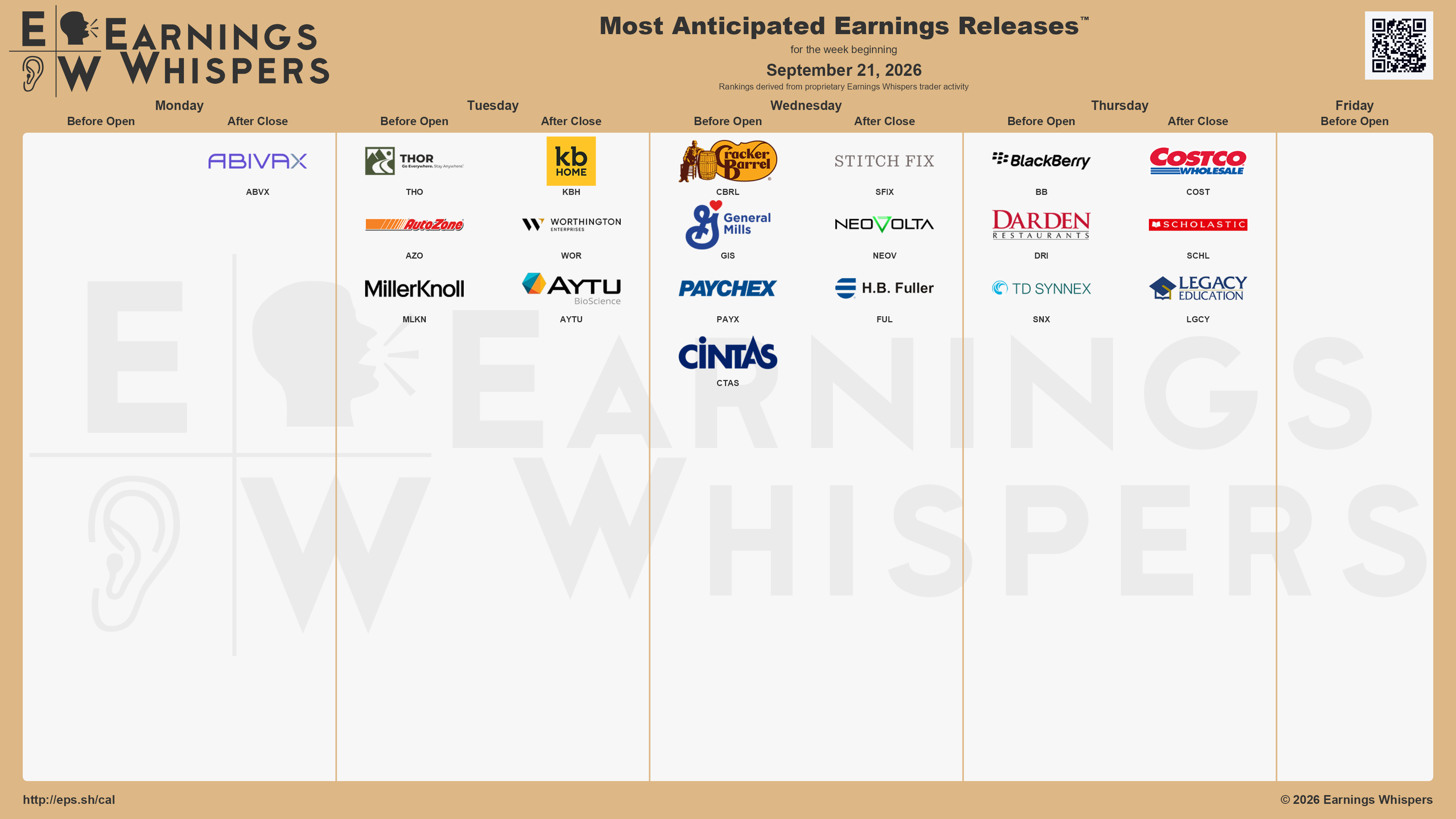
This week's earnings parade is heavy on the names that hit close to home, from the warehouse aisles of Costco to the dinner tables served by Darden and General Mills. Costco remains the marquee draw, and while the crowd loves the story, the mood heading in is surprisingly cautious given how much the stock has cooled since its last report. AutoZone and cleaning-and-uniforms powerhouse Cintas round out a strong showing from the everyday-economy crowd, both riding solid operational momentum even as traders temper their enthusiasm. The wild card is Cracker Barrel, which has quietly become one of the more optimistic setups on the calendar after a rough stretch, so keep an eye on whether the old country store can serve up a surprise. History suggests these stocks tend to swing more than a percent or two when the numbers hit, so buckle up.
Beyond the household names, the week offers a grab bag of smaller stories worth watching. RV maker THOR Industries and homebuilder KB Home give us a read on how Americans are feeling about big-ticket purchases, though the vibes around housing look decidedly mixed. In tech, BlackBerry and TD SYNNEX are quietly building goodwill, with SYNNEX in particular showing the kind of steady improvement that tends to reward patient investors. Then there are the true dice-rolls: Stitch Fix and battery upstart NeoVolta both carry the potential for outsized fireworks, meaning a single headline could send them soaring or sinking. Toss in Paychex, Darden, and a scattering of specialty names, and you have a week where the boring blue chips and the speculative flyers are competing for the spotlight. As always, the real drama is not just whether companies beat expectations, but whether they can keep the good times rolling.
Costco's Cart Is Full, But Watch the Margins at Checkout
Costco Wholesale (COST) is set to report earnings on Thursday, September 24, 2026 at around 4:15 PM ET. Wall Street is looking for $6.48 per share on revenue of $94.78 billion, which would be a healthy 10.0% jump in sales from a year ago, while the Earnings Whisper number sits a touch higher at $6.54 per share. Here is the odd part: investors are feeling grumpy heading in, yet 72.7% still expect the company to beat. Short sellers have upped their bets by 3.0% since last quarter, and the stock has slid 9.3% since its last earnings pop to land 6.8% under its 200 day moving average of $960.18. Option traders are betting on a 3.8% swing, a bit bigger than the 2.9% Costco usually delivers. One eyebrow-raiser: on September 11 someone scooped up 1,538 of the $680 puts expiring October 2, a clear wager that the warehouse could get a little chilly.
Here is the real story going into the print. Last quarter Costco stepped on the gas, literally, with sales growth accelerating to 11.6%, its fastest in a year, helped by record-breaking fuel volumes and steady core shopping. Memberships keep climbing, the renewal rate finally ticked back up, and pharmacy sales are riding the GLP-1 weight-loss wave. The catch is margins. Management chose to eat lower prices on eggs and beef to keep members loyal, so core margins dipped for the first time in a while, and they trimmed the number of new stores opening this year. None of that is weak demand, it is Costco playing the long game the way it always has. Watch whether they keep sacrificing a little margin to win the shopper, because that trade-off is the whole ballgame this quarter.

THOR's RV Ride Gets Bumpy Ahead of Earnings
THOR Industries (THO) rolls out its earnings report before the bell on Tuesday, September 22, 2026, at around 6:30 AM ET. Wall Street is looking for $0.95 per share on $2.15 billion in revenue, which would be a 14.8% drop from a year ago, though the Earnings Whisper number sits a touch higher at $0.99. Despite the shrinking sales, the mood is surprisingly upbeat, with 54.5% of investors betting on a beat. Option traders are bracing for a 10.6% swing in either direction, a bit spicier than the 7.1% average move THOR has served up in recent quarters.
Here is where it gets interesting. The bears have been circling, with short interest jumping 19.7% since last quarter, and the stock has slid to sit 22.4% below its 200 day moving average of $87.28. Earnings estimates have been trimmed across the board, and on Friday someone made a notable bet buying 1,738 of the $70.00 puts expiring in January 2027. In short, the crowd is split, the stock is limping, and a handful of traders are clearly positioning for more pain.
ABIVAX: Bears Circling as Short Sellers Pile In
ABIVAX Société Anonyme (ABVX) steps up to the earnings plate on Monday, September 21, 2026, right around 4:05 PM ET. Wall Street is bracing for a loss of $1.08 per share on revenue of just $1.86 million. The mood heading in is downright gloomy, though nobody is expecting fireworks either way, just results that land close to the mark. The real story here is the short sellers, who have swarmed in with short interest up a jaw dropping 173.5% since last quarter. Meanwhile the stock has quietly slid 17.0% from where it opened after the last report, leaving it 11.7% below its 200 day moving average of $118.98. Analysts have been trimming their estimates too, so the wind is not exactly at this company's back.
Here is the twist worth watching. Even with all the pessimism, someone is placing a big bet on the upside. On Tuesday, August 11, 2026, a hefty 4,149 contracts of the $200.00 calls expiring December 18, 2026 changed hands. That is a bold wager the stock could rocket higher. Options traders are penciling in an 11.4% swing on this report, which is a good bit larger than the 7.4% average move ABIVAX has served up in recent quarters. Translation: expect this one to move, and possibly move hard.
Cracker Barrel's Comeback Story Faces Its Toughest Test Yet
Cracker Barrel Old Country Store (CBRL) is set to serve up earnings on Wednesday, September 23, 2026 at around 8:00 AM ET. Wall Street is looking for $0.20 per share on revenue of $831.12 million, a 4.2% dip from last year, but the whisper number is a tastier $0.29. Folks are feeling good heading in, with 37.5% betting on a beat. Short sellers have backed off, cutting their bets by 15.0% since last quarter, while the stock has climbed 3.6% and now sits a hefty 19.0% above its 200 day average of $37.86. Analysts have been nudging their numbers higher, and options traders are bracing for a 10.1% swing, roughly in line with the 8.3% average move of recent quarters. And someone made a big bet on September 3rd, scooping up 4,124 of the $55.00 calls expiring October 16th.
Here is the real story: this chain has clawed its way back from the ugly logo mess of last August, and the recovery is no fluke. Restaurant sales have improved for three straight quarters, profits have gone from a measly $7.2 million to over $40 million, and management got confident enough to hike its full-year profit outlook by more than 30%. Retail even outsold the restaurants for the first time in over four years, and loyalty members hit about 12 million. But do not pop the champagne yet. People are still walking through the doors less often, gas prices are pinching wallets, tariffs are squeezing the gift shop, and here is the kicker, this quarter faces a much tougher comparison than the last few. So even if the business keeps healing, the headline numbers could look uglier than the actual progress. Watch the tone more than the traffic.
BlackBerry Hits Cruise Control: QNX Rides the AI Wave
BlackBerry Limited (BB) is confirmed to report earnings on Thursday, September 24, 2026 at approximately 7:00 AM ET. Wall Street is looking for $0.04 per share on revenue of $143.00 million, which would be a healthy 10.3% jump from a year ago, and the Earnings Whisper number lines up at $0.04 per share. That fits neatly inside the company's own guidance of $0.03 to $0.04 per share on $137.00 million to $148.00 million in revenue. Here's the funny part: investors are walking in nervous, yet a full half of them still expect a beat. The doubters have been busy too, with short interest climbing 11.4% since last quarter as the stock slid 17.8% from where it opened after the last report. Even after that slide, shares sit a comfy 30.1% above their 200 day average of $6.14. Estimates haven't budged since last time, option traders are bracing for a 14.0% swing, and the stock has actually averaged a 11.9% move lately. One bold soul on September 14 scooped up 4,094 of the $12.00 calls expiring October 16, betting the ride keeps going.
The real story is QNX, BlackBerry's software that runs cars and machines. Last quarter it grew 26% with fat 86% margins, and NVIDIA just decided to build its entire physical AI safety stack on it, which is a big vote of confidence. Development licenses hit an eight quarter high, and those are the seeds that grow into future royalty checks. The one thing to watch is the secure communications side. A one time Canadian government deal juiced last quarter to $74 million, and management already warned that number drops back to $57 to $63 million this time. So if you see revenue dip sequentially, don't panic, it was flagged in advance. Everything else, from raised full year targets to the first cash positive first quarter in nine years, points the same direction: up.
KB Home: Building Back Better, But the Buyers Are MIA
KB Home (KBH) is set to report earnings on Tuesday, September 22, 2026 at about 4:10 PM ET. Wall Street is looking for $0.88 per share on revenue of $1.29 billion, which would be a 20.4% drop from a year ago, while the Earnings Whisper number sits a touch lower at $0.85. The company had guided revenue between $1.20 billion and $1.35 billion, so it's a wide net. Investors are walking in grumpy and bearish, though oddly enough 62.5% still expect a beat. Short sellers have piled on a bit more, up 3.9% since last quarter, and the stock has slid 16.9% since its last earnings pop, now sitting 15.8% below its 200 day average of $55.94. Options traders are bracing for a big 12.6% swing, more than double the 5.5% the stock usually moves. Last Friday, some traders made notable bets, snapping up 2,680 of the $45 puts and 2,544 of the $55 calls expiring October 16, so the crowd is split on which way this thing breaks.
Here's the real story: KB Home is quietly fixing its engine while the car is still stuck in traffic. Their shift back to build-to-order homes is clearly working, with that order mix climbing to 73%, backlog jumping 26% in a single quarter, and build times now down to a decade-best 100 days. Management even rolled out full-year margin guidance for the first time, promising a step-up into the back half. The catch? The spring selling season was a dud, with March especially weak thanks to high mortgage rates and jittery buyers, and the company trimmed its full-year outlook yet again. Margins are still shrinking year over year, lumber costs are creeping back, and a shrinking lot count raises questions about 2027 and beyond. Bottom line: genuine progress under the hood, but the demand backdrop and repeated guidance cuts keep us cautious heading into the print.
AutoZone Heads Into Earnings With Growth in Gear but Bears Circling
AutoZone (AZO) is set to report earnings before the bell on Tuesday, September 22, 2026, at roughly 6:55 AM ET. Wall Street is looking for $54.78 per share on $6.71 billion in revenue, which would be a solid 7.5% jump in sales from a year ago, while the Earnings Whisper number sits a touch lower at $54.26. The mood going in is glum, though it's a split crowd, with 57.1% still betting on a beat. The skeptics have been busy: short interest has jumped 26.0% since last quarter, the stock has slid 11.2% since its last report, and it's now trading 14.5% below its 200 day moving average of $3,339.20. Analysts have also been trimming their estimates. Options traders are bracing for a 4.7% swing, a little bigger than the 4.3% average move of recent quarters, so buckle up.
Here's the twist that makes the bearish setup interesting: last quarter told a genuinely upbeat story. Sales grew 8.4%, the fastest clip in over three years, the do-it-yourself business finally re-accelerated as AutoZone grabbed market share, and the commercial side kept churning out double-digit growth. Management sped up store openings to about 365 for the year and cranked mega hub construction into overdrive, all while sounding downright confident under new CEO Phil Danielle. The catch is that a cool, wet May cooled off the last couple weeks, the international business (especially Mexico) is losing steam, and inflation that padded tickets is fading heading into Q4. So the real question this report answers is simple: was that late-quarter weather dip just noise, or the start of something the bears saw coming?
Darden's Beef Nightmare Is Finally Turning Into a Buffet
Darden Restaurants (DRI), the folks behind Olive Garden and LongHorn, dish up earnings before the bell on Thursday, September 24, 2026. Wall Street is looking for $2.06 per share on $3.20 billion in revenue, which is 5.1% more sales than a year ago, while the Earnings Whisper number sits a touch higher at $2.09. Investors are walking in a little gloomy, yet 71.4% still expect a beat, which is a funny way to be bearish. Short interest has jumped 18.0% since last quarter even though the stock has barely budged, drifting down 0.4% and now sitting 3.2% above its 200 day moving average of $202.73. Estimates have actually been nudged higher lately, options traders are bracing for a 7.0% swing versus the usual 3.1% move, and someone made a bold long-term bet with 535 of the $300 calls that run all the way out to September 2027.
Here is the real story. For most of the past year, sky-high beef prices squeezed Darden's margins, but that headwind is flipping into a tailwind. Management now sees beef inflation dropping to low single digits in FY27, even a little deflation next quarter, after roughly 12% last year. That is a huge deal for a company that grills a lot of steaks. Sales just topped $13 billion for the first time, margins bounced back in the fourth quarter, and they raised the dividend 8% while opening more restaurants. The catch is a deliberately cautious sales outlook of 2.5% to 3.5% growth after a strong 4.5% last year, plus some near-term cost noise this quarter and a little softness among younger diners. Bottom line, the momentum is real and the tone is confident, so watch whether guidance stays this conservative or management admits things are cooking better than they let on.
MillerKnoll: New Boss, Same Growing Pains
MillerKnoll reports before the market opens, and Wall Street is bracing itself. The consensus calls for earnings of $0.35 per share on revenue of $942.70 million, a slip of 1.4% from a year ago, though the Earnings Whisper number is a touch brighter at $0.37. Management had guided to $0.33 to $0.39 per share on revenue between $928.00 million and $968.00 million, so there is plenty of room to land the plane. Investors are leaning bearish here, with only 14.3% betting on a beat. The doubters have been busy too, as short interest has jumped 33.1% since last quarter. Yet oddly enough the stock has climbed 13.3% since its last earnings open and now sits 8.9% above its 200 day average of $18.98. Overall estimates have been trimmed since last quarter, and option traders are pricing in a 13.9% swing, right in line with the 12.7% average move of late.
The real story is in the corner office. New interim CEO Jeff Stutz took the reins last quarter and, unlike his relentlessly sunny predecessor, said out loud that performance 'is not where we want it to be.' That is refreshing honesty, but it also tells you the mood has shifted. North America contract sales are still the workhorse, revenue keeps grinding higher, and the fresh FY27 plan of roughly 5% sales growth is encouraging. The problem child is international, where margins cratered nearly 5 points on Middle East and Europe softness, plus the Holly Hunt brand needs a full fixer-upper. Add a shrinking backlog and creeping debt, and you get a company that is growing on top but wobbly underneath. Watch the tone as closely as the numbers.
General Mills: The Cereal Aisle's Long Slog Continues
General Mills (GIS) steps up to the plate Wednesday, September 23, 2026 at around 7:00 AM ET, and Wall Street is bracing for a soft one. The consensus calls for $0.72 per share on $4.33 billion in revenue, a 4.2% drop from last year, while the Earnings Whisper number sits a touch higher at $0.74. Investors are leaning bearish, though a solid 66.7% still expect a beat. Here is the odd part: short interest has actually dropped 12.0% since last quarter, yet the stock has drifted 3.7% lower and now trades 7.9% under its 200 day average of $39.46, with estimates being trimmed across the board. Options traders are betting on a 9.4% swing, well above the 3.8% average move of recent quarters, and on Friday someone scooped up 13,365 of the $35.00 puts expiring November 20, which is not exactly a vote of confidence.
Here is what to keep your eye on. Last quarter management basically told us FY27 is another transition year, not a comeback tour. The good news is their price reset worked, with base volumes swinging from down 10% to up about 1%, and innovation is clicking with Cheerios Protein now a $100 million business. The bad news is they guided categories to roughly flat, organic sales still falling, and inflation jumping to 4-5% from the 3% they talked about earlier. They also warned that this first quarter would come in below the full-year pace thanks to timing and the yogurt sale. Add in a fresh $3 billion cost-cutting plan and modest margin pressure, and the message is clear: they are building a foundation, not lighting a rocket. Watch the guidance tone closely, because if it slips even a notch from last quarter's already lowered bar, that put buyer looks awfully smart.
Stitch Fix Finally Sews Up Some Growth, But Can It Hold?
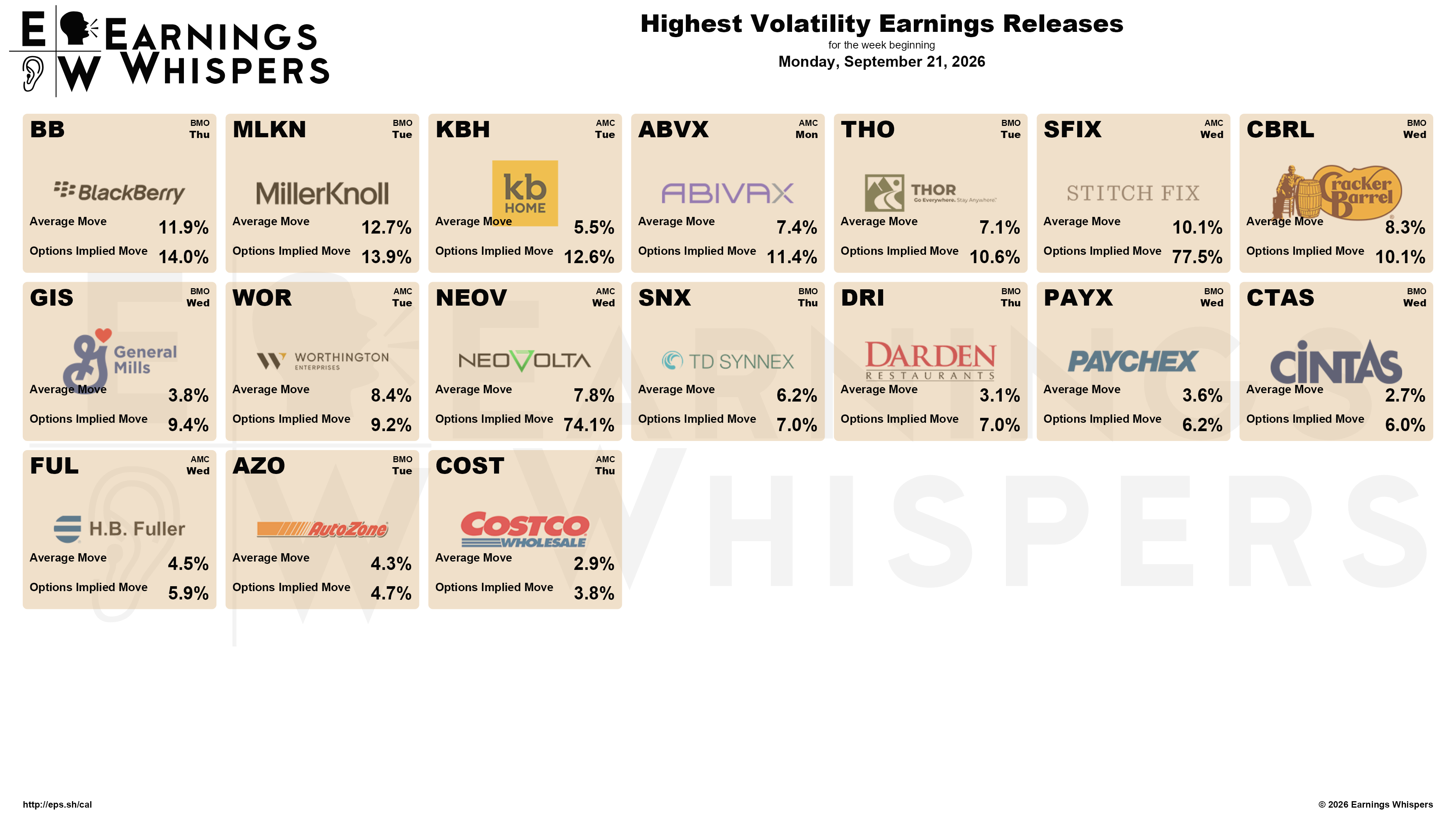
Stitch Fix (SFIX) reports after the bell on Wednesday, September 23, 2026, at about 4:05 PM ET, and Wall Street is bracing for a loss of $0.06 per share on revenue of $324.97 million, up 4.4% from a year ago. That lands right in the middle of the company's own guidance of $322 to $327 million, so nobody should be shocked here. Sentiment is cautiously hopeful, with a quarter of watchers betting on a beat. Meanwhile the short sellers have backed off, cutting their bets by 19.4% since last quarter, yet the stock has still drifted 25.8% lower since that last report and sits 27.3% under its 200-day average of $3.91. Estimates haven't budged, but don't get too comfortable: this stock has swung an average of 10.1% after recent prints. One eyebrow-raiser came Friday, September 18, when someone scooped up 1,814 of the $10 calls expiring in January 2028, a long-shot bet that this turnaround has real legs.
Here's what actually matters going in. Last quarter Stitch Fix cleared a big psychological hurdle by adding customers again for the first time in ages, up 21,000, and management raised both its revenue and profit targets for the third straight call while buying back stock. That's the good news. The catch is that revenue growth is slowing down, cooling to 4.7% from 9.4% the quarter before as easy comparisons run out, and management has started talking a lot more nervously about a jittery shopper and pricier customer acquisition. So the real question Wednesday is simple: is the comeback still building steam, or did last quarter's client growth turn out to be a one-time party trick?
AI Boom Powers Winners as Housing and Travel Feel the Squeeze
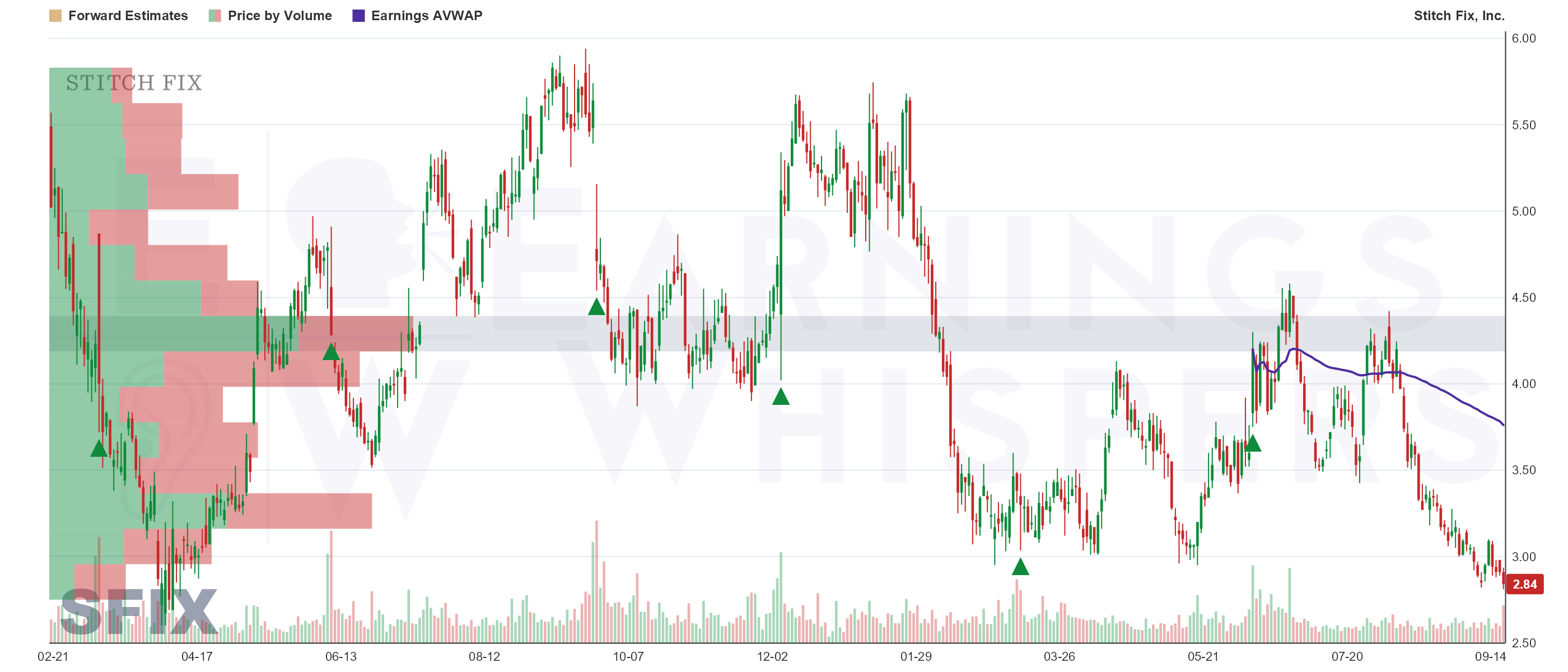
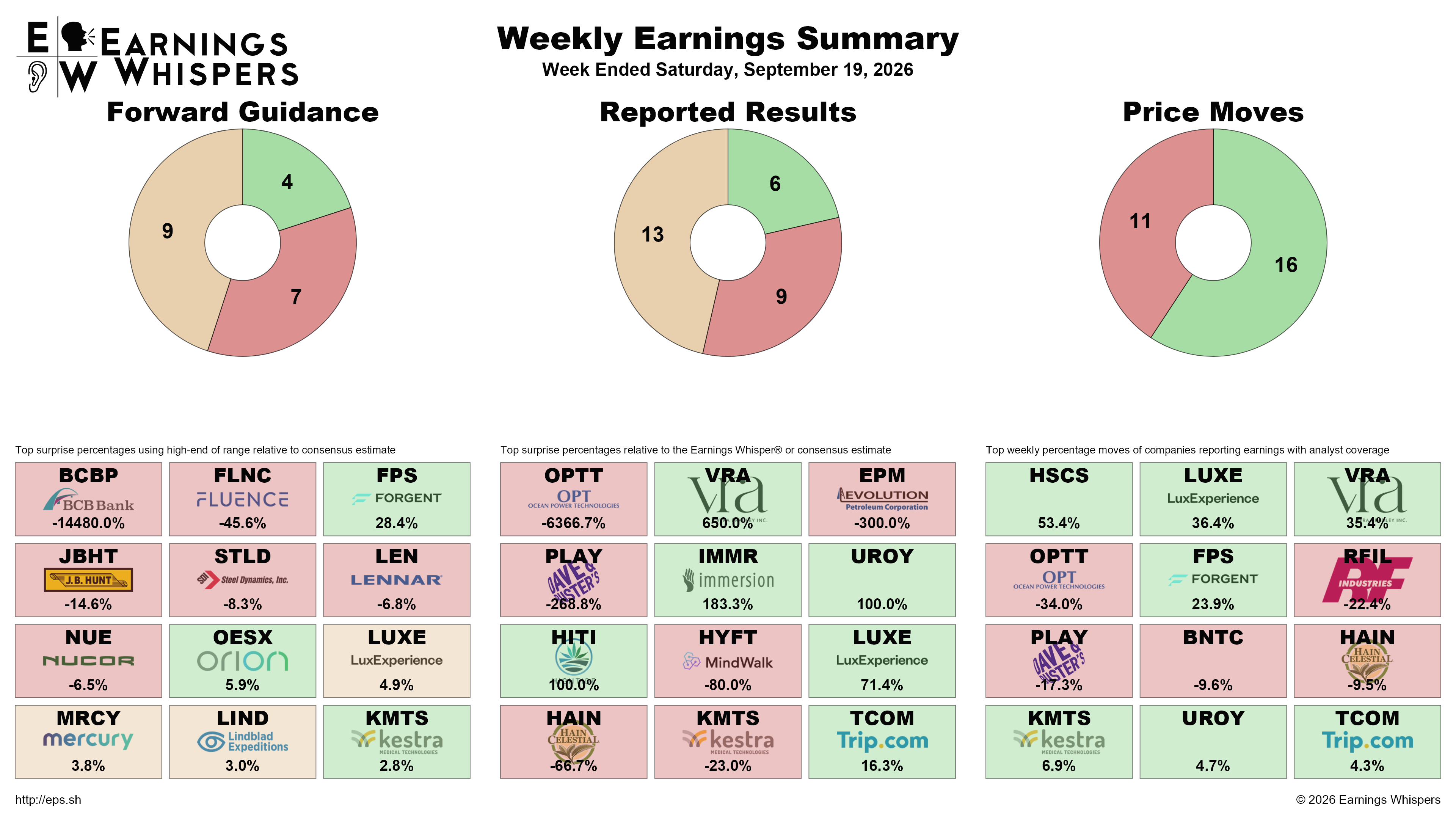
Last week's earnings served up a clear split screen between the companies riding the artificial intelligence wave and those getting knocked around by higher interest rates and cautious shoppers. The standout was Forgent (FPS), which capped its best quarter ever with revenue nearly doubling to a record $462 million and its third straight guidance raise. The company landed its first orders from a frontier AI lab and signed a deal with a hyperscaler, sending its stock up 24 percent for the week to close near $39. Backlog ballooned to $3 billion, roughly double a year ago, and management set an aggressive road map for next year that runs a full year ahead of what it promised at its IPO. This is what firing on all cylinders looks like, and investors rewarded it accordingly. Meanwhile, homebuilder Lennar (LEN) told the other side of the story. Despite quietly impressive behind-the-scenes work, cutting construction costs and building homes faster than ever, the company got hit by the ugly math of mortgage rates climbing toward 7 percent. Management flatly called the market 'more difficult than in June,' trimmed its delivery targets, and warned that a flood of resale homes in Texas and Florida is stealing buyers. The stock slipped about 4 percent, a reminder that even the best operators can only do so much when the macro turns against them.
Elsewhere, the theme was turnarounds quietly taking hold, even when the headline numbers looked messy. Luxury retailer Mydecine parent LUXE was the week's other big winner, jumping 36 percent after all three of its business segments returned to growth for the first time since it acquired the struggling Net-a-Porter and Mr Porter labels. Management added Fendi and Piaget to its roster, announced a share buyback, and issued upbeat guidance, marking a genuine inflection point for a business that has been grinding through a painful overhaul. Vera Bradley (VRA) told a similar tale of patient progress, with its core direct-to-consumer business notching its fifth straight quarter of improvement and the brand seeing its first positive Google search growth in over a decade, though a deliberate reset of its wholesale channel dragged total sales nearly flat. On the more cautious end, travel giant Trip.com (TCOM) saw growth cool sharply to just 6 percent as a hefty one-time regulatory penalty and softer domestic demand offset its still-booming international and AI-powered booking businesses. And Dave & Buster's (PLAY) offered a truly mixed bag: sales trends and cash flow are healing, but profits fell hard and the company shuffled both its CEO and CFO in the span of three months, leaving investors unsure whether the arcade model has finally found its footing. The stock tumbled 17 percent as Wall Street weighed the improving traffic against the shrinking bottom line.
Trip.com Beats on Paper, but the Growth Engine Is Sputtering
Trip.com Group Limited (TCOM) reported earnings of $1.07 per share on revenue of $2.31 billion for the second quarter ended June 2026. The consensus earnings estimate was $0.98 per share on revenue of $2.29 billion, and the Earnings Whisper number was $0.92. On the surface that is a tidy 16.30% earnings beat with revenue up 20.84% from a year ago, and management leaned into its "G2" plan of Globalization and Great Quality, with Executive Chairman James Liang talking up new AI tools spread across every step of the trip. As a reminder, Trip.com is a leading one-stop travel platform that bundles together a full menu of travel products, services, and content. Sounds great. Look under the hood, though, and the ride gets bumpy.
Here is the part that actually matters. Group revenue growth in local currency slowed to a crawl at just +6% year over year, a nasty drop from the +17% last quarter and the low-20s the quarter before that. The company also swallowed a one-off 5.18 billion yuan antitrust penalty from Chinese regulators, transportation ticketing revenue actually went backwards at -1% as high fuel prices and pricey airfares bit into demand, and management is ripping up its old domestic partner programs and openly warning of near-term turbulence at home. It is not all storm clouds: international bookings still grew 50%+, inbound travel is booming, the AI assistant TripGenie saw orders jump 400%, and the regulatory cloud that had hung around since January is finally gone. Bottom line, the global story is intact, but China is stalling and the numbers are cooling fast. Buckle up.

Forgent Powers Up: Record Quarter, AI Giants Come Knocking
Forgent Power Solutions (FPS) closed out its fiscal fourth quarter with earnings of $0.24 per share on revenue of $461.67 million, landing right in line with what Wall Street expected. Analysts had penciled in $0.22 per share on $425.58 million, and the Earnings Whisper number was $0.24, so the profit was on the nose while sales blew past the mark. But the real fireworks were in the guidance: management now sees fiscal 2027 earnings of $1.26 to $1.40 per share on revenue of $2.4 billion to $2.6 billion, towering over the consensus of $1.09 per share on $2.0 billion. CEO Gary Niederpruem summed up the vibe nicely, noting that demand for electrical distribution gear is booming and that Forgent booked over $1.5 billion in orders in a single quarter, more than the company sold in the entire year. In plain terms, they are not just riding the wave, they are surfing ahead of it.
Here is what really matters. Forgent makes the electrical guts that keep data centers, the power grid, and heavy industry running, and the AI boom is turning that into a gold rush. This quarter the company landed its first direct order from a frontier AI lab and signed a deal with a major hyperscaler, giving it a foot in the door of the biggest untapped market out there. Backlog has ballooned to $3 billion, double last year's sales, and they are adding a new Tijuana plant to lift capacity to roughly $5.8 billion. The only speed bumps worth mentioning are about $10 million in one-time startup costs that will dent first-quarter margins, and revenue that leans toward the back half of next year. This has quietly become one of the strongest growth stories in the space, and it keeps beating its own raised targets.
Lennar Runs a Tight Ship Into a Rising Storm
Lennar (LEN) came in light for its fiscal third quarter ended August 2026, posting earnings of $1.23 per share on $8.05 billion in revenue. Wall Street wanted $1.29 per share on $8.33 billion, and the Earnings Whisper crowd was hoping for $1.28. So the company missed the mark by about 3.9 percent, and revenue slid 8.67 percent from a year ago. Looking ahead, Lennar guided fourth-quarter homebuilding revenue to a range of $8.14 billion to $8.74 billion, well below the $9.38 billion analysts were penciling in. CEO Stuart Miller put it plainly, admitting results landed below expectations and that the environment has gotten worse since the last call. Translation: the housing market picked a fight, and it is not playing fair.
Here is the real story. Lennar is actually doing a great job with the stuff it can control. Homes are getting built faster than ever at a record 116 days, construction costs are down, sales sweeteners are shrinking, and unsold inventory is lean. The problem is everything outside the front door. Mortgage rates climbed toward 7 percent, the Fed hiked instead of cutting, and a flood of resale homes is piling up in Texas and Florida, which happen to be Lennar's two biggest markets. Toss in tighter labor from immigration enforcement and data center building, plus roughly half of shoppers who cannot qualify to buy, and you can see why management trimmed both order and delivery targets. The good news is that fat 12 percent incentive level gives Lennar plenty of room to bounce back once the skies clear. For now, though, this is a well-run company being asked to defy gravity.
Dave & Buster's: The Comeback Is Real, But So Is the Boardroom Reshuffle
Dave & Buster's (PLAY) posted a loss of $0.27 per share on revenue of $544.10 million for the fiscal second quarter ended July 2026, whiffing badly on the consensus call of $0.19 per share and $561.26 million, while the Earnings Whisper number sat at $0.16. Put plainly, the company missed the earnings bar by a whopping 269%, and revenue slipped 2.39% from a year ago. New CEO Darin Harper, the former finance chief who just grabbed the corner office, struck an upbeat tone: "We are energized by the obvious, actionable, and enormous opportunities ahead for Dave & Buster's and Main Event." He leaned on the Back-to-Basics plan, growing food and beverage sales, strong special events, remodels that keep outrunning the rest of the chain, and same store sales that got better in July and better still early in the third quarter. Dave & Buster's runs those big, loud venues where dining meets arcades for grown-ups and families across North America.
Here is the real story. The trend line is genuinely healing, with same store sales climbing from down 5.4% to down 2.9%, July at just down 1.6%, and cash flow swinging a huge $56 million to the good side of the ledger. But the profit engine is coughing, as adjusted profits fell to $98.9 million from $129.7 million and margins got shaved by five full points. Meanwhile the game business, the whole point of the place, has now shrunk for roughly eight quarters straight, prompting an analyst to flat out ask if the model is broken. Add in a fresh CEO and an interim finance boss changing seats within three months, a quietly abandoned cash flow target, and plans to build fewer new stores, and you get a company that is clearly winning back customers but still figuring out how to make it pay. Momentum up, math still messy.
High Tide's Best Quarter Ever, With Germany Doing the Heavy Lifting
High Tide (HITI) just posted earnings of $0.02 per share on revenue of $143.62 million for its fiscal third quarter ended July 2026. Wall Street was looking for a penny on $140.28 million, so the company doubled the profit estimate and beat on the top line too, with revenue up a healthy 31.86% from a year ago. For those new to the name, High Tide is a retail-focused cannabis company that also makes and distributes the accessories people use to consume it, think pipes, bongs, and everything in between.
Management called this the best quarter in company history, and the numbers back up the bragging. Nearly every metric hit an all-time high, and profit is finally catching up to sales, which is the part investors have been waiting years for. The real star is Germany, where the Ramexian business is booming and ramped up faster than anyone expected. The one soft spot is back home in Canada, where shoppers are pinching pennies and buying cheaper ounce bags, so store-level sales have gone flat. Still, that is a small cloud over an otherwise sunny report, and the company even pre-released guidance a day after the quarter closed with a floor above the most bullish forecasts. When a company rushes to show its homework, it usually means the grade is good.
Beyond the household names, the week offers a grab bag of smaller stories worth watching. RV maker THOR Industries and homebuilder KB Home give us a read on how Americans are feeling about big-ticket purchases, though the vibes around housing look decidedly mixed. In tech, BlackBerry and TD SYNNEX are quietly building goodwill, with SYNNEX in particular showing the kind of steady improvement that tends to reward patient investors. Then there are the true dice-rolls: Stitch Fix and battery upstart NeoVolta both carry the potential for outsized fireworks, meaning a single headline could send them soaring or sinking. Toss in Paychex, Darden, and a scattering of specialty names, and you have a week where the boring blue chips and the speculative flyers are competing for the spotlight. As always, the real drama is not just whether companies beat expectations, but whether they can keep the good times rolling.
Costco's Cart Is Full, But Watch the Margins at Checkout
Costco Wholesale (COST) is set to report earnings on Thursday, September 24, 2026 at around 4:15 PM ET. Wall Street is looking for $6.48 per share on revenue of $94.78 billion, which would be a healthy 10.0% jump in sales from a year ago, while the Earnings Whisper number sits a touch higher at $6.54 per share. Here is the odd part: investors are feeling grumpy heading in, yet 72.7% still expect the company to beat. Short sellers have upped their bets by 3.0% since last quarter, and the stock has slid 9.3% since its last earnings pop to land 6.8% under its 200 day moving average of $960.18. Option traders are betting on a 3.8% swing, a bit bigger than the 2.9% Costco usually delivers. One eyebrow-raiser: on September 11 someone scooped up 1,538 of the $680 puts expiring October 2, a clear wager that the warehouse could get a little chilly.
Here is the real story going into the print. Last quarter Costco stepped on the gas, literally, with sales growth accelerating to 11.6%, its fastest in a year, helped by record-breaking fuel volumes and steady core shopping. Memberships keep climbing, the renewal rate finally ticked back up, and pharmacy sales are riding the GLP-1 weight-loss wave. The catch is margins. Management chose to eat lower prices on eggs and beef to keep members loyal, so core margins dipped for the first time in a while, and they trimmed the number of new stores opening this year. None of that is weak demand, it is Costco playing the long game the way it always has. Watch whether they keep sacrificing a little margin to win the shopper, because that trade-off is the whole ballgame this quarter.
THOR's RV Ride Gets Bumpy Ahead of Earnings
THOR Industries (THO) rolls out its earnings report before the bell on Tuesday, September 22, 2026, at around 6:30 AM ET. Wall Street is looking for $0.95 per share on $2.15 billion in revenue, which would be a 14.8% drop from a year ago, though the Earnings Whisper number sits a touch higher at $0.99. Despite the shrinking sales, the mood is surprisingly upbeat, with 54.5% of investors betting on a beat. Option traders are bracing for a 10.6% swing in either direction, a bit spicier than the 7.1% average move THOR has served up in recent quarters.
Here is where it gets interesting. The bears have been circling, with short interest jumping 19.7% since last quarter, and the stock has slid to sit 22.4% below its 200 day moving average of $87.28. Earnings estimates have been trimmed across the board, and on Friday someone made a notable bet buying 1,738 of the $70.00 puts expiring in January 2027. In short, the crowd is split, the stock is limping, and a handful of traders are clearly positioning for more pain.
ABIVAX: Bears Circling as Short Sellers Pile In
ABIVAX Société Anonyme (ABVX) steps up to the earnings plate on Monday, September 21, 2026, right around 4:05 PM ET. Wall Street is bracing for a loss of $1.08 per share on revenue of just $1.86 million. The mood heading in is downright gloomy, though nobody is expecting fireworks either way, just results that land close to the mark. The real story here is the short sellers, who have swarmed in with short interest up a jaw dropping 173.5% since last quarter. Meanwhile the stock has quietly slid 17.0% from where it opened after the last report, leaving it 11.7% below its 200 day moving average of $118.98. Analysts have been trimming their estimates too, so the wind is not exactly at this company's back.
Here is the twist worth watching. Even with all the pessimism, someone is placing a big bet on the upside. On Tuesday, August 11, 2026, a hefty 4,149 contracts of the $200.00 calls expiring December 18, 2026 changed hands. That is a bold wager the stock could rocket higher. Options traders are penciling in an 11.4% swing on this report, which is a good bit larger than the 7.4% average move ABIVAX has served up in recent quarters. Translation: expect this one to move, and possibly move hard.
Cracker Barrel's Comeback Story Faces Its Toughest Test Yet
Cracker Barrel Old Country Store (CBRL) is set to serve up earnings on Wednesday, September 23, 2026 at around 8:00 AM ET. Wall Street is looking for $0.20 per share on revenue of $831.12 million, a 4.2% dip from last year, but the whisper number is a tastier $0.29. Folks are feeling good heading in, with 37.5% betting on a beat. Short sellers have backed off, cutting their bets by 15.0% since last quarter, while the stock has climbed 3.6% and now sits a hefty 19.0% above its 200 day average of $37.86. Analysts have been nudging their numbers higher, and options traders are bracing for a 10.1% swing, roughly in line with the 8.3% average move of recent quarters. And someone made a big bet on September 3rd, scooping up 4,124 of the $55.00 calls expiring October 16th.
Here is the real story: this chain has clawed its way back from the ugly logo mess of last August, and the recovery is no fluke. Restaurant sales have improved for three straight quarters, profits have gone from a measly $7.2 million to over $40 million, and management got confident enough to hike its full-year profit outlook by more than 30%. Retail even outsold the restaurants for the first time in over four years, and loyalty members hit about 12 million. But do not pop the champagne yet. People are still walking through the doors less often, gas prices are pinching wallets, tariffs are squeezing the gift shop, and here is the kicker, this quarter faces a much tougher comparison than the last few. So even if the business keeps healing, the headline numbers could look uglier than the actual progress. Watch the tone more than the traffic.
BlackBerry Hits Cruise Control: QNX Rides the AI Wave
BlackBerry Limited (BB) is confirmed to report earnings on Thursday, September 24, 2026 at approximately 7:00 AM ET. Wall Street is looking for $0.04 per share on revenue of $143.00 million, which would be a healthy 10.3% jump from a year ago, and the Earnings Whisper number lines up at $0.04 per share. That fits neatly inside the company's own guidance of $0.03 to $0.04 per share on $137.00 million to $148.00 million in revenue. Here's the funny part: investors are walking in nervous, yet a full half of them still expect a beat. The doubters have been busy too, with short interest climbing 11.4% since last quarter as the stock slid 17.8% from where it opened after the last report. Even after that slide, shares sit a comfy 30.1% above their 200 day average of $6.14. Estimates haven't budged since last time, option traders are bracing for a 14.0% swing, and the stock has actually averaged a 11.9% move lately. One bold soul on September 14 scooped up 4,094 of the $12.00 calls expiring October 16, betting the ride keeps going.
The real story is QNX, BlackBerry's software that runs cars and machines. Last quarter it grew 26% with fat 86% margins, and NVIDIA just decided to build its entire physical AI safety stack on it, which is a big vote of confidence. Development licenses hit an eight quarter high, and those are the seeds that grow into future royalty checks. The one thing to watch is the secure communications side. A one time Canadian government deal juiced last quarter to $74 million, and management already warned that number drops back to $57 to $63 million this time. So if you see revenue dip sequentially, don't panic, it was flagged in advance. Everything else, from raised full year targets to the first cash positive first quarter in nine years, points the same direction: up.
KB Home: Building Back Better, But the Buyers Are MIA
KB Home (KBH) is set to report earnings on Tuesday, September 22, 2026 at about 4:10 PM ET. Wall Street is looking for $0.88 per share on revenue of $1.29 billion, which would be a 20.4% drop from a year ago, while the Earnings Whisper number sits a touch lower at $0.85. The company had guided revenue between $1.20 billion and $1.35 billion, so it's a wide net. Investors are walking in grumpy and bearish, though oddly enough 62.5% still expect a beat. Short sellers have piled on a bit more, up 3.9% since last quarter, and the stock has slid 16.9% since its last earnings pop, now sitting 15.8% below its 200 day average of $55.94. Options traders are bracing for a big 12.6% swing, more than double the 5.5% the stock usually moves. Last Friday, some traders made notable bets, snapping up 2,680 of the $45 puts and 2,544 of the $55 calls expiring October 16, so the crowd is split on which way this thing breaks.
Here's the real story: KB Home is quietly fixing its engine while the car is still stuck in traffic. Their shift back to build-to-order homes is clearly working, with that order mix climbing to 73%, backlog jumping 26% in a single quarter, and build times now down to a decade-best 100 days. Management even rolled out full-year margin guidance for the first time, promising a step-up into the back half. The catch? The spring selling season was a dud, with March especially weak thanks to high mortgage rates and jittery buyers, and the company trimmed its full-year outlook yet again. Margins are still shrinking year over year, lumber costs are creeping back, and a shrinking lot count raises questions about 2027 and beyond. Bottom line: genuine progress under the hood, but the demand backdrop and repeated guidance cuts keep us cautious heading into the print.
AutoZone Heads Into Earnings With Growth in Gear but Bears Circling
AutoZone (AZO) is set to report earnings before the bell on Tuesday, September 22, 2026, at roughly 6:55 AM ET. Wall Street is looking for $54.78 per share on $6.71 billion in revenue, which would be a solid 7.5% jump in sales from a year ago, while the Earnings Whisper number sits a touch lower at $54.26. The mood going in is glum, though it's a split crowd, with 57.1% still betting on a beat. The skeptics have been busy: short interest has jumped 26.0% since last quarter, the stock has slid 11.2% since its last report, and it's now trading 14.5% below its 200 day moving average of $3,339.20. Analysts have also been trimming their estimates. Options traders are bracing for a 4.7% swing, a little bigger than the 4.3% average move of recent quarters, so buckle up.
Here's the twist that makes the bearish setup interesting: last quarter told a genuinely upbeat story. Sales grew 8.4%, the fastest clip in over three years, the do-it-yourself business finally re-accelerated as AutoZone grabbed market share, and the commercial side kept churning out double-digit growth. Management sped up store openings to about 365 for the year and cranked mega hub construction into overdrive, all while sounding downright confident under new CEO Phil Danielle. The catch is that a cool, wet May cooled off the last couple weeks, the international business (especially Mexico) is losing steam, and inflation that padded tickets is fading heading into Q4. So the real question this report answers is simple: was that late-quarter weather dip just noise, or the start of something the bears saw coming?
Darden's Beef Nightmare Is Finally Turning Into a Buffet
Darden Restaurants (DRI), the folks behind Olive Garden and LongHorn, dish up earnings before the bell on Thursday, September 24, 2026. Wall Street is looking for $2.06 per share on $3.20 billion in revenue, which is 5.1% more sales than a year ago, while the Earnings Whisper number sits a touch higher at $2.09. Investors are walking in a little gloomy, yet 71.4% still expect a beat, which is a funny way to be bearish. Short interest has jumped 18.0% since last quarter even though the stock has barely budged, drifting down 0.4% and now sitting 3.2% above its 200 day moving average of $202.73. Estimates have actually been nudged higher lately, options traders are bracing for a 7.0% swing versus the usual 3.1% move, and someone made a bold long-term bet with 535 of the $300 calls that run all the way out to September 2027.
Here is the real story. For most of the past year, sky-high beef prices squeezed Darden's margins, but that headwind is flipping into a tailwind. Management now sees beef inflation dropping to low single digits in FY27, even a little deflation next quarter, after roughly 12% last year. That is a huge deal for a company that grills a lot of steaks. Sales just topped $13 billion for the first time, margins bounced back in the fourth quarter, and they raised the dividend 8% while opening more restaurants. The catch is a deliberately cautious sales outlook of 2.5% to 3.5% growth after a strong 4.5% last year, plus some near-term cost noise this quarter and a little softness among younger diners. Bottom line, the momentum is real and the tone is confident, so watch whether guidance stays this conservative or management admits things are cooking better than they let on.
MillerKnoll: New Boss, Same Growing Pains
MillerKnoll reports before the market opens, and Wall Street is bracing itself. The consensus calls for earnings of $0.35 per share on revenue of $942.70 million, a slip of 1.4% from a year ago, though the Earnings Whisper number is a touch brighter at $0.37. Management had guided to $0.33 to $0.39 per share on revenue between $928.00 million and $968.00 million, so there is plenty of room to land the plane. Investors are leaning bearish here, with only 14.3% betting on a beat. The doubters have been busy too, as short interest has jumped 33.1% since last quarter. Yet oddly enough the stock has climbed 13.3% since its last earnings open and now sits 8.9% above its 200 day average of $18.98. Overall estimates have been trimmed since last quarter, and option traders are pricing in a 13.9% swing, right in line with the 12.7% average move of late.
The real story is in the corner office. New interim CEO Jeff Stutz took the reins last quarter and, unlike his relentlessly sunny predecessor, said out loud that performance 'is not where we want it to be.' That is refreshing honesty, but it also tells you the mood has shifted. North America contract sales are still the workhorse, revenue keeps grinding higher, and the fresh FY27 plan of roughly 5% sales growth is encouraging. The problem child is international, where margins cratered nearly 5 points on Middle East and Europe softness, plus the Holly Hunt brand needs a full fixer-upper. Add a shrinking backlog and creeping debt, and you get a company that is growing on top but wobbly underneath. Watch the tone as closely as the numbers.
General Mills: The Cereal Aisle's Long Slog Continues
General Mills (GIS) steps up to the plate Wednesday, September 23, 2026 at around 7:00 AM ET, and Wall Street is bracing for a soft one. The consensus calls for $0.72 per share on $4.33 billion in revenue, a 4.2% drop from last year, while the Earnings Whisper number sits a touch higher at $0.74. Investors are leaning bearish, though a solid 66.7% still expect a beat. Here is the odd part: short interest has actually dropped 12.0% since last quarter, yet the stock has drifted 3.7% lower and now trades 7.9% under its 200 day average of $39.46, with estimates being trimmed across the board. Options traders are betting on a 9.4% swing, well above the 3.8% average move of recent quarters, and on Friday someone scooped up 13,365 of the $35.00 puts expiring November 20, which is not exactly a vote of confidence.
Here is what to keep your eye on. Last quarter management basically told us FY27 is another transition year, not a comeback tour. The good news is their price reset worked, with base volumes swinging from down 10% to up about 1%, and innovation is clicking with Cheerios Protein now a $100 million business. The bad news is they guided categories to roughly flat, organic sales still falling, and inflation jumping to 4-5% from the 3% they talked about earlier. They also warned that this first quarter would come in below the full-year pace thanks to timing and the yogurt sale. Add in a fresh $3 billion cost-cutting plan and modest margin pressure, and the message is clear: they are building a foundation, not lighting a rocket. Watch the guidance tone closely, because if it slips even a notch from last quarter's already lowered bar, that put buyer looks awfully smart.
Stitch Fix Finally Sews Up Some Growth, But Can It Hold?
Stitch Fix (SFIX) reports after the bell on Wednesday, September 23, 2026, at about 4:05 PM ET, and Wall Street is bracing for a loss of $0.06 per share on revenue of $324.97 million, up 4.4% from a year ago. That lands right in the middle of the company's own guidance of $322 to $327 million, so nobody should be shocked here. Sentiment is cautiously hopeful, with a quarter of watchers betting on a beat. Meanwhile the short sellers have backed off, cutting their bets by 19.4% since last quarter, yet the stock has still drifted 25.8% lower since that last report and sits 27.3% under its 200-day average of $3.91. Estimates haven't budged, but don't get too comfortable: this stock has swung an average of 10.1% after recent prints. One eyebrow-raiser came Friday, September 18, when someone scooped up 1,814 of the $10 calls expiring in January 2028, a long-shot bet that this turnaround has real legs.
Here's what actually matters going in. Last quarter Stitch Fix cleared a big psychological hurdle by adding customers again for the first time in ages, up 21,000, and management raised both its revenue and profit targets for the third straight call while buying back stock. That's the good news. The catch is that revenue growth is slowing down, cooling to 4.7% from 9.4% the quarter before as easy comparisons run out, and management has started talking a lot more nervously about a jittery shopper and pricier customer acquisition. So the real question Wednesday is simple: is the comeback still building steam, or did last quarter's client growth turn out to be a one-time party trick?
AI Boom Powers Winners as Housing and Travel Feel the Squeeze
Last week's earnings served up a clear split screen between the companies riding the artificial intelligence wave and those getting knocked around by higher interest rates and cautious shoppers. The standout was Forgent (FPS), which capped its best quarter ever with revenue nearly doubling to a record $462 million and its third straight guidance raise. The company landed its first orders from a frontier AI lab and signed a deal with a hyperscaler, sending its stock up 24 percent for the week to close near $39. Backlog ballooned to $3 billion, roughly double a year ago, and management set an aggressive road map for next year that runs a full year ahead of what it promised at its IPO. This is what firing on all cylinders looks like, and investors rewarded it accordingly. Meanwhile, homebuilder Lennar (LEN) told the other side of the story. Despite quietly impressive behind-the-scenes work, cutting construction costs and building homes faster than ever, the company got hit by the ugly math of mortgage rates climbing toward 7 percent. Management flatly called the market 'more difficult than in June,' trimmed its delivery targets, and warned that a flood of resale homes in Texas and Florida is stealing buyers. The stock slipped about 4 percent, a reminder that even the best operators can only do so much when the macro turns against them.
Elsewhere, the theme was turnarounds quietly taking hold, even when the headline numbers looked messy. Luxury retailer Mydecine parent LUXE was the week's other big winner, jumping 36 percent after all three of its business segments returned to growth for the first time since it acquired the struggling Net-a-Porter and Mr Porter labels. Management added Fendi and Piaget to its roster, announced a share buyback, and issued upbeat guidance, marking a genuine inflection point for a business that has been grinding through a painful overhaul. Vera Bradley (VRA) told a similar tale of patient progress, with its core direct-to-consumer business notching its fifth straight quarter of improvement and the brand seeing its first positive Google search growth in over a decade, though a deliberate reset of its wholesale channel dragged total sales nearly flat. On the more cautious end, travel giant Trip.com (TCOM) saw growth cool sharply to just 6 percent as a hefty one-time regulatory penalty and softer domestic demand offset its still-booming international and AI-powered booking businesses. And Dave & Buster's (PLAY) offered a truly mixed bag: sales trends and cash flow are healing, but profits fell hard and the company shuffled both its CEO and CFO in the span of three months, leaving investors unsure whether the arcade model has finally found its footing. The stock tumbled 17 percent as Wall Street weighed the improving traffic against the shrinking bottom line.
Trip.com Beats on Paper, but the Growth Engine Is Sputtering
Trip.com Group Limited (TCOM) reported earnings of $1.07 per share on revenue of $2.31 billion for the second quarter ended June 2026. The consensus earnings estimate was $0.98 per share on revenue of $2.29 billion, and the Earnings Whisper number was $0.92. On the surface that is a tidy 16.30% earnings beat with revenue up 20.84% from a year ago, and management leaned into its "G2" plan of Globalization and Great Quality, with Executive Chairman James Liang talking up new AI tools spread across every step of the trip. As a reminder, Trip.com is a leading one-stop travel platform that bundles together a full menu of travel products, services, and content. Sounds great. Look under the hood, though, and the ride gets bumpy.
Here is the part that actually matters. Group revenue growth in local currency slowed to a crawl at just +6% year over year, a nasty drop from the +17% last quarter and the low-20s the quarter before that. The company also swallowed a one-off 5.18 billion yuan antitrust penalty from Chinese regulators, transportation ticketing revenue actually went backwards at -1% as high fuel prices and pricey airfares bit into demand, and management is ripping up its old domestic partner programs and openly warning of near-term turbulence at home. It is not all storm clouds: international bookings still grew 50%+, inbound travel is booming, the AI assistant TripGenie saw orders jump 400%, and the regulatory cloud that had hung around since January is finally gone. Bottom line, the global story is intact, but China is stalling and the numbers are cooling fast. Buckle up.
Forgent Powers Up: Record Quarter, AI Giants Come Knocking
Forgent Power Solutions (FPS) closed out its fiscal fourth quarter with earnings of $0.24 per share on revenue of $461.67 million, landing right in line with what Wall Street expected. Analysts had penciled in $0.22 per share on $425.58 million, and the Earnings Whisper number was $0.24, so the profit was on the nose while sales blew past the mark. But the real fireworks were in the guidance: management now sees fiscal 2027 earnings of $1.26 to $1.40 per share on revenue of $2.4 billion to $2.6 billion, towering over the consensus of $1.09 per share on $2.0 billion. CEO Gary Niederpruem summed up the vibe nicely, noting that demand for electrical distribution gear is booming and that Forgent booked over $1.5 billion in orders in a single quarter, more than the company sold in the entire year. In plain terms, they are not just riding the wave, they are surfing ahead of it.
Here is what really matters. Forgent makes the electrical guts that keep data centers, the power grid, and heavy industry running, and the AI boom is turning that into a gold rush. This quarter the company landed its first direct order from a frontier AI lab and signed a deal with a major hyperscaler, giving it a foot in the door of the biggest untapped market out there. Backlog has ballooned to $3 billion, double last year's sales, and they are adding a new Tijuana plant to lift capacity to roughly $5.8 billion. The only speed bumps worth mentioning are about $10 million in one-time startup costs that will dent first-quarter margins, and revenue that leans toward the back half of next year. This has quietly become one of the strongest growth stories in the space, and it keeps beating its own raised targets.
Lennar Runs a Tight Ship Into a Rising Storm
Lennar (LEN) came in light for its fiscal third quarter ended August 2026, posting earnings of $1.23 per share on $8.05 billion in revenue. Wall Street wanted $1.29 per share on $8.33 billion, and the Earnings Whisper crowd was hoping for $1.28. So the company missed the mark by about 3.9 percent, and revenue slid 8.67 percent from a year ago. Looking ahead, Lennar guided fourth-quarter homebuilding revenue to a range of $8.14 billion to $8.74 billion, well below the $9.38 billion analysts were penciling in. CEO Stuart Miller put it plainly, admitting results landed below expectations and that the environment has gotten worse since the last call. Translation: the housing market picked a fight, and it is not playing fair.
Here is the real story. Lennar is actually doing a great job with the stuff it can control. Homes are getting built faster than ever at a record 116 days, construction costs are down, sales sweeteners are shrinking, and unsold inventory is lean. The problem is everything outside the front door. Mortgage rates climbed toward 7 percent, the Fed hiked instead of cutting, and a flood of resale homes is piling up in Texas and Florida, which happen to be Lennar's two biggest markets. Toss in tighter labor from immigration enforcement and data center building, plus roughly half of shoppers who cannot qualify to buy, and you can see why management trimmed both order and delivery targets. The good news is that fat 12 percent incentive level gives Lennar plenty of room to bounce back once the skies clear. For now, though, this is a well-run company being asked to defy gravity.
Dave & Buster's: The Comeback Is Real, But So Is the Boardroom Reshuffle
Dave & Buster's (PLAY) posted a loss of $0.27 per share on revenue of $544.10 million for the fiscal second quarter ended July 2026, whiffing badly on the consensus call of $0.19 per share and $561.26 million, while the Earnings Whisper number sat at $0.16. Put plainly, the company missed the earnings bar by a whopping 269%, and revenue slipped 2.39% from a year ago. New CEO Darin Harper, the former finance chief who just grabbed the corner office, struck an upbeat tone: "We are energized by the obvious, actionable, and enormous opportunities ahead for Dave & Buster's and Main Event." He leaned on the Back-to-Basics plan, growing food and beverage sales, strong special events, remodels that keep outrunning the rest of the chain, and same store sales that got better in July and better still early in the third quarter. Dave & Buster's runs those big, loud venues where dining meets arcades for grown-ups and families across North America.
Here is the real story. The trend line is genuinely healing, with same store sales climbing from down 5.4% to down 2.9%, July at just down 1.6%, and cash flow swinging a huge $56 million to the good side of the ledger. But the profit engine is coughing, as adjusted profits fell to $98.9 million from $129.7 million and margins got shaved by five full points. Meanwhile the game business, the whole point of the place, has now shrunk for roughly eight quarters straight, prompting an analyst to flat out ask if the model is broken. Add in a fresh CEO and an interim finance boss changing seats within three months, a quietly abandoned cash flow target, and plans to build fewer new stores, and you get a company that is clearly winning back customers but still figuring out how to make it pay. Momentum up, math still messy.
High Tide's Best Quarter Ever, With Germany Doing the Heavy Lifting
High Tide (HITI) just posted earnings of $0.02 per share on revenue of $143.62 million for its fiscal third quarter ended July 2026. Wall Street was looking for a penny on $140.28 million, so the company doubled the profit estimate and beat on the top line too, with revenue up a healthy 31.86% from a year ago. For those new to the name, High Tide is a retail-focused cannabis company that also makes and distributes the accessories people use to consume it, think pipes, bongs, and everything in between.
Management called this the best quarter in company history, and the numbers back up the bragging. Nearly every metric hit an all-time high, and profit is finally catching up to sales, which is the part investors have been waiting years for. The real star is Germany, where the Ramexian business is booming and ramped up faster than anyone expected. The one soft spot is back home in Canada, where shoppers are pinching pennies and buying cheaper ounce bags, so store-level sales have gone flat. Still, that is a small cloud over an otherwise sunny report, and the company even pre-released guidance a day after the quarter closed with a floor above the most bullish forecasts. When a company rushes to show its homework, it usually means the grade is good.