Upcoming Earnings
The Most Anticipated Earnings Releases for the Week of August 3, 2026
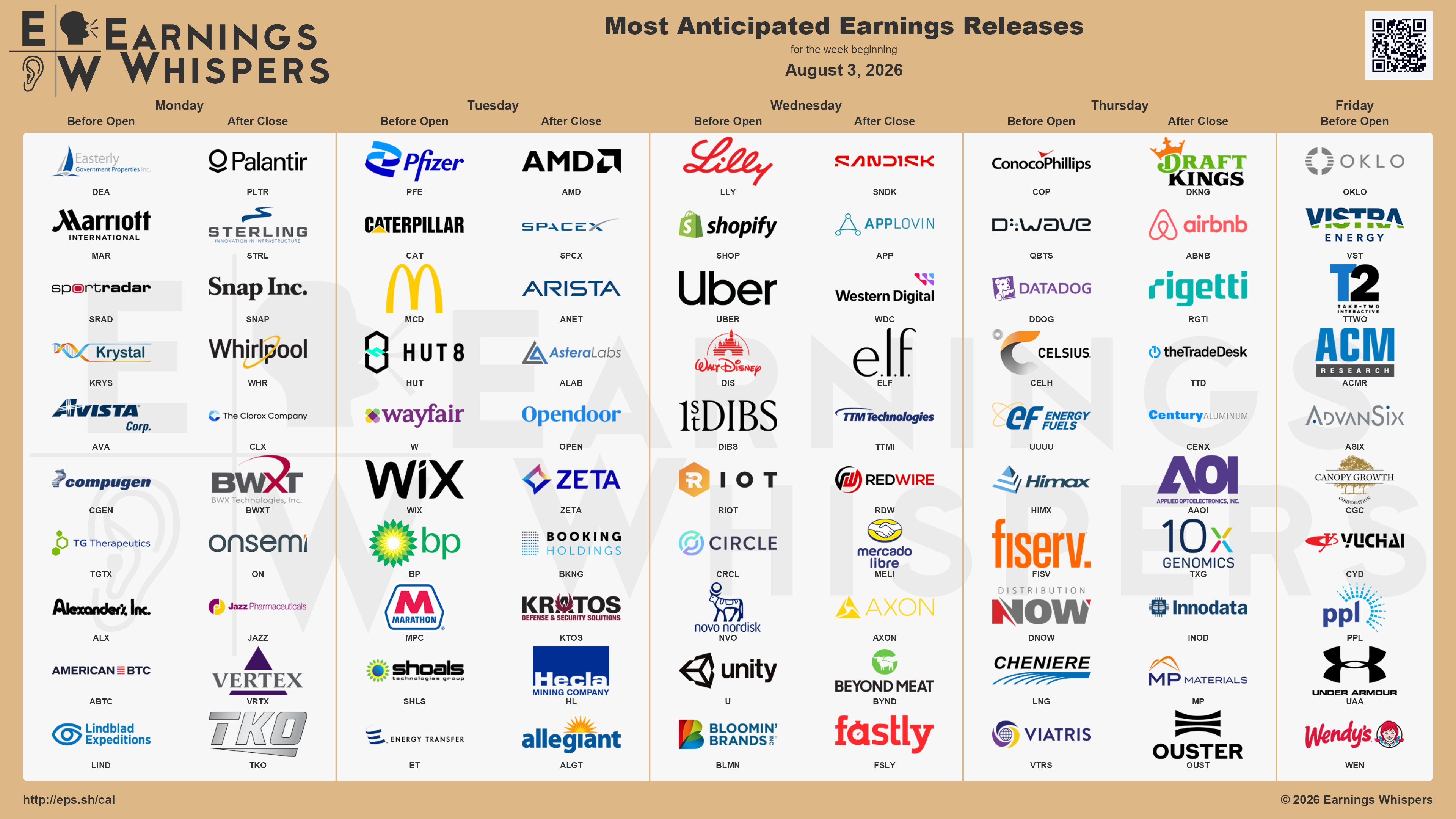
Chips, Drugs and Rockets: What to Watch as Earnings Season Hits Full Throttle
This week the earnings machine roars back to life, and if the mood music is any guide, technology is once again the star of the show. Palantir headlines a crowded stage where the crowd is leaning decidedly optimistic, and it is joined by a chorus of chip and hardware names like SanDisk, Advanced Micro Devices, Arista Networks and Western Digital, all of which are walking in with the wind at their backs after strong finishes to last quarter. Options traders are bracing for fireworks in some of these names, with several capable of swinging ten percent or more in a single session, so buckle up. Not everyone gets a warm welcome, though. Eli Lilly and Novo Nordisk, the twin titans of the weight loss craze, are drawing a surprisingly frosty reception despite their blockbuster reputations, and Pfizer continues to fight an uphill battle for investor affection. Even SpaceX makes a rare appearance on the earnings calendar, a reminder that the rocket business now commands as much attention as the boardroom.
Beyond the tech glamour, the week offers a little something for every kind of investor, and plenty of drama to go around. Industrial bellwether Caterpillar and travel favorites Marriott and Airbnb are strolling in on a confident note, while Sterling Construction and energy pipeline giant Energy Transfer are quietly among the most upbeat stories nobody is talking about. The other side of the ledger tells a cautionary tale. Trade Desk, Whirlpool, e.l.f. Beauty and Clorox are the names to approach with a raincoat, as the enthusiasm has clearly drained out of them and last quarter's stumbles still linger. Keep a close eye on the speculative crowd too, where quantum computing hopefuls like D-Wave, Rigetti and IonQ sit alongside Bitcoin miners and nuclear upstarts, all of them wildly unpredictable and capable of doubling your excitement or breaking your heart before the closing bell. In short, it is shaping up to be a week where fortunes turn fast, so grab your coffee and settle in.
Palantir's Only Problem: Too Much Demand
Palantir Technologies (PLTR) is set to report earnings on Monday, August 3, 2026 at around 4:05 PM ET. Wall Street is looking for $0.35 per share on $1.81 billion in revenue, which would be a jaw-dropping 80.3% jump from a year ago, though the whisper number is a touch higher at $0.38. The company guided to about $1.80 billion. Folks are feeling good going in, with 75% betting on a beat. That said, the crowd is split: short sellers have piled on, up 46.5% since last quarter, and the stock has slid 12.3% since its last report to sit 19.6% below its 200 day average of $153.01. Estimates have been creeping higher across the board. Options traders are betting on an 11.5% swing, right in line with the roughly 10.9% move this stock usually makes. And on Friday, someone snapped up over 20,000 of the $130 calls expiring August 7, so a few players are clearly leaning bullish.
Here is the real story: Palantir's biggest headache isn't finding customers, it's keeping up with them. Last quarter was a blowout, with revenue growing 85% (the fastest ever) and US sales cracking triple digits at 104%. Management raised its full-year outlook by the largest amount in company history and keeps saying the same thing over and over, which is that they simply cannot build fast enough to meet US demand. New wins are stacking up, from a $300 million USDA deal to deeper work with GE Aerospace and a fresh mortgage partnership. The only soft spots are international sales, which remain sluggish, and the risk that pouring resources into defense could strain the commercial side. Bottom line, if Palantir keeps this pace, the recent stock dip may end up looking like a gift.

SanDisk's Memory Boom: From Sleepy Chipmaker to Cash Machine
SanDisk (SNDK) reports earnings after the closing bell on Wednesday, August 5, 2026, at about 4:05 PM ET. Wall Street is looking for $33.28 per share on revenue of $8.30 billion, which would be a jaw-dropping 336.6% jump in sales from a year ago, and the whisper number is even juicier at $36.15 per share. The company itself guided for $30.00 to $33.00 per share on revenue between $7.75 and $8.25 billion, so the bar is set high but reachable. Investors are feeling good, with 70.2% betting on a beat. Short sellers have backed off too, cutting their bets by 19.4% since last quarter, while the stock has quietly climbed 14.7% since the last report and now sits a hefty 44.7% above its 200 day average of $839.56. Analysts keep nudging their numbers up. Options traders are bracing for a wild 19.4% swing, well above the usual 8.0% move, and on July 24 someone scooped up 4,409 of the $1,370 puts expiring August 7, which is worth watching.
Here is the real story. SanDisk has flipped from a boom-and-bust memory maker into something that looks a lot more like a steady cash machine. Last quarter revenue nearly doubled to $5.95 billion, gross margins rocketed to 78.4% from 51.1%, and earnings hit $23.41 versus a measly $6.20 the quarter before. The magic is a new supply model where SanDisk locks customers into multi-year contracts, and they now have five signed deals worth $42 billion in future revenue with over $11 billion in financial guarantees behind them. Data center sales exploded 233% in a single quarter thanks to the AI storage frenzy, and management even started its first-ever $6 billion buyback after paying off debt. The only soft spots are lower bit shipments, which is a deliberate stockpiling move ahead of a big product ramp, and a seasonal dip in consumer sales. In short, this is one of the strongest setups we have seen, and the tone from management has gone from cautious to downright confident.
AMD's Data Center Engine Roars Into Q2
Advanced Micro Devices (AMD) is confirmed to report earnings on Tuesday, August 4, 2026 at approximately 4:15 PM ET. Wall Street is looking for $1.62 per share on revenue of $11.31 billion, a hefty 47.2% jump from a year ago, though the whisper number is a touch higher at $1.69. Management had guided to $10.90 billion to $11.50 billion, so they set the bar and now they get to jump over it. The crowd is feeling good, with 75.4% betting on a beat. That optimism shows in the chart too, as the stock has drifted 16.3% higher since last quarter and now sits a whopping 52.9% above its 200 day moving average of $311.35. Not everyone is convinced, mind you, since short interest has climbed 11.6% since the last report. Estimates have been revised higher across the board. Options traders are bracing for an 11.8% swing, a bit bigger than the 8.8% average move of recent quarters, and on Tuesday, July 28, 2026 someone scooped up 18,427 contracts of the $400.00 put expiring August 07, which is worth keeping an eye on.
Last quarter was what management flat out called an inflection, and the numbers backed up the swagger. Data center revenue rocketed 57% to a record $5.8 billion, and the company doubled its 2030 server CPU market forecast to over $120 billion, riding the wave of AI workloads that suddenly need a lot more CPUs sitting next to the GPUs. The kicker was an expanded Meta deal for up to 6 gigawatts of Instinct chips, stacking neatly on top of the earlier OpenAI win, with the new MI450 and Helios products already tracking ahead of plan for late this year. Free cash flow hit a record $2.6 billion. The one soft spot to watch is the consumer side, where rising memory and component costs are expected to drag gaming down more than 20% in the back half, and China remains a question mark that AMD has simply left out of its numbers. Bottom line, the AI story is doing all the heavy lifting, and investors will be listening closely to see if the data center keeps outrunning the consumer drag.
Big Swing Ahead: Options Traders Brace for Fireworks
Mark your calendars, because this one reports after the market closes. Wall Street is bracing for a loss of $0.26 per share on revenue of $6.72 billion. The mood heading in is downright gloomy, though a stubborn 34.6% of the crowd is still betting on a beat. The stock has taken its lumps, sitting 25.3% below its 200 day moving average of $145.13. Option traders are strapping in for a wild ride, pricing in a 16.9% swing once the numbers drop.
Here is the eyebrow raiser. On Friday, July 31, 2026, someone stepped up in a big way, scooping up 381,592 contracts of the $330.00 calls expiring Friday, August 07, 2026. That is a mountain of optimism on a stock trading well below that level, so either somebody knows something or they are swinging for the fences. Keep your eyes on this print.
Lilly's Little Pill Could Be a Big Deal
Eli Lilly (LLY) steps into the earnings booth on Wednesday, August 5, 2026 at roughly 6:45 AM ET. Wall Street is looking for $6.71 per share on $20.26 billion in revenue, which would be a hefty 30.2% jump from a year ago, though the whisper number is aiming much higher at $9.10 per share. Here's the funny part: investors are walking in nervous, yet 82.8% still expect a beat. Short sellers have piled on, boosting short interest by 26.7% since last quarter, even as the stock quietly climbed 27.8% since its last report to sit 12.4% above its 200 day average of $1,022.53. Analysts have been nudging estimates higher, option traders are bracing for an 8.0% swing, and the stock has actually averaged an 8.9% move lately. One trader made a notable bet on Friday, July 31, 2026, snapping up 1,690 of the $700.00 puts expiring September 11, 2026.
The real story is Fundayo, Lilly's new pill version of the popular weight loss shots that hit the market in April. In just weeks it reached about 20,000 patients, most of them brand new to these drugs, and Medicare added a $50 monthly cap program that runs through 2027. Last quarter Lilly raised its full-year outlook across the board, growth sped up to 56%, and the pipeline delivered a string of wins. The catch is pricing, which keeps dragging on results, plus some states pulling weight loss coverage that dinged ZepBound sales. But with a new pill launching, a fuller ad blitz coming, and management sounding more confident than ever, this quarter is one to watch.
AppLovin Heads Into Earnings With Bulls Roaring but the Stock Limping
AppLovin (APP) steps up to the plate after the close on Wednesday, August 5, 2026, at roughly 4:05 PM ET. Wall Street is looking for $3.72 per share on $1.94 billion in revenue, which would be a hefty 54.1% jump from a year ago, but the whisper number is even juicier at $3.87. Management itself guided for $1.92 billion to $1.95 billion, so the bar is set. The crowd is feeling good here, with 77.3% betting on a beat, yet here's the twist: the stock has quietly slid 13.0% since it last reported and now sits a full 24.0% below its 200 day moving average of $520.63. Short interest ticked up a hair, 0.7%, while overall estimates have actually been nudged higher. Options traders are bracing for a big 15.8% swing, roughly in line with the 12.4% average move lately, and someone made a notable bet buying 6,162 of the $250 puts expiring August 21.
The real story worth watching is momentum in the consumer business. Last quarter management sounded downright giddy, saying the future has never looked better as March spending ran about 25% above January and April set a record beating any holiday peak. The big self-serve platform is set to go live in June, video AI creative tools are rolling out broadly, and the company is testing new lead-generation deals in insurance, fintech, and food delivery. Margins hit a new high at 85%, so the machine is humming. The only clouds are slowing year-over-year growth on a bigger base and a possible spending bump tied to the launch. With the stock beaten down but the business clearly heating up, this print could be the moment the two finally reconnect.
ConocoPhillips: Cash Gushes While Qatar Coughs
ConocoPhillips (COP) is set to report earnings before the bell on Thursday, August 6, 2026, at roughly 7:00 AM ET. Wall Street is looking for $2.96 per share on $17.54 billion in revenue, a healthy 19.0% jump from a year ago, but the Earnings Whisper number sits a touch higher at $3.04. Optimism is running hot here, with a full 100.0% of investors betting on a beat. That said, the skeptics are stirring too, as short interest has climbed 4.5% since last quarter and overall earnings estimates have quietly been trimmed. The stock has slipped 3.3% since its last report yet still sits comfortably 11.9% above its 200 day moving average of $107.64. Options traders are bracing for a 4.7% swing, which is a lot bigger than the tame 1.5% the stock has actually delivered lately. One eyebrow-raiser: on Friday, July 31, someone snapped up 3,053 of the $125.00 calls expiring August 21, a clear bet that the good times keep rolling.
Last quarter's story was all about the money machine. Management said cash flow was up materially thanks to unhedged oil and LNG exposure right as a Middle East supply shock lit a fire under prices, and they're still handing back 45% of that cash to shareholders. The LNG picture tightened up nicely, Alaska drilling found oil near Willow, and they even added a Permian rig because the returns were, in their words, no-brainers. The catch is the Qatar shut-in, which knocks out about 3% of production and pushed second quarter output guidance lower, plus construction delays that could slip into next year. They also dialed back their global oil demand outlook to flat. Bottom line, this is a company leaning into growth with more cash in hand, and the market clearly wants to believe the buyers, not the bears.
Western Digital: The Hard Drive Comeback Nobody Saw Coming
Western Digital (WDC) is confirmed to report earnings on Wednesday, August 5, 2026 at approximately 4:00 PM ET. Wall Street is looking for $3.32 per share on revenue of $3.70 billion, which would be a hefty 42.0% jump in sales from a year ago, though the whisper number is running hotter at $3.53. Management had guided to $3.10 to $3.40 per share on $3.55 billion to $3.75 billion in revenue, so they set the bar and now have to clear it. Investors are feeling good here, with 78.9% betting on a beat. Short sellers have backed off, cutting their bets by 13.1% since last quarter, while the stock has cruised 34.1% higher since its last earnings pop and now sits a remarkable 64.7% above its 200 day average of $330.78. Estimates have been drifting up across the board. Options traders are bracing for a big 14.8% swing, roughly double the 7.1% move this stock has averaged lately, and on July 30 someone snapped up 2,639 of the $800 calls expiring August 7. Somebody is swinging for the fences.
Here is the simple story: this old-school disk drive maker has quietly become an AI winner. Last quarter WDC crossed 50% gross margins for the first time ever, nearly doubled its earnings, and raised basically every number that matters. The reason is AI eating storage for breakfast, so much so that management bumped its long-term growth outlook past 25% a year. Pricing on their drives flipped from falling to up 9%, the balance sheet swung from $2.7 billion in debt to actual cash in the bank, and they raised the dividend and bought back stock. The only nitpicks are that next quarter's margin bump looks a touch modest, which some think is just management playing it safe, and their new HAMR drive technology still needs to prove it can ramp cleanly. Everything else points the same direction, and it is up.
Shopify: The AI Shopping Rails Are Getting Crowded (In a Good Way)
Shopify (SHOP) is set to report earnings on Wednesday, August 5, 2026, at around 7:00 AM ET. Wall Street is looking for $0.40 per share on revenue of $3.43 billion, which would be a healthy 28% jump from a year ago, though the whisper number is a touch higher at $0.43. The company itself guided for about $3.42 billion, so the bar is set. Investors are feeling good here, with nearly 78% betting on a beat. That said, the doubters have shown up too, as short interest jumped 22.2% since last quarter. The stock has barely budged since the last report, drifting up less than 1%, and it still sits 12.1% below its 200 day average of $133.26. Estimates have been ticking higher across the board. Options traders are bracing for a 13.5% swing, bigger than the 9.1% average move lately, and on July 28 someone stepped in and scooped up 49,317 of the $175 calls expiring September 18, a clear bet that a pop is coming.
Here is what really matters going in: last quarter Shopify hit its fastest revenue growth in over four years at 34%, and management called it "Shopify at its best." The big story is AI shopping. Traffic driven by AI is up 8 times from a year ago, and their Universal Commerce Protocol just pulled in Amazon, Meta, Microsoft, Salesforce, and Stripe, meaning the whole industry is lining up behind Shopify's playbook. Add in enterprise wins like LVMH and Balmain and it is firing on all cylinders. The one thing to watch is that free cash flow margin slipped from 19% to 15%, partly from higher taxes, and next quarter's guide of high 20s growth looks softer, but that is mostly a currency quirk, not shoppers pulling back. Rising AI costs and some credit losses are worth keeping an eye on, but the momentum story is very much intact.
D-Wave's Bookings Are Booming, But the Revenue Line Is Playing Hard to Get
D-Wave Quantum (QBTS) is set to report earnings on Thursday, August 6, 2026 at around 7:00 AM ET. Wall Street is looking for a loss of $0.09 per share on revenue of $3.82 million, which would be 23.4% growth from a year ago, though the whisper number is a slightly better loss of $0.07. Investors are leaning bearish heading in, but oddly enough two out of three still expect a beat. Short sellers have piled on, with short interest up 24.6% since last quarter, while the stock has slid 19.4% since its last earnings pop and now sits 22.2% below its 200 day moving average of $23.23. Option traders are bracing for a 15.2% swing, right in line with the roughly 15% moves this stock has been serving up lately. And someone made a bold bet on July 20, scooping up 3,753 of the $50 calls expiring in November, so at least a few folks are dreaming big.
Here is the real story ahead of the print. Last quarter the headline revenue number looked ugly, just $2.9 million and down 81% from a year ago, but that was because the prior year had a fat $12.6 million system sale baked in. Look under the hood and the demand is on fire. Bookings hit a record $33.4 million, backlog more than tripled to $42.4 million, and the sales pipeline doubled. Management even bumped up how many systems they plan to sell, going from about one a year to two or three. The catch is that all this growth costs money, so margins shrank and losses widened as they digest their $250 million Quantum Circuits acquisition and hire aggressively. With $588 million in cash they say they are funded all the way to profitability. So the key question Thursday is simple. Does the booking boom start showing up in the revenue line, or is that still a back-half of the year promise?

agilon Health: A Stock on Fire Heads Into Its Big Test
agilon health, inc. (AGL) is locked in to report earnings on Wednesday, August 5, 2026, right around 4:05 PM ET. Wall Street is looking for $0.06 per share on revenue of $1.45 billion, which would be 3.9% year-over-year growth. Investors are walking in bullish but are bracing for results that land pretty much in line with expectations. The setup is telling: short interest has dropped 14.1% since last quarter, the stock has rocketed 110.2% from where it opened after the last report, and it now sits a jaw-dropping 116.2% above its 200 day moving average of $42.36. Analysts have been nudging their estimates higher too, and option traders are betting on a wild 29.4% swing when the numbers hit.
Here is the bottom line: this stock has been on an absolute tear, and that cuts both ways. When a name climbs this fast and this far above its longer-term trend, the bar gets raised whether the company likes it or not. In-line results might not be enough to keep the party going, and with a nearly 30% move baked in by the options crowd, this one is set up to move big in either direction. Buckle up.

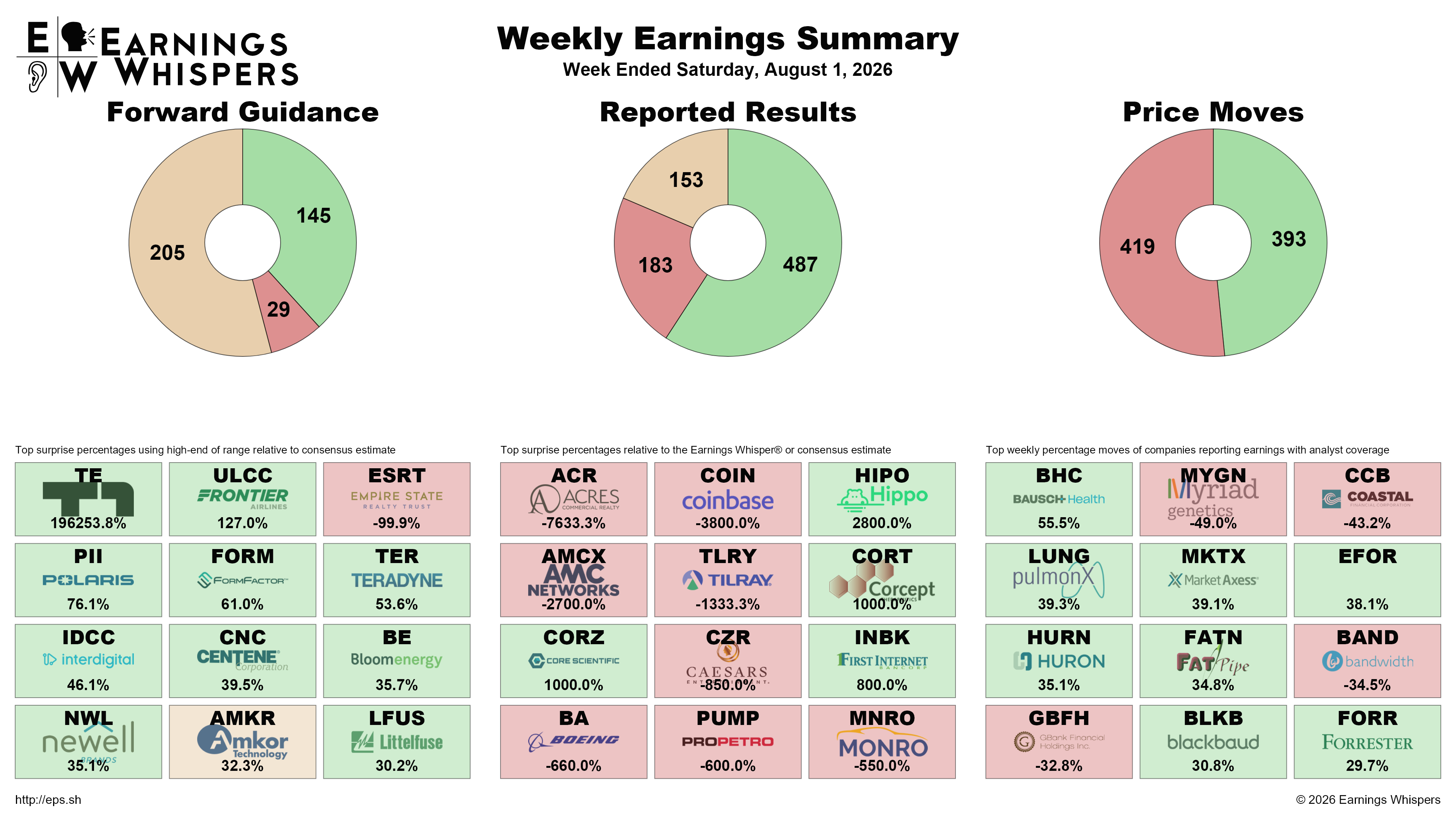
AI Spending Meets the Great Chip Squeeze as Refiners Cash In on Chaos
If last week's earnings had a single storyline, it was the price of building the artificial intelligence future. The tech giants are pouring money into data centers at a staggering pace, and their results showed both the payoff and the pain. Amazon delivered its fifth straight quarter of accelerating cloud growth, with AWS jumping nearly 37 percent and, more surprisingly, expanding its profit margins to around 39 percent, quieting critics who feared AI would be a money pit. Microsoft echoed the theme, guiding its Azure cloud toward a remarkable 45 percent growth clip while Copilot subscriptions blew past 30 million seats, even as consumer PCs and Xbox slumped and margins thinned under a capital-spending bill approaching $175 billion. Meta's core advertising engine hummed along in the mid-20s percent range thanks to smarter AI ad targeting, but the cost of ambition was brutal: free cash flow collapsed from over $12 billion to less than $1 billion in a single quarter as it plowed $31 billion into buildout. The one sour note was Apple, whose stock tumbled roughly 7 percent after it warned of a memory-chip shortage it called a '100-year flood,' forcing reluctant price hikes and squeezing margins just as Tim Cook handed the reins to his successor. That same memory and hard-drive inflation quietly haunted Amazon's outlook too, a reminder that the AI gold rush is straining supply chains everywhere.
Away from Silicon Valley, the winners were the companies profiting from a messy world. Refiners had a blowout quarter as war and outages knocked millions of barrels of processing capacity offline, and Valero was the standout, posting what may be its best quarter ever with earnings tripling in its refining arm and a 68 percent stock surge over the year. Oil majors Exxon and Chevron both leaned into disruption; Exxon shrugged off a 10 percent hit to its production from Middle East turmoil to deliver near-record results, while Chevron's profits and cash flow exploded higher, boosted by record U.S. output and a splashy 20-year deal to power a Microsoft data center. The health insurers offered a quieter but powerful comeback story, as Centene stunned Wall Street by nearly tripling analyst profit expectations and hiking its full-year forecast dramatically, a genuine turnaround after a rough stretch, while Cigna raised guidance for a third straight time. And in Detroit, Ford proved old-economy grit still matters, lifting its full-year profit target by $1 billion on stronger pricing and a promising new energy-storage business, even as a one-time charge dragged it to a paper loss. The common thread across a chaotic week: whether it is chips, crude or premiums, scarcity is where the money is being made.
Microsoft's AI Engine Roars as Azure Crosses $100 Billion
Microsoft (MSFT) blew past Wall Street in its fiscal fourth quarter ended June 2026, posting earnings of $4.74 per share on revenue of $90.01 billion. Analysts had penciled in just $4.21 per share on $87.44 billion, and even the whisper number of $4.34 came up short. That is a 9.22% earnings beat with revenue growing a healthy 17.75% from a year ago. Looking ahead, management guided first quarter earnings to $4.63 to $4.78 per share on revenue of $89.85 billion to $90.95 billion, comfortably above the $4.55 and $89.53 billion the Street was expecting. CEO Satya Nadella struck a victory-lap tone, noting Azure topped $100 billion in annual revenue for the first time and Microsoft 365 Copilot now boasts over 30 million paid seats. In plain English, Microsoft is turning the AI hype into cold, hard cash.
The real story here is Azure hitting the gas. Growth is guided to jump to roughly 45% next quarter, up from 39% this quarter, and demand is so strong the company still cannot build data centers fast enough. Copilot seats have doubled every couple of quarters, GitHub's coding assistant ballooned to 50 million users, and the backlog of signed contracts swelled to a staggering $678 billion, up 84% from last year. The catch? All this AI muscle costs a fortune. Margins are slipping as capital spending races toward roughly $175 billion, the Xbox and PC businesses are stumbling, and free cash flow is getting squeezed. But make no mistake, the moneymaking commercial and AI franchises are firing on all cylinders, and that is where the future lives.

Apple's Best June Ever, But Storm Clouds Gather Over Cook's Farewell
Apple (AAPL) posted earnings of $1.91 per share on revenue of $109.42 billion for its fiscal third quarter ended June 2026, edging past the $108.79 billion revenue consensus while nudging under the $1.97 whisper number by about 3%. Revenue jumped a healthy 16.36% from a year ago. Looking ahead, Apple guided fourth-quarter earnings to $1.91 to $2.04 per share on revenue of $111.69 billion to $113.74 billion, both shy of the $2.03 and $115.78 billion Wall Street was hoping for. In his final call as CEO, Tim Cook crowed about Apple's "strongest June quarter ever," with double-digit growth across iPhone, Mac and Services in every region, plus the shiny new Siri AI unveiled at WWDC26.
Here's the catch: demand has never looked better, but the guidance tells a gloomier story. Next quarter's growth forecast dropped roughly 500 basis points, from 14-17% down to 9-11%, as supply shortages that used to only pinch the Mac now squeeze iPhone and iPad too. The real villain is a so-called "100-year flood" in memory chip prices, which is chewing through margins and forcing Apple to reluctantly raise prices on gear, a gamble since nobody knows how shoppers will react. Services growth also cooled to 12% from 16%. So while iPhone sales are on fire (up 22% again) and the AI story is finally getting traction, the numbers are softening just as John Ternus grabs the wheel. Great demand, tougher math.
Amazon's Cloud Just Hit the Gas, and the Brakes Are Nowhere in Sight
Amazon delivered a solid second quarter, posting earnings of $1.88 per share on revenue of $200.61 billion, edging past Wall Street's expectations of $1.83 per share and $196.85 billion, and even topping the $1.87 Earnings Whisper number. Revenue climbed a healthy 19.62% from a year ago. Looking ahead, management guided third quarter revenue to a range of $197.0 billion to $202.0 billion, which sits a touch below the $204.30 billion analysts were hoping for, but don't let that spook you. That softer number is almost entirely a calendar quirk, since Prime Day shifted into the second quarter this year, so the real business is chugging along just fine.
Here's the headline that actually matters: AWS is on fire. Cloud revenue grew 36.7% year-over-year, the fastest pace in 18 quarters and the fifth straight quarter of acceleration, pushing the run rate to a jaw-dropping $169 billion. Even better, the profit margins on that cloud business jumped to roughly 39%, quietly demolishing the old worry that all this AI spending would eat into profits. The custom chip business is now cranking past $25 billion, and Amazon is even exploring selling those chips to outside customers. Yes, the company is spending a fortune to keep up, with capital expenditures ballooning to $53.1 billion this quarter and memory prices biting into costs, but this is a spending spree fueled by roaring demand, not desperation. When your biggest problem is building fast enough to keep customers happy, you are in a very good place.
Meta's Ad Engine Roars While Its Wallet Bleeds
META Platforms (META) just posted second-quarter earnings of $6.18 per share on revenue of $60.80 billion for the period ending June 2026, and the profit number landed with a thud. Wall Street wanted $7.10 per share, the whisper crowd was dreaming of $7.61, and Meta came up short by nearly 19%. The saving grace? Revenue grew a healthy 28% from a year ago and even beat the $60.18 billion estimate. Looking ahead, the company guided third-quarter revenue to a range of $61.0 billion to $64.0 billion, straddling the $63.04 billion analysts are penciling in. CEO Mark Zuckerberg struck an upbeat note, saying AI is 'accelerating our core business today' and opening doors to brand new enterprise money-makers, and honestly, the ad numbers back him up.
Here's the real story: the top line is on fire, but the bottom line got torched. Meta's AI-powered ad ranking is delivering, with 8.3% more clicks and nearly 16% more conversions on Facebook, plus a wave of new products finally shipping, from AI ad tools to its own Luxottica-made smart glasses with a Kylie Jenner style. The catch is that costs exploded 55% higher, stung by $2.4 billion in legal charges and $1.2 billion in severance from an 8,000-person layoff. Operating margin cratered from 41% to 31%, and free cash flow all but vanished, collapsing to $784 million from $12.4 billion just one quarter ago as Meta poured a staggering $31.1 billion into building AI capacity. In short, the growth is real, but Zuckerberg is spending like there's no tomorrow, and investors will want to see those bets pay off before the cash drought gets uncomfortable.
SoFi Hits Escape Velocity, but the Taxman Wants a Ride
SoFi Technologies (SOFI) posted second quarter earnings of $0.12 per share on revenue of $1.22 billion, edging past Wall Street's $0.11 estimate and landing right on the Earnings Whisper number. Revenue jumped nearly 43% from a year ago, which is the kind of growth that gets a fintech noticed. The company still expects roughly $0.60 per share in earnings for 2026, but it bumped up its revenue outlook to $4.75 billion to $4.85 billion, up from the $4.66 billion it guided to before and comfortably ahead of the $4.66 billion analysts had penciled in. In plain English, SoFi is bringing in more money than expected and telling us to expect even more.
Here is the real story. CEO Anthony Noto kept using the phrase "inflection point," and the numbers back him up. SoFi added a record 1.1 million members and a record 2.2 million products, with more than half of new products coming from existing customers buying more stuff. Loan originations hit a record $14.8 billion, including the company's first ever $10 billion personal loan quarter. So why did earnings guidance stay flat instead of climbing? Two reasons. First, the taxman showed up with a higher tax rate that shaved about a nickel off earnings, meaning profits would have been $0.65 without it. Second, the Federal Reserve outlook flipped from expected rate cuts to possible hikes, which dinged the value of some loans on the books. Bottom line, the growth engine is roaring, but a heavier tax bill and a trickier rate picture are keeping the profit story in check for now.
This week the earnings machine roars back to life, and if the mood music is any guide, technology is once again the star of the show. Palantir headlines a crowded stage where the crowd is leaning decidedly optimistic, and it is joined by a chorus of chip and hardware names like SanDisk, Advanced Micro Devices, Arista Networks and Western Digital, all of which are walking in with the wind at their backs after strong finishes to last quarter. Options traders are bracing for fireworks in some of these names, with several capable of swinging ten percent or more in a single session, so buckle up. Not everyone gets a warm welcome, though. Eli Lilly and Novo Nordisk, the twin titans of the weight loss craze, are drawing a surprisingly frosty reception despite their blockbuster reputations, and Pfizer continues to fight an uphill battle for investor affection. Even SpaceX makes a rare appearance on the earnings calendar, a reminder that the rocket business now commands as much attention as the boardroom.
Beyond the tech glamour, the week offers a little something for every kind of investor, and plenty of drama to go around. Industrial bellwether Caterpillar and travel favorites Marriott and Airbnb are strolling in on a confident note, while Sterling Construction and energy pipeline giant Energy Transfer are quietly among the most upbeat stories nobody is talking about. The other side of the ledger tells a cautionary tale. Trade Desk, Whirlpool, e.l.f. Beauty and Clorox are the names to approach with a raincoat, as the enthusiasm has clearly drained out of them and last quarter's stumbles still linger. Keep a close eye on the speculative crowd too, where quantum computing hopefuls like D-Wave, Rigetti and IonQ sit alongside Bitcoin miners and nuclear upstarts, all of them wildly unpredictable and capable of doubling your excitement or breaking your heart before the closing bell. In short, it is shaping up to be a week where fortunes turn fast, so grab your coffee and settle in.
Palantir's Only Problem: Too Much Demand
Palantir Technologies (PLTR) is set to report earnings on Monday, August 3, 2026 at around 4:05 PM ET. Wall Street is looking for $0.35 per share on $1.81 billion in revenue, which would be a jaw-dropping 80.3% jump from a year ago, though the whisper number is a touch higher at $0.38. The company guided to about $1.80 billion. Folks are feeling good going in, with 75% betting on a beat. That said, the crowd is split: short sellers have piled on, up 46.5% since last quarter, and the stock has slid 12.3% since its last report to sit 19.6% below its 200 day average of $153.01. Estimates have been creeping higher across the board. Options traders are betting on an 11.5% swing, right in line with the roughly 10.9% move this stock usually makes. And on Friday, someone snapped up over 20,000 of the $130 calls expiring August 7, so a few players are clearly leaning bullish.
Here is the real story: Palantir's biggest headache isn't finding customers, it's keeping up with them. Last quarter was a blowout, with revenue growing 85% (the fastest ever) and US sales cracking triple digits at 104%. Management raised its full-year outlook by the largest amount in company history and keeps saying the same thing over and over, which is that they simply cannot build fast enough to meet US demand. New wins are stacking up, from a $300 million USDA deal to deeper work with GE Aerospace and a fresh mortgage partnership. The only soft spots are international sales, which remain sluggish, and the risk that pouring resources into defense could strain the commercial side. Bottom line, if Palantir keeps this pace, the recent stock dip may end up looking like a gift.
SanDisk's Memory Boom: From Sleepy Chipmaker to Cash Machine
SanDisk (SNDK) reports earnings after the closing bell on Wednesday, August 5, 2026, at about 4:05 PM ET. Wall Street is looking for $33.28 per share on revenue of $8.30 billion, which would be a jaw-dropping 336.6% jump in sales from a year ago, and the whisper number is even juicier at $36.15 per share. The company itself guided for $30.00 to $33.00 per share on revenue between $7.75 and $8.25 billion, so the bar is set high but reachable. Investors are feeling good, with 70.2% betting on a beat. Short sellers have backed off too, cutting their bets by 19.4% since last quarter, while the stock has quietly climbed 14.7% since the last report and now sits a hefty 44.7% above its 200 day average of $839.56. Analysts keep nudging their numbers up. Options traders are bracing for a wild 19.4% swing, well above the usual 8.0% move, and on July 24 someone scooped up 4,409 of the $1,370 puts expiring August 7, which is worth watching.
Here is the real story. SanDisk has flipped from a boom-and-bust memory maker into something that looks a lot more like a steady cash machine. Last quarter revenue nearly doubled to $5.95 billion, gross margins rocketed to 78.4% from 51.1%, and earnings hit $23.41 versus a measly $6.20 the quarter before. The magic is a new supply model where SanDisk locks customers into multi-year contracts, and they now have five signed deals worth $42 billion in future revenue with over $11 billion in financial guarantees behind them. Data center sales exploded 233% in a single quarter thanks to the AI storage frenzy, and management even started its first-ever $6 billion buyback after paying off debt. The only soft spots are lower bit shipments, which is a deliberate stockpiling move ahead of a big product ramp, and a seasonal dip in consumer sales. In short, this is one of the strongest setups we have seen, and the tone from management has gone from cautious to downright confident.
AMD's Data Center Engine Roars Into Q2
Advanced Micro Devices (AMD) is confirmed to report earnings on Tuesday, August 4, 2026 at approximately 4:15 PM ET. Wall Street is looking for $1.62 per share on revenue of $11.31 billion, a hefty 47.2% jump from a year ago, though the whisper number is a touch higher at $1.69. Management had guided to $10.90 billion to $11.50 billion, so they set the bar and now they get to jump over it. The crowd is feeling good, with 75.4% betting on a beat. That optimism shows in the chart too, as the stock has drifted 16.3% higher since last quarter and now sits a whopping 52.9% above its 200 day moving average of $311.35. Not everyone is convinced, mind you, since short interest has climbed 11.6% since the last report. Estimates have been revised higher across the board. Options traders are bracing for an 11.8% swing, a bit bigger than the 8.8% average move of recent quarters, and on Tuesday, July 28, 2026 someone scooped up 18,427 contracts of the $400.00 put expiring August 07, which is worth keeping an eye on.
Last quarter was what management flat out called an inflection, and the numbers backed up the swagger. Data center revenue rocketed 57% to a record $5.8 billion, and the company doubled its 2030 server CPU market forecast to over $120 billion, riding the wave of AI workloads that suddenly need a lot more CPUs sitting next to the GPUs. The kicker was an expanded Meta deal for up to 6 gigawatts of Instinct chips, stacking neatly on top of the earlier OpenAI win, with the new MI450 and Helios products already tracking ahead of plan for late this year. Free cash flow hit a record $2.6 billion. The one soft spot to watch is the consumer side, where rising memory and component costs are expected to drag gaming down more than 20% in the back half, and China remains a question mark that AMD has simply left out of its numbers. Bottom line, the AI story is doing all the heavy lifting, and investors will be listening closely to see if the data center keeps outrunning the consumer drag.
Big Swing Ahead: Options Traders Brace for Fireworks
Mark your calendars, because this one reports after the market closes. Wall Street is bracing for a loss of $0.26 per share on revenue of $6.72 billion. The mood heading in is downright gloomy, though a stubborn 34.6% of the crowd is still betting on a beat. The stock has taken its lumps, sitting 25.3% below its 200 day moving average of $145.13. Option traders are strapping in for a wild ride, pricing in a 16.9% swing once the numbers drop.
Here is the eyebrow raiser. On Friday, July 31, 2026, someone stepped up in a big way, scooping up 381,592 contracts of the $330.00 calls expiring Friday, August 07, 2026. That is a mountain of optimism on a stock trading well below that level, so either somebody knows something or they are swinging for the fences. Keep your eyes on this print.
Lilly's Little Pill Could Be a Big Deal
Eli Lilly (LLY) steps into the earnings booth on Wednesday, August 5, 2026 at roughly 6:45 AM ET. Wall Street is looking for $6.71 per share on $20.26 billion in revenue, which would be a hefty 30.2% jump from a year ago, though the whisper number is aiming much higher at $9.10 per share. Here's the funny part: investors are walking in nervous, yet 82.8% still expect a beat. Short sellers have piled on, boosting short interest by 26.7% since last quarter, even as the stock quietly climbed 27.8% since its last report to sit 12.4% above its 200 day average of $1,022.53. Analysts have been nudging estimates higher, option traders are bracing for an 8.0% swing, and the stock has actually averaged an 8.9% move lately. One trader made a notable bet on Friday, July 31, 2026, snapping up 1,690 of the $700.00 puts expiring September 11, 2026.
The real story is Fundayo, Lilly's new pill version of the popular weight loss shots that hit the market in April. In just weeks it reached about 20,000 patients, most of them brand new to these drugs, and Medicare added a $50 monthly cap program that runs through 2027. Last quarter Lilly raised its full-year outlook across the board, growth sped up to 56%, and the pipeline delivered a string of wins. The catch is pricing, which keeps dragging on results, plus some states pulling weight loss coverage that dinged ZepBound sales. But with a new pill launching, a fuller ad blitz coming, and management sounding more confident than ever, this quarter is one to watch.
AppLovin Heads Into Earnings With Bulls Roaring but the Stock Limping
AppLovin (APP) steps up to the plate after the close on Wednesday, August 5, 2026, at roughly 4:05 PM ET. Wall Street is looking for $3.72 per share on $1.94 billion in revenue, which would be a hefty 54.1% jump from a year ago, but the whisper number is even juicier at $3.87. Management itself guided for $1.92 billion to $1.95 billion, so the bar is set. The crowd is feeling good here, with 77.3% betting on a beat, yet here's the twist: the stock has quietly slid 13.0% since it last reported and now sits a full 24.0% below its 200 day moving average of $520.63. Short interest ticked up a hair, 0.7%, while overall estimates have actually been nudged higher. Options traders are bracing for a big 15.8% swing, roughly in line with the 12.4% average move lately, and someone made a notable bet buying 6,162 of the $250 puts expiring August 21.
The real story worth watching is momentum in the consumer business. Last quarter management sounded downright giddy, saying the future has never looked better as March spending ran about 25% above January and April set a record beating any holiday peak. The big self-serve platform is set to go live in June, video AI creative tools are rolling out broadly, and the company is testing new lead-generation deals in insurance, fintech, and food delivery. Margins hit a new high at 85%, so the machine is humming. The only clouds are slowing year-over-year growth on a bigger base and a possible spending bump tied to the launch. With the stock beaten down but the business clearly heating up, this print could be the moment the two finally reconnect.
ConocoPhillips: Cash Gushes While Qatar Coughs
ConocoPhillips (COP) is set to report earnings before the bell on Thursday, August 6, 2026, at roughly 7:00 AM ET. Wall Street is looking for $2.96 per share on $17.54 billion in revenue, a healthy 19.0% jump from a year ago, but the Earnings Whisper number sits a touch higher at $3.04. Optimism is running hot here, with a full 100.0% of investors betting on a beat. That said, the skeptics are stirring too, as short interest has climbed 4.5% since last quarter and overall earnings estimates have quietly been trimmed. The stock has slipped 3.3% since its last report yet still sits comfortably 11.9% above its 200 day moving average of $107.64. Options traders are bracing for a 4.7% swing, which is a lot bigger than the tame 1.5% the stock has actually delivered lately. One eyebrow-raiser: on Friday, July 31, someone snapped up 3,053 of the $125.00 calls expiring August 21, a clear bet that the good times keep rolling.
Last quarter's story was all about the money machine. Management said cash flow was up materially thanks to unhedged oil and LNG exposure right as a Middle East supply shock lit a fire under prices, and they're still handing back 45% of that cash to shareholders. The LNG picture tightened up nicely, Alaska drilling found oil near Willow, and they even added a Permian rig because the returns were, in their words, no-brainers. The catch is the Qatar shut-in, which knocks out about 3% of production and pushed second quarter output guidance lower, plus construction delays that could slip into next year. They also dialed back their global oil demand outlook to flat. Bottom line, this is a company leaning into growth with more cash in hand, and the market clearly wants to believe the buyers, not the bears.
Western Digital: The Hard Drive Comeback Nobody Saw Coming
Western Digital (WDC) is confirmed to report earnings on Wednesday, August 5, 2026 at approximately 4:00 PM ET. Wall Street is looking for $3.32 per share on revenue of $3.70 billion, which would be a hefty 42.0% jump in sales from a year ago, though the whisper number is running hotter at $3.53. Management had guided to $3.10 to $3.40 per share on $3.55 billion to $3.75 billion in revenue, so they set the bar and now have to clear it. Investors are feeling good here, with 78.9% betting on a beat. Short sellers have backed off, cutting their bets by 13.1% since last quarter, while the stock has cruised 34.1% higher since its last earnings pop and now sits a remarkable 64.7% above its 200 day average of $330.78. Estimates have been drifting up across the board. Options traders are bracing for a big 14.8% swing, roughly double the 7.1% move this stock has averaged lately, and on July 30 someone snapped up 2,639 of the $800 calls expiring August 7. Somebody is swinging for the fences.
Here is the simple story: this old-school disk drive maker has quietly become an AI winner. Last quarter WDC crossed 50% gross margins for the first time ever, nearly doubled its earnings, and raised basically every number that matters. The reason is AI eating storage for breakfast, so much so that management bumped its long-term growth outlook past 25% a year. Pricing on their drives flipped from falling to up 9%, the balance sheet swung from $2.7 billion in debt to actual cash in the bank, and they raised the dividend and bought back stock. The only nitpicks are that next quarter's margin bump looks a touch modest, which some think is just management playing it safe, and their new HAMR drive technology still needs to prove it can ramp cleanly. Everything else points the same direction, and it is up.
Shopify: The AI Shopping Rails Are Getting Crowded (In a Good Way)
Shopify (SHOP) is set to report earnings on Wednesday, August 5, 2026, at around 7:00 AM ET. Wall Street is looking for $0.40 per share on revenue of $3.43 billion, which would be a healthy 28% jump from a year ago, though the whisper number is a touch higher at $0.43. The company itself guided for about $3.42 billion, so the bar is set. Investors are feeling good here, with nearly 78% betting on a beat. That said, the doubters have shown up too, as short interest jumped 22.2% since last quarter. The stock has barely budged since the last report, drifting up less than 1%, and it still sits 12.1% below its 200 day average of $133.26. Estimates have been ticking higher across the board. Options traders are bracing for a 13.5% swing, bigger than the 9.1% average move lately, and on July 28 someone stepped in and scooped up 49,317 of the $175 calls expiring September 18, a clear bet that a pop is coming.
Here is what really matters going in: last quarter Shopify hit its fastest revenue growth in over four years at 34%, and management called it "Shopify at its best." The big story is AI shopping. Traffic driven by AI is up 8 times from a year ago, and their Universal Commerce Protocol just pulled in Amazon, Meta, Microsoft, Salesforce, and Stripe, meaning the whole industry is lining up behind Shopify's playbook. Add in enterprise wins like LVMH and Balmain and it is firing on all cylinders. The one thing to watch is that free cash flow margin slipped from 19% to 15%, partly from higher taxes, and next quarter's guide of high 20s growth looks softer, but that is mostly a currency quirk, not shoppers pulling back. Rising AI costs and some credit losses are worth keeping an eye on, but the momentum story is very much intact.
D-Wave's Bookings Are Booming, But the Revenue Line Is Playing Hard to Get
D-Wave Quantum (QBTS) is set to report earnings on Thursday, August 6, 2026 at around 7:00 AM ET. Wall Street is looking for a loss of $0.09 per share on revenue of $3.82 million, which would be 23.4% growth from a year ago, though the whisper number is a slightly better loss of $0.07. Investors are leaning bearish heading in, but oddly enough two out of three still expect a beat. Short sellers have piled on, with short interest up 24.6% since last quarter, while the stock has slid 19.4% since its last earnings pop and now sits 22.2% below its 200 day moving average of $23.23. Option traders are bracing for a 15.2% swing, right in line with the roughly 15% moves this stock has been serving up lately. And someone made a bold bet on July 20, scooping up 3,753 of the $50 calls expiring in November, so at least a few folks are dreaming big.
Here is the real story ahead of the print. Last quarter the headline revenue number looked ugly, just $2.9 million and down 81% from a year ago, but that was because the prior year had a fat $12.6 million system sale baked in. Look under the hood and the demand is on fire. Bookings hit a record $33.4 million, backlog more than tripled to $42.4 million, and the sales pipeline doubled. Management even bumped up how many systems they plan to sell, going from about one a year to two or three. The catch is that all this growth costs money, so margins shrank and losses widened as they digest their $250 million Quantum Circuits acquisition and hire aggressively. With $588 million in cash they say they are funded all the way to profitability. So the key question Thursday is simple. Does the booking boom start showing up in the revenue line, or is that still a back-half of the year promise?
agilon Health: A Stock on Fire Heads Into Its Big Test
agilon health, inc. (AGL) is locked in to report earnings on Wednesday, August 5, 2026, right around 4:05 PM ET. Wall Street is looking for $0.06 per share on revenue of $1.45 billion, which would be 3.9% year-over-year growth. Investors are walking in bullish but are bracing for results that land pretty much in line with expectations. The setup is telling: short interest has dropped 14.1% since last quarter, the stock has rocketed 110.2% from where it opened after the last report, and it now sits a jaw-dropping 116.2% above its 200 day moving average of $42.36. Analysts have been nudging their estimates higher too, and option traders are betting on a wild 29.4% swing when the numbers hit.
Here is the bottom line: this stock has been on an absolute tear, and that cuts both ways. When a name climbs this fast and this far above its longer-term trend, the bar gets raised whether the company likes it or not. In-line results might not be enough to keep the party going, and with a nearly 30% move baked in by the options crowd, this one is set up to move big in either direction. Buckle up.
AI Spending Meets the Great Chip Squeeze as Refiners Cash In on Chaos
If last week's earnings had a single storyline, it was the price of building the artificial intelligence future. The tech giants are pouring money into data centers at a staggering pace, and their results showed both the payoff and the pain. Amazon delivered its fifth straight quarter of accelerating cloud growth, with AWS jumping nearly 37 percent and, more surprisingly, expanding its profit margins to around 39 percent, quieting critics who feared AI would be a money pit. Microsoft echoed the theme, guiding its Azure cloud toward a remarkable 45 percent growth clip while Copilot subscriptions blew past 30 million seats, even as consumer PCs and Xbox slumped and margins thinned under a capital-spending bill approaching $175 billion. Meta's core advertising engine hummed along in the mid-20s percent range thanks to smarter AI ad targeting, but the cost of ambition was brutal: free cash flow collapsed from over $12 billion to less than $1 billion in a single quarter as it plowed $31 billion into buildout. The one sour note was Apple, whose stock tumbled roughly 7 percent after it warned of a memory-chip shortage it called a '100-year flood,' forcing reluctant price hikes and squeezing margins just as Tim Cook handed the reins to his successor. That same memory and hard-drive inflation quietly haunted Amazon's outlook too, a reminder that the AI gold rush is straining supply chains everywhere.
Away from Silicon Valley, the winners were the companies profiting from a messy world. Refiners had a blowout quarter as war and outages knocked millions of barrels of processing capacity offline, and Valero was the standout, posting what may be its best quarter ever with earnings tripling in its refining arm and a 68 percent stock surge over the year. Oil majors Exxon and Chevron both leaned into disruption; Exxon shrugged off a 10 percent hit to its production from Middle East turmoil to deliver near-record results, while Chevron's profits and cash flow exploded higher, boosted by record U.S. output and a splashy 20-year deal to power a Microsoft data center. The health insurers offered a quieter but powerful comeback story, as Centene stunned Wall Street by nearly tripling analyst profit expectations and hiking its full-year forecast dramatically, a genuine turnaround after a rough stretch, while Cigna raised guidance for a third straight time. And in Detroit, Ford proved old-economy grit still matters, lifting its full-year profit target by $1 billion on stronger pricing and a promising new energy-storage business, even as a one-time charge dragged it to a paper loss. The common thread across a chaotic week: whether it is chips, crude or premiums, scarcity is where the money is being made.
Microsoft's AI Engine Roars as Azure Crosses $100 Billion
Microsoft (MSFT) blew past Wall Street in its fiscal fourth quarter ended June 2026, posting earnings of $4.74 per share on revenue of $90.01 billion. Analysts had penciled in just $4.21 per share on $87.44 billion, and even the whisper number of $4.34 came up short. That is a 9.22% earnings beat with revenue growing a healthy 17.75% from a year ago. Looking ahead, management guided first quarter earnings to $4.63 to $4.78 per share on revenue of $89.85 billion to $90.95 billion, comfortably above the $4.55 and $89.53 billion the Street was expecting. CEO Satya Nadella struck a victory-lap tone, noting Azure topped $100 billion in annual revenue for the first time and Microsoft 365 Copilot now boasts over 30 million paid seats. In plain English, Microsoft is turning the AI hype into cold, hard cash.
The real story here is Azure hitting the gas. Growth is guided to jump to roughly 45% next quarter, up from 39% this quarter, and demand is so strong the company still cannot build data centers fast enough. Copilot seats have doubled every couple of quarters, GitHub's coding assistant ballooned to 50 million users, and the backlog of signed contracts swelled to a staggering $678 billion, up 84% from last year. The catch? All this AI muscle costs a fortune. Margins are slipping as capital spending races toward roughly $175 billion, the Xbox and PC businesses are stumbling, and free cash flow is getting squeezed. But make no mistake, the moneymaking commercial and AI franchises are firing on all cylinders, and that is where the future lives.
Apple's Best June Ever, But Storm Clouds Gather Over Cook's Farewell
Apple (AAPL) posted earnings of $1.91 per share on revenue of $109.42 billion for its fiscal third quarter ended June 2026, edging past the $108.79 billion revenue consensus while nudging under the $1.97 whisper number by about 3%. Revenue jumped a healthy 16.36% from a year ago. Looking ahead, Apple guided fourth-quarter earnings to $1.91 to $2.04 per share on revenue of $111.69 billion to $113.74 billion, both shy of the $2.03 and $115.78 billion Wall Street was hoping for. In his final call as CEO, Tim Cook crowed about Apple's "strongest June quarter ever," with double-digit growth across iPhone, Mac and Services in every region, plus the shiny new Siri AI unveiled at WWDC26.
Here's the catch: demand has never looked better, but the guidance tells a gloomier story. Next quarter's growth forecast dropped roughly 500 basis points, from 14-17% down to 9-11%, as supply shortages that used to only pinch the Mac now squeeze iPhone and iPad too. The real villain is a so-called "100-year flood" in memory chip prices, which is chewing through margins and forcing Apple to reluctantly raise prices on gear, a gamble since nobody knows how shoppers will react. Services growth also cooled to 12% from 16%. So while iPhone sales are on fire (up 22% again) and the AI story is finally getting traction, the numbers are softening just as John Ternus grabs the wheel. Great demand, tougher math.
Amazon's Cloud Just Hit the Gas, and the Brakes Are Nowhere in Sight
Amazon delivered a solid second quarter, posting earnings of $1.88 per share on revenue of $200.61 billion, edging past Wall Street's expectations of $1.83 per share and $196.85 billion, and even topping the $1.87 Earnings Whisper number. Revenue climbed a healthy 19.62% from a year ago. Looking ahead, management guided third quarter revenue to a range of $197.0 billion to $202.0 billion, which sits a touch below the $204.30 billion analysts were hoping for, but don't let that spook you. That softer number is almost entirely a calendar quirk, since Prime Day shifted into the second quarter this year, so the real business is chugging along just fine.
Here's the headline that actually matters: AWS is on fire. Cloud revenue grew 36.7% year-over-year, the fastest pace in 18 quarters and the fifth straight quarter of acceleration, pushing the run rate to a jaw-dropping $169 billion. Even better, the profit margins on that cloud business jumped to roughly 39%, quietly demolishing the old worry that all this AI spending would eat into profits. The custom chip business is now cranking past $25 billion, and Amazon is even exploring selling those chips to outside customers. Yes, the company is spending a fortune to keep up, with capital expenditures ballooning to $53.1 billion this quarter and memory prices biting into costs, but this is a spending spree fueled by roaring demand, not desperation. When your biggest problem is building fast enough to keep customers happy, you are in a very good place.
Meta's Ad Engine Roars While Its Wallet Bleeds
META Platforms (META) just posted second-quarter earnings of $6.18 per share on revenue of $60.80 billion for the period ending June 2026, and the profit number landed with a thud. Wall Street wanted $7.10 per share, the whisper crowd was dreaming of $7.61, and Meta came up short by nearly 19%. The saving grace? Revenue grew a healthy 28% from a year ago and even beat the $60.18 billion estimate. Looking ahead, the company guided third-quarter revenue to a range of $61.0 billion to $64.0 billion, straddling the $63.04 billion analysts are penciling in. CEO Mark Zuckerberg struck an upbeat note, saying AI is 'accelerating our core business today' and opening doors to brand new enterprise money-makers, and honestly, the ad numbers back him up.
Here's the real story: the top line is on fire, but the bottom line got torched. Meta's AI-powered ad ranking is delivering, with 8.3% more clicks and nearly 16% more conversions on Facebook, plus a wave of new products finally shipping, from AI ad tools to its own Luxottica-made smart glasses with a Kylie Jenner style. The catch is that costs exploded 55% higher, stung by $2.4 billion in legal charges and $1.2 billion in severance from an 8,000-person layoff. Operating margin cratered from 41% to 31%, and free cash flow all but vanished, collapsing to $784 million from $12.4 billion just one quarter ago as Meta poured a staggering $31.1 billion into building AI capacity. In short, the growth is real, but Zuckerberg is spending like there's no tomorrow, and investors will want to see those bets pay off before the cash drought gets uncomfortable.
SoFi Hits Escape Velocity, but the Taxman Wants a Ride
SoFi Technologies (SOFI) posted second quarter earnings of $0.12 per share on revenue of $1.22 billion, edging past Wall Street's $0.11 estimate and landing right on the Earnings Whisper number. Revenue jumped nearly 43% from a year ago, which is the kind of growth that gets a fintech noticed. The company still expects roughly $0.60 per share in earnings for 2026, but it bumped up its revenue outlook to $4.75 billion to $4.85 billion, up from the $4.66 billion it guided to before and comfortably ahead of the $4.66 billion analysts had penciled in. In plain English, SoFi is bringing in more money than expected and telling us to expect even more.
Here is the real story. CEO Anthony Noto kept using the phrase "inflection point," and the numbers back him up. SoFi added a record 1.1 million members and a record 2.2 million products, with more than half of new products coming from existing customers buying more stuff. Loan originations hit a record $14.8 billion, including the company's first ever $10 billion personal loan quarter. So why did earnings guidance stay flat instead of climbing? Two reasons. First, the taxman showed up with a higher tax rate that shaved about a nickel off earnings, meaning profits would have been $0.65 without it. Second, the Federal Reserve outlook flipped from expected rate cuts to possible hikes, which dinged the value of some loans on the books. Bottom line, the growth engine is roaring, but a heavier tax bill and a trickier rate picture are keeping the profit story in check for now.