Upcoming Earnings
The Most Anticipated Earnings Releases for the Week of August 17, 2026
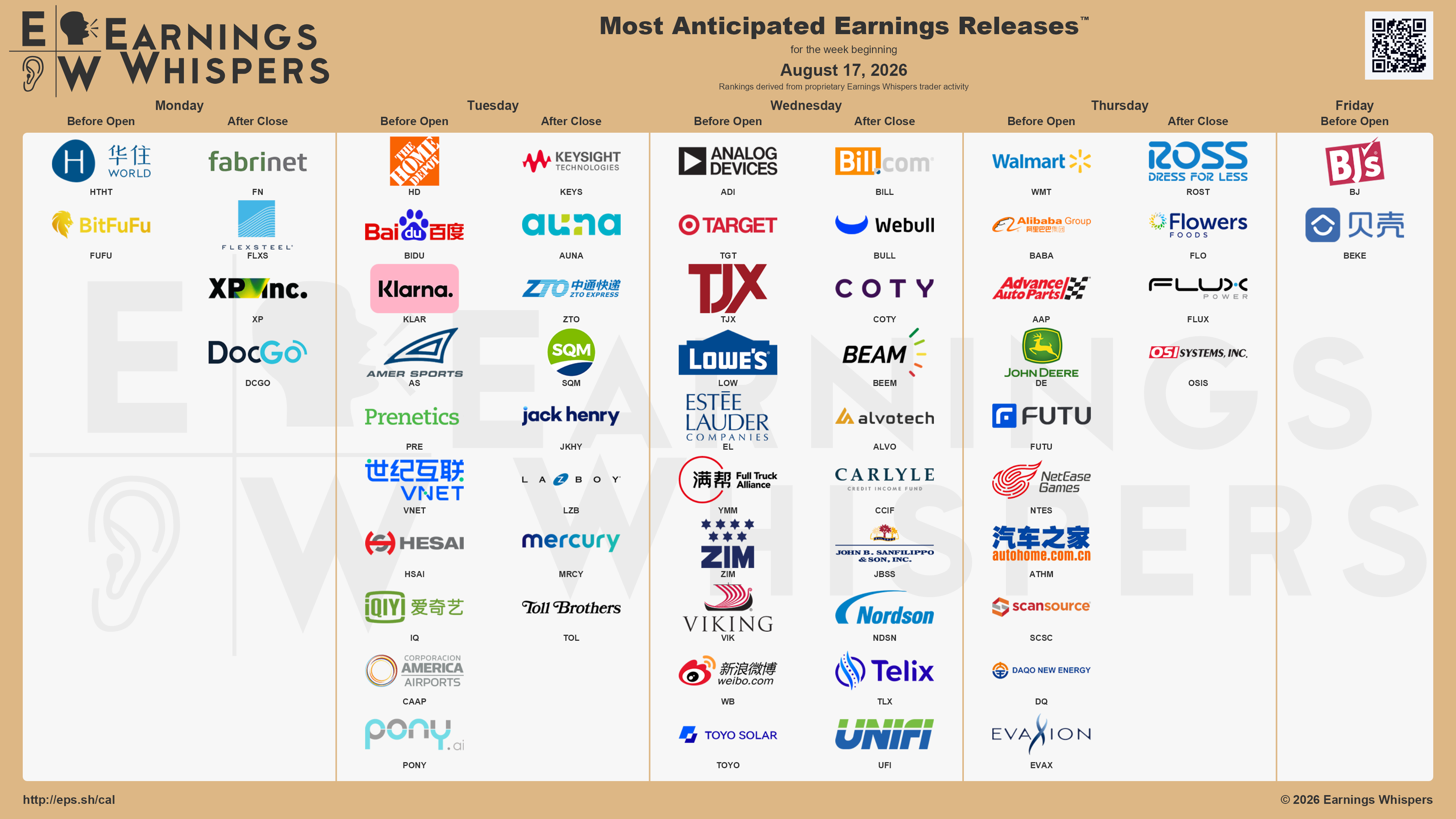
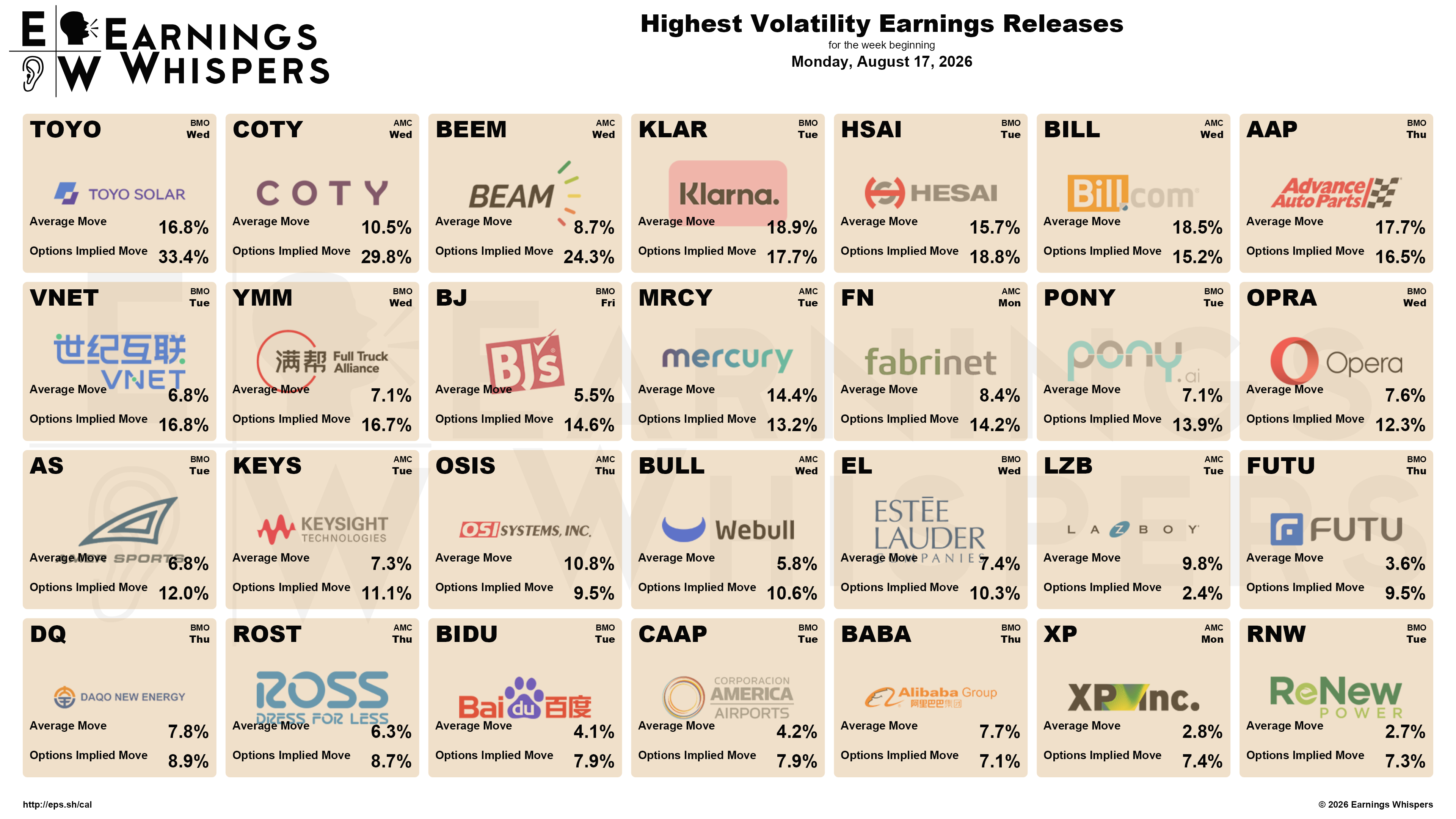
Retail Titans and China Tech Headline a High-Stakes Earnings Week
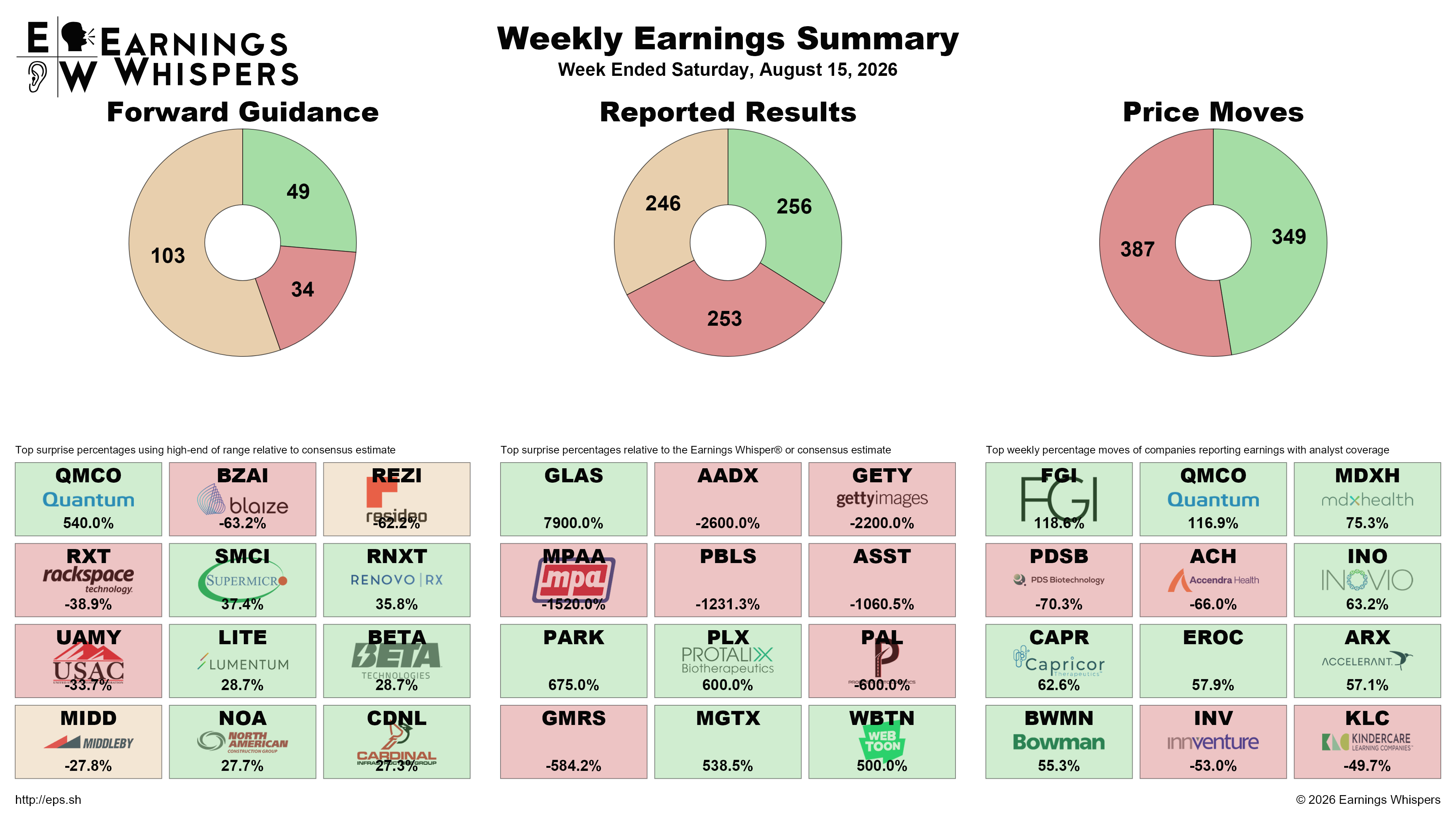
The week belongs to the big-box giants, and all eyes are on Walmart, which sits atop the most-watched list as investors look for confirmation that the American shopper is still spending. The mood heading into its report is quietly optimistic, and history suggests the stock tends to make a decent move when it opens the books. The picture gets more interesting across the home-improvement aisle, where Home Depot and Lowe's tell very different stories. Home Depot walks in carrying a chill in the air, with cooling expectations and softer signals suggesting traders are bracing for a stumble, while Lowe's has quietly won over the crowd and could surprise to the upside. Target and TJX round out the retail parade, with the discount-and-off-price crowd generally in better spirits than the traditional department players. Keep an eye on Deere as well, the farm-equipment bellwether that offers a read on the industrial and agricultural economy, though sentiment there is leaning cautious.
Beyond the mall, this is a monster week for China-linked names, with Alibaba, Baidu, NetEase and a parade of smaller players all stepping up to the plate. The vibe here is a mixed bag: NetEase and a few gaming and cloud names have momentum on their side, while Baidu and Weibo carry a heavier, more skeptical tone that could make for a bumpy session. In technology, Analog Devices and Keysight are the crowd favorites, both riding strong tailwinds and upbeat expectations that have traders leaning bullish. The real fireworks, though, may come from the smaller and more speculative names where opinions are sharply divided. Buy-now-pay-later upstart Klarna and fintech player Webull are drawing plenty of doubters, and Estee Lauder faces the perennial question of whether its turnaround is finally taking hold. Expect big swings, plenty of surprises, and more than a few stocks that keep drifting long after the numbers hit the tape. Buckle up.
Walmart's Profit Machine Hums as Wall Street Waits for Fuel to Cool
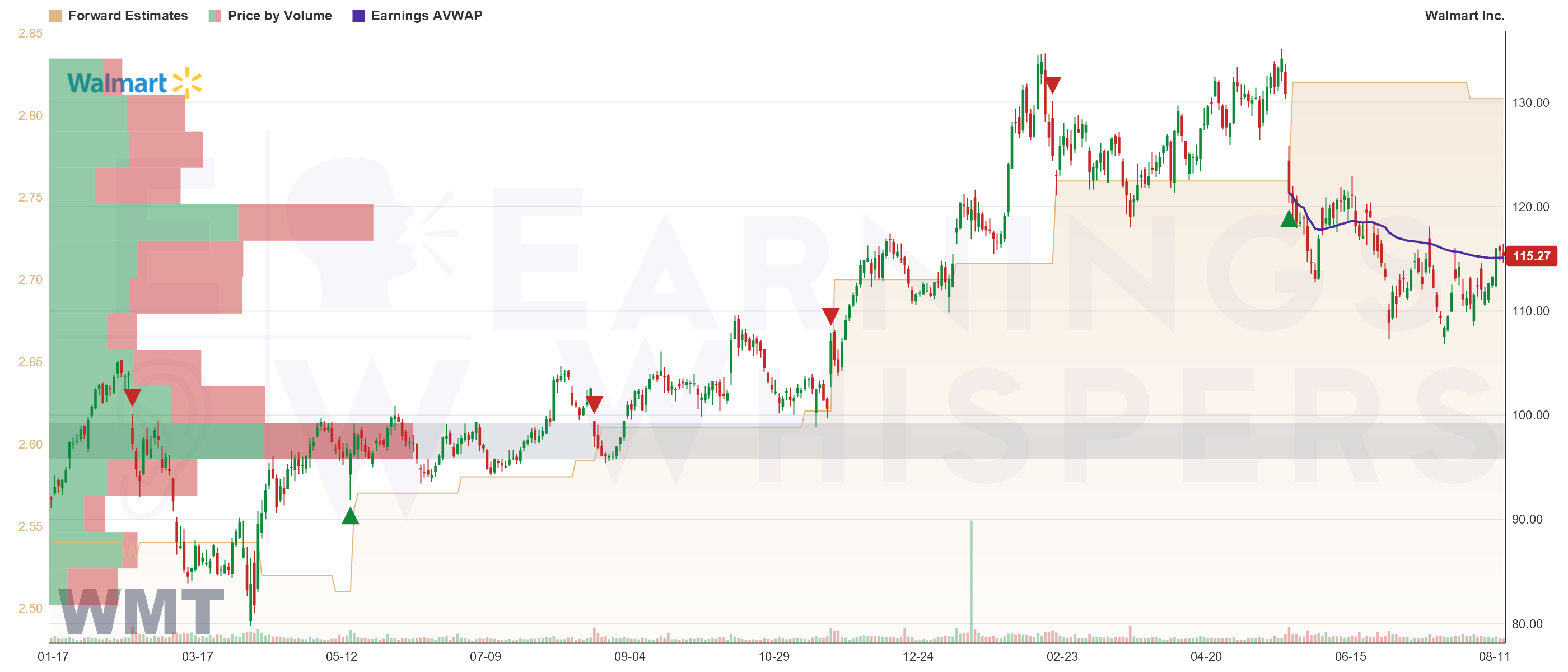
Walmart (WMT) is confirmed to report earnings on Thursday, August 20, 2026 at about 7:00 AM ET. Wall Street is looking for $0.73 per share on $186.32 billion in revenue, which would be 5.0% more sales than a year ago, but the whisper number is a touch higher at $0.75. Management itself guided to $0.72 to $0.74 per share on $184.50 to $186.27 billion. Investors are feeling good, with 57.1% betting on a beat, yet the stock has quietly slipped 7.3% since last quarter's report and now sits 2.5% below its 200 day moving average of $118.25. Short sellers nudged their bets up 1.0%, estimates have crept lower, and on August 5 someone scooped up 20,948 of the $119.00 puts expiring August 21, so not everyone is popping the champagne early.
Here is what actually matters heading in. Last quarter Walmart's profit engine kicked into a higher gear, with U.S. merchandise margins turning favorable for the first time in eighteen quarters, the strongest customer traffic in six quarters, and the high margin stuff like advertising, memberships, and its marketplace now making up roughly a third of operating profit. The catch is fuel. Pricier gas took a bite out of profit growth and is squeezing lower income shoppers so hard that fill-ups under ten gallons showed up for the first time since 2022. If fuel stays high through the back half, expect more talk of retail inflation. Watch whether management nudges full-year guidance up rather than just holding it, because the next quarter's profit outlook already hinted at acceleration.
ADI Rides the AI and Industrial Wave Into Earnings
Analog Devices (ADI) steps up to the earnings plate on Wednesday, August 19, 2026 at roughly 7:00 AM ET, and the crowd is leaning in. Wall Street wants $3.33 per share on $3.92 billion in revenue, which would be a hefty 36.1% jump in sales from a year ago, but the smart money whispers even higher at $3.45 per share. That is right at the top of the company's own guidance of $3.15 to $3.45 per share on $3.80 billion to $4.00 billion. Investors are feeling good, with 83.3% betting on a beat. Short interest has dropped 10.2% since last quarter, and while the stock has barely budged since the last report, drifting down a tiny 0.2%, it still sits a comfortable 15.3% above its 200 day moving average of $337.74. Estimates have been ticking up across the board. One thing worth a raised eyebrow: on Tuesday, August 11, someone scooped up 1,081 of the $330.00 puts expiring September 18, so a few folks are quietly buying insurance.
Here is the real story. Last quarter ADI was firing on all cylinders, posting record revenue and raising its guide on revenue, margins, and earnings all at once, with management saying their confidence has never been greater. The chips business is being carried by two big engines: industrial, now half of all sales and up a monster 56% from last year, and data center, which exploded more than 90% as AI demand keeps eating everything in sight. They also announced the Empower Semiconductor deal to grab power technology aimed squarely at AI accelerators, with the payoff expected in 2027. Even the sleepy automotive segment woke up. The one soft spot to watch is gross margin, which they guided slightly lower because their factories are basically running flat out and consumer is dipping a bit on memory shortages. Bottom line, the momentum is strong and the bar is high, so the question is whether ADI can keep clearing it.
Alibaba's AI Bet Starts Paying Off, But the Meter Is Still Running
Alibaba Group Holding Limited (BABA) is set to report earnings before the sun is fully up on Thursday, August 20, 2026, at roughly 5:30 AM ET. Wall Street is looking for $1.94 per share on revenue of $38.63 billion, which would be solid growth of 11.7% from a year ago, though the quieter whisper number sits a bit lighter at $1.85. The mood heading in is grumpy, with investors leaning bearish, yet more than half still think the company will squeak out a beat. Short sellers have piled in, bumping up their bets by 7.1% since last quarter, while the stock has slid 6.2% since the last report and now trades 11% under its 200 day average of $139.15. Analysts have been trimming their estimates too. But not everyone is pessimistic. On Tuesday, August 11, someone stepped up and scooped 7,569 of the $165.00 calls expiring September 18, a clear vote that not all the smart money is running for the exits.
Here is the real story to watch. Last quarter, Alibaba's massive spending on AI and cloud finally started showing up on the revenue side, and management could not stop saying the words inflection point. Cloud sales are speeding up quarter after quarter, hitting 40% growth, and they unveiled a brand new AI revenue figure that has jumped more than tenfold since November, with a promise to keep climbing. The catch is the bill. Profits and cash are getting squeezed hard, with one key profit measure down a jaw dropping 84% and cash flow flipping back to negative as they pour money into chips and data centers. So the question this quarter is simple: is the growth story strong enough to make investors forgive the shrinking wallet.
Target's Comeback Story Faces Its Toughest Test
Target (TGT) is confirmed to report earnings on Wednesday, August 19, 2026 at approximately 6:30 AM ET. Wall Street is looking for $2.26 per share on revenue of $26.00 billion, which would be 3.1% growth from a year ago, but the whisper number is a touch higher at $2.35. Here's the funny part: investors are walking in grumpy, yet nearly 58% still think Target beats. Short sellers have piled on 8.1% more bets since last quarter, and yet the stock has quietly climbed 28.5% since the last report to sit a lofty 31.9% above its 200 day average of $117.13. Estimates have been creeping higher, and on August 11 someone made a big bullish wager, scooping up 17,413 of the $80 calls expiring in January 2027.
Last quarter was Target's first real bounce after more than a year of shrinking sales, with a surprising 5.6% jump powered by Pokemon collabs, a baby aisle makeover, and a massive food reset. But management was quick to pump the brakes, and for good reason. This quarter is the hardest comparison of the entire year because Target is now lapping the huge Nintendo Switch 2 launch. Add in fading tax refund spending and a jittery shopper, and the company itself signaled sales growth could cool to around 1% for the rest of the year. So the big question on Wednesday is simple: was last quarter the start of a real turnaround, or just a nice one-off? The stock's steep run-up means it needs to show the momentum is sticking.
Home Depot: Steady Hands, Squeezed Margins
Home Depot (HD) is confirmed to report earnings on Tuesday, August 18, 2026 at roughly 6:00 AM ET, and the crowd is walking in cautious even while betting on a win. Wall Street wants $4.71 per share on $47.50 billion in revenue, good for 4.9% sales growth, and the Earnings Whisper number sits just a hair higher at $4.72. Here is the funny part: investors are bearish going in, yet 87.5% still expect a beat. Short interest has climbed 11.3% since last quarter, but the stock did not get the memo and drifted 16.1% higher, leaving it just 2.4% below its 200 day moving average of $347.29. Overall estimates have been nudged lower, and on Monday, August 3, someone scooped up 2,391 of the $295 puts expiring September 18, so a few people are clearly buying umbrellas.
The real story is a solid quarter that keeps giving back through the bottom line. Last quarter sales grew and comps stayed positive with Pro and online carrying the load, but earnings per share slipped, gross margin thinned by about three quarters of a point, and return on invested capital fell to 25.4% from 31.3% a year ago. Management traded its sunny mid-2025 tone for a plainer keep your head down message, warning that fresh tariffs and higher fuel and energy costs are now pushing input prices up. The new Mingledorff's HVAC deal opens a big new market and cross-selling is building, but big discretionary projects are still stuck on affordability. Bottom line: the top line holds while the margins keep leaking, so watch what management says about costs more than the headline number.
Baidu's AI Engine Is Revving, But Traders Are Betting Against It
Baidu (BIDU) steps up to report earnings before the sun is fully up on Tuesday, August 18, 2026, at roughly 5:00 AM ET. Wall Street is looking for $1.51 per share on revenue of $4.65 billion, a modest 1.8% bump from a year ago, though the Earnings Whisper number sits a touch higher at $1.57. Here's the funny part: investors are grumpy heading in, yet a full 80% of them still expect a beat. Meanwhile the skeptics are loading up, with short interest jumping 16.4% since last quarter as the stock slid 27.6% from where it opened after the last report, leaving it 17% under its 200 day moving average of $124.93. And on Friday, August 14, someone made a bold move, snapping up 11,510 of the $91.00 puts expiring August 21, a clear bet the pain isn't over.
But don't sleep on the story underneath. Last quarter was a genuine turning point, as Baidu's AI-powered business crossed 50% of its core revenue for the first time and dragged the whole general business back to positive growth after several rough quarters. The real fireworks came from AI cloud, where infrastructure revenue exploded 79% and the GPU side rocketed 184%, all at fatter margins that management says will keep lifting the bottom line. Toss in a shiny new Ernie 5.1 model ranked tops in China, fresh marquee clients like Honor and Oppo, and three straight quarters of positive cash flow, and you have a company hitting its stride. The catch? Robotaxi rides ticked down slightly, iQIYI is still soft, and tight chip supply could cap the party. So the question Tuesday is simple: does the market finally reward the AI momentum, or keep siding with the shorts?
BILL Bets the House on AI While Fattening Its Margins
BILL (BILL) steps up to the earnings plate on Wednesday, August 19, 2026 at about 4:00 PM ET. Wall Street is looking for $0.71 per share on revenue of $429.71 million, good for 12.1% growth over last year, though the Whisper number nudges a touch higher to $0.73. Management set the table with guidance of $0.69 to $0.72 per share on revenue between $425 million and $435 million. Here's the fun part: investors are walking in with a frown, yet 90% of them still expect a beat. Meanwhile the shorts are heading for the exits, with short interest down 24.4% since last quarter as the stock quietly climbed 21.4% to sit 13.6% above its 200 day average of $43.81. And on July 29, someone snapped up 2,012 of the $50 calls expiring September 18, so at least a few folks are betting on fireworks.
The real story is BILL going all in on AI. Last quarter the company hit its first ever GAAP profit, cranked operating margin up to 20%, and doubled its buyback authorization to a cool $1 billion. To fund the pivot, it announced a workforce cut of up to 30% aimed at roughly $110 million in savings, and named AI its single number one priority. The catch is that core growth is cooling, with the key APAR business slowing to 12% and same-store payment volume stuck at 4%. So watch two things: whether margins keep marching higher, and whether that aggressive reorg comes with any hiccups. This one is a profit-and-payout winner set against a slow-growth backdrop, so expect a tug of war.
H World Heads Into Earnings With Fresh Recovery Legs and Skeptical Fans
H World Group Limited (HTHT) is on deck to report earnings Monday, August 17, 2026 at roughly 6:15 AM ET. Wall Street is looking for $0.65 per share on revenue of $982.80 million, which would mark 9.6% growth from a year ago. Here is the funny part: investors are leaning bearish going in, yet 60.0% of them still expect the company to beat. Short sellers have quietly backed off, cutting their bets by 26.1% since last quarter, while the stock has slid 6.1% from where it opened after the last report and now sits 11.2% under its 200 day moving average of $47.18. Analysts have been trimming their estimates, so the bar has come down a bit. And on Friday, August 14, 2026, someone snapped up 704 of the $45.00 calls expiring August 21, 2026, a small wager that the bulls might be right.
Here is what actually matters right now. Last quarter was a real turning point for this Chinese hotel giant. Its core RevPAR, basically how much money each room earns, finally flipped positive at plus 3.0% after a long stretch of flat to falling numbers, and profits jumped even faster with adjusted net income up 38.6%. Management also kicked off an overseas push, planting its first flags in Vietnam and Laos and setting up Singapore as its Asia-Pacific home base. The catch is that they held their full-year revenue outlook steady instead of raising it, and their older Hanting budget hotels are still a drag that could take a year or two to fix. So the story heading into Monday is simple: momentum is clearly building, but management is not popping the champagne just yet, and neither is the crowd.
Klarna Finally Turns a Profit, and the Options Crowd Smells More
Klarna Group plc (KLAR) steps up to report earnings on Tuesday, August 18, 2026 at roughly 7:30 AM ET. Wall Street is penciling in a loss of $0.07 per share on revenue of $987.94 million, though the Earnings Whisper number is a slimmer loss of $0.03 per share, and management itself guided to revenue between $960 million and $1 billion. Here is the fun part: investors are leaning bearish going in, yet a full 80% still expect a beat. Short sellers have piled on, bumping short interest up 18.9% since last quarter, but the stock has shrugged them off and climbed 34.3% since its last post-earnings open, now sitting just 2.9% under its 200 day moving average of $21.41. Estimates have been nudged higher across the board, and on Monday, August 10, someone scooped up 5,809 of the $25.00 calls expiring January 15, 2027, a decent bet that the good times keep rolling.
Last quarter was the moment Klarna flipped the script. The company had spent two quarters getting hammered for pouring money into its buy now, pay later loan build-out with little profit to show for it, but in the first quarter of 2026 that patience finally paid off. Operating income swung to a positive $68 million, net income crept into the black at $1 million, and revenue crossed the $1 billion mark, up 44%. Even better, the loans are getting healthier, not sicker, with late payments improving, while card users grew to 5 million and big new partners like JP Morgan Payments, WorldPay, Google Pay, and Stripe came aboard. The one thing to watch is that management only reiterated its full year outlook rather than raising it, and the second half looks softer as easy currency tailwinds fade and last year's giant Walmart-sized wins become tougher to top.
Lowe's Q2: Online Roars, Margins Snore
Lowe's (LOW) is confirmed to report earnings on Wednesday, August 19, 2026 at roughly 6:00 AM ET. Wall Street is looking for $4.22 per share on revenue of $26.18 billion, a healthy 9.3% jump from last year, though the Earnings Whisper number sits a touch higher at $4.26. The crowd is feeling good here, with 88.9% expecting a beat. Short interest has slipped 4.5% since last quarter, and the stock has quietly ticked up 2.1% since its last report, yet it still sits 8.2% below its 200 day moving average of $238.10. One thing to keep an eye on: overall earnings estimates have actually been trimmed lower since last time. And on Friday, July 31, someone stepped up and bought 1,955 of the $235.00 calls expiring August 21, so at least a few folks are betting on a pop.
Here is the real story going in. The good stuff is genuinely good. Online sales have been picking up speed every quarter, hitting +15.5% last time, comps have been positive four quarters running, and the Milo AI assistant is now fielding over a million questions a month while converting shoppers three times better. But the catch is margins, and management basically told us Q2 earnings would land about 2% below last year. Blame the acquisition drag from FBM and ADG plus a fresh punch of higher fuel and shipping costs tied to the oil spike. DIY shoppers are still sitting on their wallets in what Marvin flat out called the worst housing market since the financial crisis. Bottom line: the growth engine hums, but this quarter the margins are the ones doing the talking.
Hesai Heads Into Earnings With Bears Circling and a Mercedes in the Garage
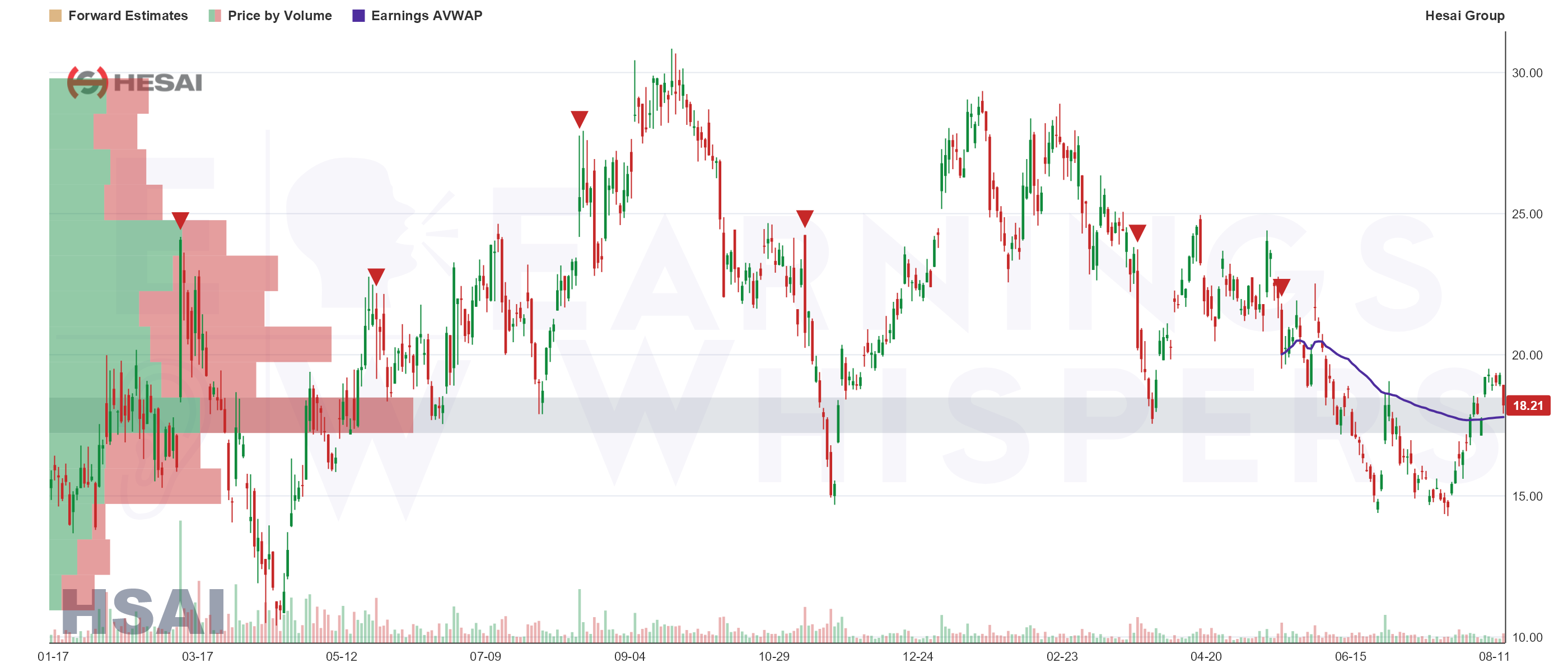
Hesai Group (HSAI) is set to report earnings before the bell on Tuesday, August 18, 2026 at roughly 4:30 AM ET, with the Street looking for revenue of $661.93 million. That would be a jaw-dropping 571.3% jump from a year ago, and it towers over the company's own guidance of just $123.00 million to $130.00 million. Investors are leaning bearish going in, though it is a coin flip, with half still betting on a beat. The skeptics have been busy too, as short interest has jumped 76.3% since the last report while the stock has slid 15.7% from its post-earnings open to sit 15.0% under its 200 day moving average of $21.41. Analysts have quietly trimmed their estimates, and yet somebody is not buying the gloom. On Wednesday, August 12, 2026 a chunky trade of 2,288 of the $17.50 calls expiring September 18, 2026 crossed the tape, a bullish wink amid all the frowning.
Here is the real story worth watching. Last quarter Hesai landed a genuine, named win as the LiDAR supplier for Mercedes-Benz L3 models in Europe and China, adding first-time entries with GAC Toyota and Xiaomi on top of it. Its grip on China's long-range ADAS market tightened to 55% share, it reaffirmed plans to roughly double shipments to 3.0 to 3.5 million units this year, and it has now strung together four straight profitable quarters. The catch is that management is also pushing into a new physical AI segment that is losing money for now, near-term revenue growth is cooling to the 20% to 27% range, and prices per unit keep sliding as cheaper mass-market sensors take over the mix. So the question for Tuesday is simple: does the Mercedes-fueled growth story outrun the margin math?
Nebius Breaks Free From Its Big-Tech Crutch and the Numbers Are Screaming
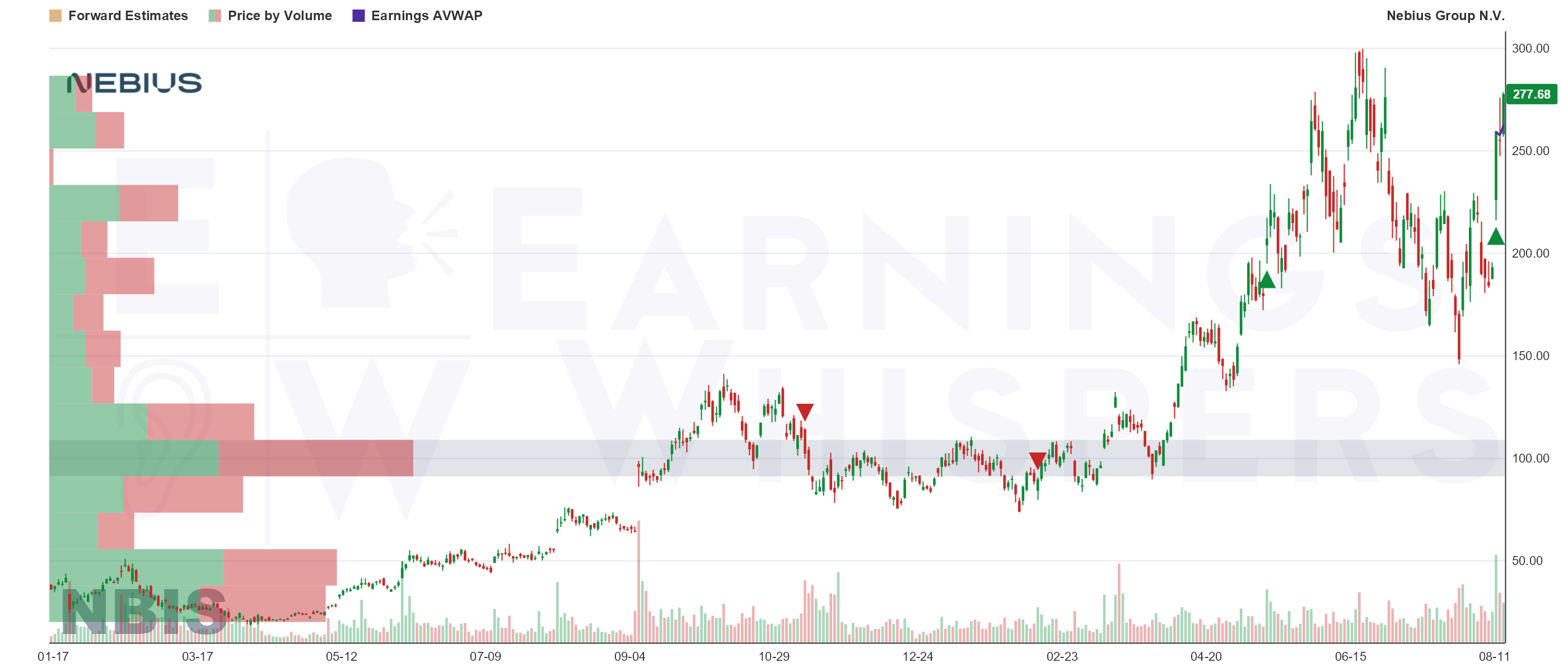
Nebius Group N.V. Cl A (NBIS) posted a loss of $0.12 per share on revenue of $582.30 million for the second quarter ended June 2026, and it wasn't even close to what Wall Street braced for. The consensus called for a loss of $0.67 per share on $545.12 million in revenue, and the Earnings Whisper number sat at a loss of $0.52. In plain English, Nebius beat the pack by nearly 77 percent, the kind of number that makes an analyst spill his coffee. On the call, management stuck to its 2026 revenue outlook of $3.00 billion to $3.40 billion, a touch below the $3.48 billion the Street had penciled in, but there's a good reason for that (more below). Nebius, for the uninitiated, is the AI cloud company building the full toolkit that lets developers and companies run their own AI show, from crunching data and training models all the way to going live.
Here's the real story: Nebius finally kicked its dependence on a couple of giant hyperscaler deals and landed four fresh billion-dollar-plus wins with names like Reflection and Cohere, each paying up with less than two-year paybacks. Revenue jumped 46 percent from last quarter, annual recurring revenue tripled to $3 billion, and profit margins fattened up to 41 percent. The company even raised its contracted-power target to 5 gigawatts and is sitting on a $40 billion backlog. The reason 2026 guidance held steady rather than jumping is simple: these shiny new deals switch on late in the year, so the fireworks really light up in 2027. Watch for a pending New Jersey site vote and some choppy debt markets, but make no mistake, this is a company hitting its stride.
AMAT Rides the AI Wave to Record Quarter, Barely Misses on EPS
Applied Materials (AMAT) posted earnings of $3.50 per share on revenue of $9.12 billion for the fiscal third quarter that ended in July 2026. Wall Street was looking for $3.38 per share on $9.00 billion, so the company beat on the top line but came up just a touch short of the whisper number of $3.56, missing by a hair at 1.69%. Don't let that tiny miss fool you though, because revenue jumped nearly 25% from a year ago, and this was the highest quarter-over-quarter revenue growth in the company's entire history. Looking ahead, management guided fourth quarter earnings to a range of $3.82 to $4.22 per share on revenue between $9.75 billion and $10.75 billion, both comfortably above what analysts expected. CEO Gary Dickerson called it a record-breaking quarter and said the AI boom is driving demand like they've never seen, prompting them to raise their outlook yet again for 2026 and to expect another strong year in 2027. In plain terms, Applied Materials makes the machines and tools that build the chips powering the AI revolution, and business is booming.
Here's what really matters: this company keeps raising the bar every single quarter. Their forecast for chip equipment growth has climbed from over 20% earlier this year to now stronger than 30%, and packaging demand tied to AI chips is expected to grow more than 70%. Gross margin hit a record 50.4%, marking the 13th straight quarter of improvement. They're so confident they plan to double their factory output by 2028 and just added over 1,500 workers in a single quarter. Broadcom even signed on as a new innovation partner. The only speed bumps worth mentioning are minor: next quarter's margins will stay flat as they pay for all that hiring and expansion, and a slightly higher tax rate is coming in 2027. Against a demand backdrop this strong, those are small potatoes.
Rocket Lab Misses on Profit but Fires Up Record Revenue and a Bold Iridium Bet
Rocket Lab (RKLB) posted a loss of $0.08 per share on revenue of $234.07 million for the second quarter ended June 2026, coming in well below the consensus and Earnings Whisper estimates of a $0.03 loss. That headline miss stings, but the revenue told a different story, growing nearly 62% year over year to a record and topping the $231.57 million the Street was looking for. Even better, management guided third quarter revenue to $250 to $265 million, comfortably above the $238.34 million consensus. Founder and CEO Sir Peter Beck was in full victory-lap mode, touting a record $2.36 billion backlog and more than $1 billion in fresh launch and space systems contracts already inked in the current quarter. In short, the profit line disappointed while the growth engine roared.
Here is what really matters. Rocket Lab is spending big to become a full-blown space power, and that is why the losses look ugly right now. The company is buying Iridium, a satellite operator with 66 satellites and more than 2.5 million subscribers that brings in roughly $870 million a year, a deal that pushes Rocket Lab into steadier, higher-margin territory once it closes in mid-2027. Meanwhile the defense wins are stacking up fast, including a record $266 million Space Force contract and a $397 million award tied to its upcoming Neutron rocket. The two things to watch are the cash going out the door, which widened to $110 million this quarter, and the Neutron rocket's first flight, which has slipped several times and now needs to hit a narrowing late 2026 window. Bottom line, the momentum is real and building, but investors are paying up front for a payoff that is still a rocket launch or two away.
Supermicro Finally Learns to Make Money on AI
Supermicro (SMCI) just crushed it for the quarter ending June 2026, posting $1.70 per share on $11.12 billion in revenue. Wall Street was looking for a measly $0.69 per share on $11.00 billion, so the profit beat by nearly 143% while sales nearly doubled from a year ago. But the real jaw-dropper is the outlook. Management guided next quarter to $1.01 to $1.10 per share on $14.5 to $15.5 billion in revenue, way above the $0.79 and $11.72 billion analysts expected. Then they went and initiated a full-year 2027 revenue forecast of $65 to $72 billion, roughly double this year and miles ahead of the $52.39 billion consensus. CEO Charles Liang credited the company's all-in-one AI and IT strategy, which reeled in hundreds of new customers, booked over $60 billion in fresh orders, and stuffed the backlog to record levels heading into the new fiscal year.
Here is the part clients need to hear. The headline story is genuinely better, with a repaired balance sheet after a $5.6 billion raise, cash flow swinging positive, and enterprise customers now making up half of sales instead of a sliver. But do not get too excited about that eye-popping 17.6% gross margin. Management admitted about three quarters of that beat came from lucky product mix and one-time items like pushing low-margin deals into next quarter. The run rate is closer to the 10.4% to 10.8% they guided for next quarter, still solid but back to earth. Add in the fact that revenue landed near the low end again because big customers keep dragging their feet on installations, plus an unresolved government probe into old export issues, and the picture is clear. Real momentum, real orders, real cash, but keep one eye on whether they can actually ship it all on time.
CoreWeave Turns the Corner: Margins Finally Show Up to the Party
CoreWeave (CRWV) posted a loss of $1.14 per share on revenue of $2.58 billion for its second quarter ended June 2026. That's a wider miss than Wall Street wanted, coming in 15.15% below the consensus loss estimate of $1.48, and even further from the $0.99 whisper. But here's the twist that matters: revenue grew a jaw-dropping 112% year over year and actually beat the $2.54 billion consensus. So while the bottom line still looks ugly, the top line is on fire. CEO Michael Intrator called this an "inflection point," and for once the buzzword actually fits, because the profit picture is finally starting to bend the right way.
The real story is margins. Adjusted operating income jumped to $128 million, blowing past guidance and up from just $21 million last quarter. Management raised pretty much every number that matters, including full-year 2026 revenue to $12.4 to $13.2 billion and third quarter guidance of $3.45 to $3.60 billion, both ahead of consensus. A roughly 25% July price hike and richer new contracts are fueling the shift, and the backlog now sits at a massive $104 billion. The catch? The company is still spending like crazy, with capex now guided to $35 to $39 billion and a net loss that widened to $626 million as interest costs climb. In short, CoreWeave is burning cash to build an AI empire, but for the first time the money is starting to come back faster than the doubters expected.
The week belongs to the big-box giants, and all eyes are on Walmart, which sits atop the most-watched list as investors look for confirmation that the American shopper is still spending. The mood heading into its report is quietly optimistic, and history suggests the stock tends to make a decent move when it opens the books. The picture gets more interesting across the home-improvement aisle, where Home Depot and Lowe's tell very different stories. Home Depot walks in carrying a chill in the air, with cooling expectations and softer signals suggesting traders are bracing for a stumble, while Lowe's has quietly won over the crowd and could surprise to the upside. Target and TJX round out the retail parade, with the discount-and-off-price crowd generally in better spirits than the traditional department players. Keep an eye on Deere as well, the farm-equipment bellwether that offers a read on the industrial and agricultural economy, though sentiment there is leaning cautious.
Beyond the mall, this is a monster week for China-linked names, with Alibaba, Baidu, NetEase and a parade of smaller players all stepping up to the plate. The vibe here is a mixed bag: NetEase and a few gaming and cloud names have momentum on their side, while Baidu and Weibo carry a heavier, more skeptical tone that could make for a bumpy session. In technology, Analog Devices and Keysight are the crowd favorites, both riding strong tailwinds and upbeat expectations that have traders leaning bullish. The real fireworks, though, may come from the smaller and more speculative names where opinions are sharply divided. Buy-now-pay-later upstart Klarna and fintech player Webull are drawing plenty of doubters, and Estee Lauder faces the perennial question of whether its turnaround is finally taking hold. Expect big swings, plenty of surprises, and more than a few stocks that keep drifting long after the numbers hit the tape. Buckle up.
Walmart's Profit Machine Hums as Wall Street Waits for Fuel to Cool
Walmart (WMT) is confirmed to report earnings on Thursday, August 20, 2026 at about 7:00 AM ET. Wall Street is looking for $0.73 per share on $186.32 billion in revenue, which would be 5.0% more sales than a year ago, but the whisper number is a touch higher at $0.75. Management itself guided to $0.72 to $0.74 per share on $184.50 to $186.27 billion. Investors are feeling good, with 57.1% betting on a beat, yet the stock has quietly slipped 7.3% since last quarter's report and now sits 2.5% below its 200 day moving average of $118.25. Short sellers nudged their bets up 1.0%, estimates have crept lower, and on August 5 someone scooped up 20,948 of the $119.00 puts expiring August 21, so not everyone is popping the champagne early.
Here is what actually matters heading in. Last quarter Walmart's profit engine kicked into a higher gear, with U.S. merchandise margins turning favorable for the first time in eighteen quarters, the strongest customer traffic in six quarters, and the high margin stuff like advertising, memberships, and its marketplace now making up roughly a third of operating profit. The catch is fuel. Pricier gas took a bite out of profit growth and is squeezing lower income shoppers so hard that fill-ups under ten gallons showed up for the first time since 2022. If fuel stays high through the back half, expect more talk of retail inflation. Watch whether management nudges full-year guidance up rather than just holding it, because the next quarter's profit outlook already hinted at acceleration.
ADI Rides the AI and Industrial Wave Into Earnings
Analog Devices (ADI) steps up to the earnings plate on Wednesday, August 19, 2026 at roughly 7:00 AM ET, and the crowd is leaning in. Wall Street wants $3.33 per share on $3.92 billion in revenue, which would be a hefty 36.1% jump in sales from a year ago, but the smart money whispers even higher at $3.45 per share. That is right at the top of the company's own guidance of $3.15 to $3.45 per share on $3.80 billion to $4.00 billion. Investors are feeling good, with 83.3% betting on a beat. Short interest has dropped 10.2% since last quarter, and while the stock has barely budged since the last report, drifting down a tiny 0.2%, it still sits a comfortable 15.3% above its 200 day moving average of $337.74. Estimates have been ticking up across the board. One thing worth a raised eyebrow: on Tuesday, August 11, someone scooped up 1,081 of the $330.00 puts expiring September 18, so a few folks are quietly buying insurance.
Here is the real story. Last quarter ADI was firing on all cylinders, posting record revenue and raising its guide on revenue, margins, and earnings all at once, with management saying their confidence has never been greater. The chips business is being carried by two big engines: industrial, now half of all sales and up a monster 56% from last year, and data center, which exploded more than 90% as AI demand keeps eating everything in sight. They also announced the Empower Semiconductor deal to grab power technology aimed squarely at AI accelerators, with the payoff expected in 2027. Even the sleepy automotive segment woke up. The one soft spot to watch is gross margin, which they guided slightly lower because their factories are basically running flat out and consumer is dipping a bit on memory shortages. Bottom line, the momentum is strong and the bar is high, so the question is whether ADI can keep clearing it.
Alibaba's AI Bet Starts Paying Off, But the Meter Is Still Running
Alibaba Group Holding Limited (BABA) is set to report earnings before the sun is fully up on Thursday, August 20, 2026, at roughly 5:30 AM ET. Wall Street is looking for $1.94 per share on revenue of $38.63 billion, which would be solid growth of 11.7% from a year ago, though the quieter whisper number sits a bit lighter at $1.85. The mood heading in is grumpy, with investors leaning bearish, yet more than half still think the company will squeak out a beat. Short sellers have piled in, bumping up their bets by 7.1% since last quarter, while the stock has slid 6.2% since the last report and now trades 11% under its 200 day average of $139.15. Analysts have been trimming their estimates too. But not everyone is pessimistic. On Tuesday, August 11, someone stepped up and scooped 7,569 of the $165.00 calls expiring September 18, a clear vote that not all the smart money is running for the exits.
Here is the real story to watch. Last quarter, Alibaba's massive spending on AI and cloud finally started showing up on the revenue side, and management could not stop saying the words inflection point. Cloud sales are speeding up quarter after quarter, hitting 40% growth, and they unveiled a brand new AI revenue figure that has jumped more than tenfold since November, with a promise to keep climbing. The catch is the bill. Profits and cash are getting squeezed hard, with one key profit measure down a jaw dropping 84% and cash flow flipping back to negative as they pour money into chips and data centers. So the question this quarter is simple: is the growth story strong enough to make investors forgive the shrinking wallet.
Target's Comeback Story Faces Its Toughest Test
Target (TGT) is confirmed to report earnings on Wednesday, August 19, 2026 at approximately 6:30 AM ET. Wall Street is looking for $2.26 per share on revenue of $26.00 billion, which would be 3.1% growth from a year ago, but the whisper number is a touch higher at $2.35. Here's the funny part: investors are walking in grumpy, yet nearly 58% still think Target beats. Short sellers have piled on 8.1% more bets since last quarter, and yet the stock has quietly climbed 28.5% since the last report to sit a lofty 31.9% above its 200 day average of $117.13. Estimates have been creeping higher, and on August 11 someone made a big bullish wager, scooping up 17,413 of the $80 calls expiring in January 2027.
Last quarter was Target's first real bounce after more than a year of shrinking sales, with a surprising 5.6% jump powered by Pokemon collabs, a baby aisle makeover, and a massive food reset. But management was quick to pump the brakes, and for good reason. This quarter is the hardest comparison of the entire year because Target is now lapping the huge Nintendo Switch 2 launch. Add in fading tax refund spending and a jittery shopper, and the company itself signaled sales growth could cool to around 1% for the rest of the year. So the big question on Wednesday is simple: was last quarter the start of a real turnaround, or just a nice one-off? The stock's steep run-up means it needs to show the momentum is sticking.
Home Depot: Steady Hands, Squeezed Margins
Home Depot (HD) is confirmed to report earnings on Tuesday, August 18, 2026 at roughly 6:00 AM ET, and the crowd is walking in cautious even while betting on a win. Wall Street wants $4.71 per share on $47.50 billion in revenue, good for 4.9% sales growth, and the Earnings Whisper number sits just a hair higher at $4.72. Here is the funny part: investors are bearish going in, yet 87.5% still expect a beat. Short interest has climbed 11.3% since last quarter, but the stock did not get the memo and drifted 16.1% higher, leaving it just 2.4% below its 200 day moving average of $347.29. Overall estimates have been nudged lower, and on Monday, August 3, someone scooped up 2,391 of the $295 puts expiring September 18, so a few people are clearly buying umbrellas.
The real story is a solid quarter that keeps giving back through the bottom line. Last quarter sales grew and comps stayed positive with Pro and online carrying the load, but earnings per share slipped, gross margin thinned by about three quarters of a point, and return on invested capital fell to 25.4% from 31.3% a year ago. Management traded its sunny mid-2025 tone for a plainer keep your head down message, warning that fresh tariffs and higher fuel and energy costs are now pushing input prices up. The new Mingledorff's HVAC deal opens a big new market and cross-selling is building, but big discretionary projects are still stuck on affordability. Bottom line: the top line holds while the margins keep leaking, so watch what management says about costs more than the headline number.
Baidu's AI Engine Is Revving, But Traders Are Betting Against It
Baidu (BIDU) steps up to report earnings before the sun is fully up on Tuesday, August 18, 2026, at roughly 5:00 AM ET. Wall Street is looking for $1.51 per share on revenue of $4.65 billion, a modest 1.8% bump from a year ago, though the Earnings Whisper number sits a touch higher at $1.57. Here's the funny part: investors are grumpy heading in, yet a full 80% of them still expect a beat. Meanwhile the skeptics are loading up, with short interest jumping 16.4% since last quarter as the stock slid 27.6% from where it opened after the last report, leaving it 17% under its 200 day moving average of $124.93. And on Friday, August 14, someone made a bold move, snapping up 11,510 of the $91.00 puts expiring August 21, a clear bet the pain isn't over.
But don't sleep on the story underneath. Last quarter was a genuine turning point, as Baidu's AI-powered business crossed 50% of its core revenue for the first time and dragged the whole general business back to positive growth after several rough quarters. The real fireworks came from AI cloud, where infrastructure revenue exploded 79% and the GPU side rocketed 184%, all at fatter margins that management says will keep lifting the bottom line. Toss in a shiny new Ernie 5.1 model ranked tops in China, fresh marquee clients like Honor and Oppo, and three straight quarters of positive cash flow, and you have a company hitting its stride. The catch? Robotaxi rides ticked down slightly, iQIYI is still soft, and tight chip supply could cap the party. So the question Tuesday is simple: does the market finally reward the AI momentum, or keep siding with the shorts?
BILL Bets the House on AI While Fattening Its Margins
BILL (BILL) steps up to the earnings plate on Wednesday, August 19, 2026 at about 4:00 PM ET. Wall Street is looking for $0.71 per share on revenue of $429.71 million, good for 12.1% growth over last year, though the Whisper number nudges a touch higher to $0.73. Management set the table with guidance of $0.69 to $0.72 per share on revenue between $425 million and $435 million. Here's the fun part: investors are walking in with a frown, yet 90% of them still expect a beat. Meanwhile the shorts are heading for the exits, with short interest down 24.4% since last quarter as the stock quietly climbed 21.4% to sit 13.6% above its 200 day average of $43.81. And on July 29, someone snapped up 2,012 of the $50 calls expiring September 18, so at least a few folks are betting on fireworks.
The real story is BILL going all in on AI. Last quarter the company hit its first ever GAAP profit, cranked operating margin up to 20%, and doubled its buyback authorization to a cool $1 billion. To fund the pivot, it announced a workforce cut of up to 30% aimed at roughly $110 million in savings, and named AI its single number one priority. The catch is that core growth is cooling, with the key APAR business slowing to 12% and same-store payment volume stuck at 4%. So watch two things: whether margins keep marching higher, and whether that aggressive reorg comes with any hiccups. This one is a profit-and-payout winner set against a slow-growth backdrop, so expect a tug of war.
H World Heads Into Earnings With Fresh Recovery Legs and Skeptical Fans
H World Group Limited (HTHT) is on deck to report earnings Monday, August 17, 2026 at roughly 6:15 AM ET. Wall Street is looking for $0.65 per share on revenue of $982.80 million, which would mark 9.6% growth from a year ago. Here is the funny part: investors are leaning bearish going in, yet 60.0% of them still expect the company to beat. Short sellers have quietly backed off, cutting their bets by 26.1% since last quarter, while the stock has slid 6.1% from where it opened after the last report and now sits 11.2% under its 200 day moving average of $47.18. Analysts have been trimming their estimates, so the bar has come down a bit. And on Friday, August 14, 2026, someone snapped up 704 of the $45.00 calls expiring August 21, 2026, a small wager that the bulls might be right.
Here is what actually matters right now. Last quarter was a real turning point for this Chinese hotel giant. Its core RevPAR, basically how much money each room earns, finally flipped positive at plus 3.0% after a long stretch of flat to falling numbers, and profits jumped even faster with adjusted net income up 38.6%. Management also kicked off an overseas push, planting its first flags in Vietnam and Laos and setting up Singapore as its Asia-Pacific home base. The catch is that they held their full-year revenue outlook steady instead of raising it, and their older Hanting budget hotels are still a drag that could take a year or two to fix. So the story heading into Monday is simple: momentum is clearly building, but management is not popping the champagne just yet, and neither is the crowd.
Klarna Finally Turns a Profit, and the Options Crowd Smells More
Klarna Group plc (KLAR) steps up to report earnings on Tuesday, August 18, 2026 at roughly 7:30 AM ET. Wall Street is penciling in a loss of $0.07 per share on revenue of $987.94 million, though the Earnings Whisper number is a slimmer loss of $0.03 per share, and management itself guided to revenue between $960 million and $1 billion. Here is the fun part: investors are leaning bearish going in, yet a full 80% still expect a beat. Short sellers have piled on, bumping short interest up 18.9% since last quarter, but the stock has shrugged them off and climbed 34.3% since its last post-earnings open, now sitting just 2.9% under its 200 day moving average of $21.41. Estimates have been nudged higher across the board, and on Monday, August 10, someone scooped up 5,809 of the $25.00 calls expiring January 15, 2027, a decent bet that the good times keep rolling.
Last quarter was the moment Klarna flipped the script. The company had spent two quarters getting hammered for pouring money into its buy now, pay later loan build-out with little profit to show for it, but in the first quarter of 2026 that patience finally paid off. Operating income swung to a positive $68 million, net income crept into the black at $1 million, and revenue crossed the $1 billion mark, up 44%. Even better, the loans are getting healthier, not sicker, with late payments improving, while card users grew to 5 million and big new partners like JP Morgan Payments, WorldPay, Google Pay, and Stripe came aboard. The one thing to watch is that management only reiterated its full year outlook rather than raising it, and the second half looks softer as easy currency tailwinds fade and last year's giant Walmart-sized wins become tougher to top.
Lowe's Q2: Online Roars, Margins Snore
Lowe's (LOW) is confirmed to report earnings on Wednesday, August 19, 2026 at roughly 6:00 AM ET. Wall Street is looking for $4.22 per share on revenue of $26.18 billion, a healthy 9.3% jump from last year, though the Earnings Whisper number sits a touch higher at $4.26. The crowd is feeling good here, with 88.9% expecting a beat. Short interest has slipped 4.5% since last quarter, and the stock has quietly ticked up 2.1% since its last report, yet it still sits 8.2% below its 200 day moving average of $238.10. One thing to keep an eye on: overall earnings estimates have actually been trimmed lower since last time. And on Friday, July 31, someone stepped up and bought 1,955 of the $235.00 calls expiring August 21, so at least a few folks are betting on a pop.
Here is the real story going in. The good stuff is genuinely good. Online sales have been picking up speed every quarter, hitting +15.5% last time, comps have been positive four quarters running, and the Milo AI assistant is now fielding over a million questions a month while converting shoppers three times better. But the catch is margins, and management basically told us Q2 earnings would land about 2% below last year. Blame the acquisition drag from FBM and ADG plus a fresh punch of higher fuel and shipping costs tied to the oil spike. DIY shoppers are still sitting on their wallets in what Marvin flat out called the worst housing market since the financial crisis. Bottom line: the growth engine hums, but this quarter the margins are the ones doing the talking.
Hesai Heads Into Earnings With Bears Circling and a Mercedes in the Garage
Hesai Group (HSAI) is set to report earnings before the bell on Tuesday, August 18, 2026 at roughly 4:30 AM ET, with the Street looking for revenue of $661.93 million. That would be a jaw-dropping 571.3% jump from a year ago, and it towers over the company's own guidance of just $123.00 million to $130.00 million. Investors are leaning bearish going in, though it is a coin flip, with half still betting on a beat. The skeptics have been busy too, as short interest has jumped 76.3% since the last report while the stock has slid 15.7% from its post-earnings open to sit 15.0% under its 200 day moving average of $21.41. Analysts have quietly trimmed their estimates, and yet somebody is not buying the gloom. On Wednesday, August 12, 2026 a chunky trade of 2,288 of the $17.50 calls expiring September 18, 2026 crossed the tape, a bullish wink amid all the frowning.
Here is the real story worth watching. Last quarter Hesai landed a genuine, named win as the LiDAR supplier for Mercedes-Benz L3 models in Europe and China, adding first-time entries with GAC Toyota and Xiaomi on top of it. Its grip on China's long-range ADAS market tightened to 55% share, it reaffirmed plans to roughly double shipments to 3.0 to 3.5 million units this year, and it has now strung together four straight profitable quarters. The catch is that management is also pushing into a new physical AI segment that is losing money for now, near-term revenue growth is cooling to the 20% to 27% range, and prices per unit keep sliding as cheaper mass-market sensors take over the mix. So the question for Tuesday is simple: does the Mercedes-fueled growth story outrun the margin math?
Nebius Breaks Free From Its Big-Tech Crutch and the Numbers Are Screaming
Nebius Group N.V. Cl A (NBIS) posted a loss of $0.12 per share on revenue of $582.30 million for the second quarter ended June 2026, and it wasn't even close to what Wall Street braced for. The consensus called for a loss of $0.67 per share on $545.12 million in revenue, and the Earnings Whisper number sat at a loss of $0.52. In plain English, Nebius beat the pack by nearly 77 percent, the kind of number that makes an analyst spill his coffee. On the call, management stuck to its 2026 revenue outlook of $3.00 billion to $3.40 billion, a touch below the $3.48 billion the Street had penciled in, but there's a good reason for that (more below). Nebius, for the uninitiated, is the AI cloud company building the full toolkit that lets developers and companies run their own AI show, from crunching data and training models all the way to going live.
Here's the real story: Nebius finally kicked its dependence on a couple of giant hyperscaler deals and landed four fresh billion-dollar-plus wins with names like Reflection and Cohere, each paying up with less than two-year paybacks. Revenue jumped 46 percent from last quarter, annual recurring revenue tripled to $3 billion, and profit margins fattened up to 41 percent. The company even raised its contracted-power target to 5 gigawatts and is sitting on a $40 billion backlog. The reason 2026 guidance held steady rather than jumping is simple: these shiny new deals switch on late in the year, so the fireworks really light up in 2027. Watch for a pending New Jersey site vote and some choppy debt markets, but make no mistake, this is a company hitting its stride.
AMAT Rides the AI Wave to Record Quarter, Barely Misses on EPS
Applied Materials (AMAT) posted earnings of $3.50 per share on revenue of $9.12 billion for the fiscal third quarter that ended in July 2026. Wall Street was looking for $3.38 per share on $9.00 billion, so the company beat on the top line but came up just a touch short of the whisper number of $3.56, missing by a hair at 1.69%. Don't let that tiny miss fool you though, because revenue jumped nearly 25% from a year ago, and this was the highest quarter-over-quarter revenue growth in the company's entire history. Looking ahead, management guided fourth quarter earnings to a range of $3.82 to $4.22 per share on revenue between $9.75 billion and $10.75 billion, both comfortably above what analysts expected. CEO Gary Dickerson called it a record-breaking quarter and said the AI boom is driving demand like they've never seen, prompting them to raise their outlook yet again for 2026 and to expect another strong year in 2027. In plain terms, Applied Materials makes the machines and tools that build the chips powering the AI revolution, and business is booming.
Here's what really matters: this company keeps raising the bar every single quarter. Their forecast for chip equipment growth has climbed from over 20% earlier this year to now stronger than 30%, and packaging demand tied to AI chips is expected to grow more than 70%. Gross margin hit a record 50.4%, marking the 13th straight quarter of improvement. They're so confident they plan to double their factory output by 2028 and just added over 1,500 workers in a single quarter. Broadcom even signed on as a new innovation partner. The only speed bumps worth mentioning are minor: next quarter's margins will stay flat as they pay for all that hiring and expansion, and a slightly higher tax rate is coming in 2027. Against a demand backdrop this strong, those are small potatoes.
Rocket Lab Misses on Profit but Fires Up Record Revenue and a Bold Iridium Bet
Rocket Lab (RKLB) posted a loss of $0.08 per share on revenue of $234.07 million for the second quarter ended June 2026, coming in well below the consensus and Earnings Whisper estimates of a $0.03 loss. That headline miss stings, but the revenue told a different story, growing nearly 62% year over year to a record and topping the $231.57 million the Street was looking for. Even better, management guided third quarter revenue to $250 to $265 million, comfortably above the $238.34 million consensus. Founder and CEO Sir Peter Beck was in full victory-lap mode, touting a record $2.36 billion backlog and more than $1 billion in fresh launch and space systems contracts already inked in the current quarter. In short, the profit line disappointed while the growth engine roared.
Here is what really matters. Rocket Lab is spending big to become a full-blown space power, and that is why the losses look ugly right now. The company is buying Iridium, a satellite operator with 66 satellites and more than 2.5 million subscribers that brings in roughly $870 million a year, a deal that pushes Rocket Lab into steadier, higher-margin territory once it closes in mid-2027. Meanwhile the defense wins are stacking up fast, including a record $266 million Space Force contract and a $397 million award tied to its upcoming Neutron rocket. The two things to watch are the cash going out the door, which widened to $110 million this quarter, and the Neutron rocket's first flight, which has slipped several times and now needs to hit a narrowing late 2026 window. Bottom line, the momentum is real and building, but investors are paying up front for a payoff that is still a rocket launch or two away.
Supermicro Finally Learns to Make Money on AI
Supermicro (SMCI) just crushed it for the quarter ending June 2026, posting $1.70 per share on $11.12 billion in revenue. Wall Street was looking for a measly $0.69 per share on $11.00 billion, so the profit beat by nearly 143% while sales nearly doubled from a year ago. But the real jaw-dropper is the outlook. Management guided next quarter to $1.01 to $1.10 per share on $14.5 to $15.5 billion in revenue, way above the $0.79 and $11.72 billion analysts expected. Then they went and initiated a full-year 2027 revenue forecast of $65 to $72 billion, roughly double this year and miles ahead of the $52.39 billion consensus. CEO Charles Liang credited the company's all-in-one AI and IT strategy, which reeled in hundreds of new customers, booked over $60 billion in fresh orders, and stuffed the backlog to record levels heading into the new fiscal year.
Here is the part clients need to hear. The headline story is genuinely better, with a repaired balance sheet after a $5.6 billion raise, cash flow swinging positive, and enterprise customers now making up half of sales instead of a sliver. But do not get too excited about that eye-popping 17.6% gross margin. Management admitted about three quarters of that beat came from lucky product mix and one-time items like pushing low-margin deals into next quarter. The run rate is closer to the 10.4% to 10.8% they guided for next quarter, still solid but back to earth. Add in the fact that revenue landed near the low end again because big customers keep dragging their feet on installations, plus an unresolved government probe into old export issues, and the picture is clear. Real momentum, real orders, real cash, but keep one eye on whether they can actually ship it all on time.
CoreWeave Turns the Corner: Margins Finally Show Up to the Party
CoreWeave (CRWV) posted a loss of $1.14 per share on revenue of $2.58 billion for its second quarter ended June 2026. That's a wider miss than Wall Street wanted, coming in 15.15% below the consensus loss estimate of $1.48, and even further from the $0.99 whisper. But here's the twist that matters: revenue grew a jaw-dropping 112% year over year and actually beat the $2.54 billion consensus. So while the bottom line still looks ugly, the top line is on fire. CEO Michael Intrator called this an "inflection point," and for once the buzzword actually fits, because the profit picture is finally starting to bend the right way.
The real story is margins. Adjusted operating income jumped to $128 million, blowing past guidance and up from just $21 million last quarter. Management raised pretty much every number that matters, including full-year 2026 revenue to $12.4 to $13.2 billion and third quarter guidance of $3.45 to $3.60 billion, both ahead of consensus. A roughly 25% July price hike and richer new contracts are fueling the shift, and the backlog now sits at a massive $104 billion. The catch? The company is still spending like crazy, with capex now guided to $35 to $39 billion and a net loss that widened to $626 million as interest costs climb. In short, CoreWeave is burning cash to build an AI empire, but for the first time the money is starting to come back faster than the doubters expected.