Upcoming Earnings
Nvidia Headlines a Blockbuster Earnings Week as Software and Retail Fight for the Spotlight
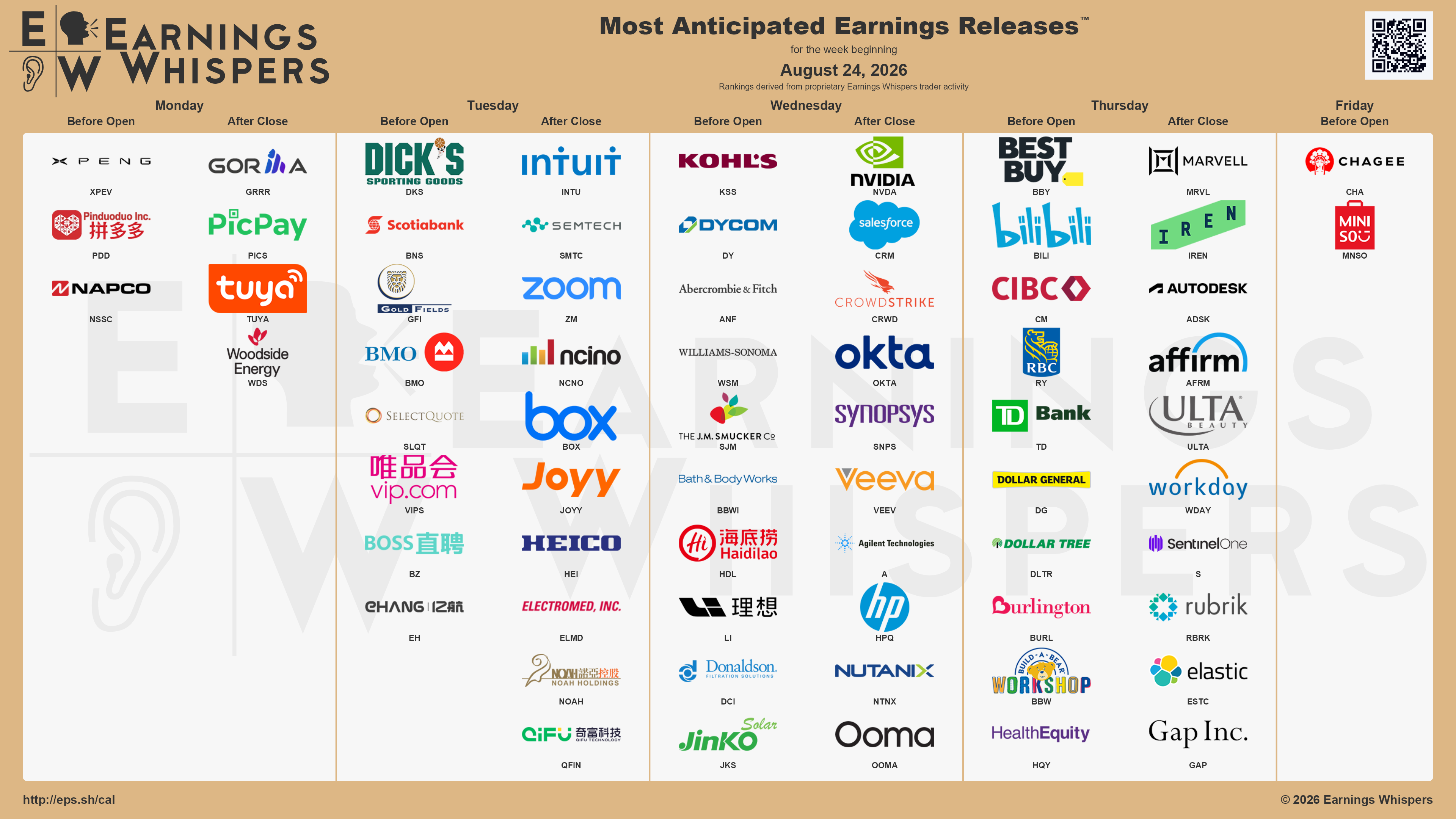
All eyes are on Nvidia this week, and for good reason. The chip giant remains the undisputed heavyweight of this earnings slate, drawing more attention than any other name by a country mile. The mood heading into its report is upbeat, momentum is strong, and options traders are bracing for a swing of roughly four percent in either direction, so buckle up. But Nvidia is far from the only show in town. The technology sector dominates the calendar, with heavyweights like Salesforce, CrowdStrike, Intuit and Workday all stepping up to the plate. Here the tone gets more interesting, because several of these software darlings are walking in with a cloud of doubt hanging over them. Salesforce and Workday in particular have investors feeling cautious, and given how sharply these stocks can lurch after results, even a small stumble could send shares tumbling. Marvell, on the other hand, has quietly built up strength and could surprise the skeptics.
Away from the tech titans, the retail crowd offers a fascinating mixed bag. Williams-Sonoma is the standout, strolling in with genuine swagger and one of the most confident setups of the entire week, while Abercrombie & Fitch and Urban Outfitters also look poised to keep shoppers and shareholders happy. The discount players tell a murkier story, as Dollar General, Dollar Tree and PDD face lingering questions about whether the bargain-hunting consumer is still showing up. Don't overlook the parade of Canadian banks either, with Royal Bank, TD and Bank of Nova Scotia all reporting to a warm reception and steady footing. Beauty lovers get their moment when Ulta reports, though expectations there are more guarded. Add in wild cards like Affirm, Zoom and Best Buy, all of which are drawing plenty of chatter, and you have a week where fortunes could turn on a dime. The takeaway for the layman is simple: the confident names have room to shine, but the doubted ones are the trap doors to watch.
NVIDIA's AI Party Shows No Sign of a Hangover
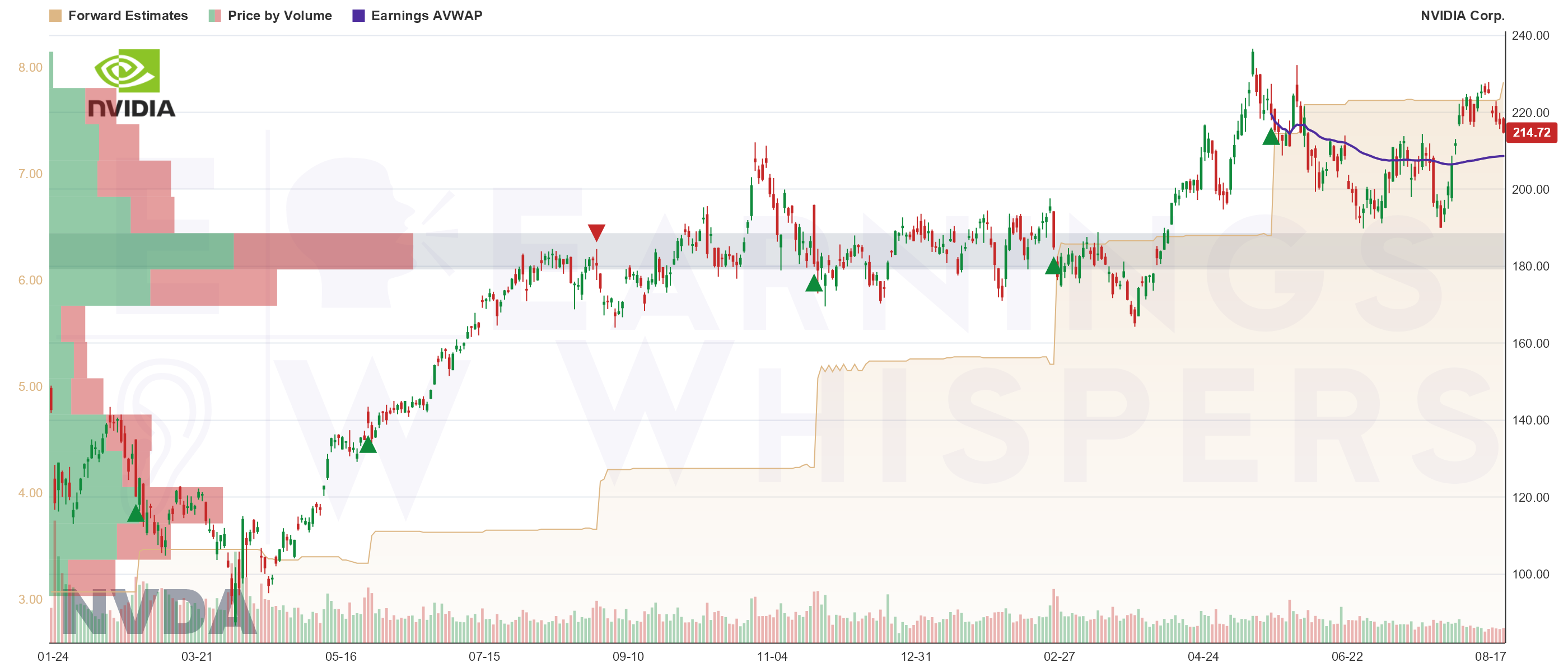
NVIDIA (NVDA) is confirmed to report earnings on Wednesday, August 26, 2026 at approximately 4:20 PM ET, and expectations are sky high. The consensus calls for $2.09 per share on revenue of $91.71 billion, which is a jaw-dropping 96.2% jump from a year ago, while the Earnings Whisper number sits a touch higher at $2.12 per share. Management guided to $1.93 to $2.10 per share on revenue of $89.18 billion to $92.82 billion, so the whisper is basically betting they clear the top of their own range. Investors are feeling good, with 83.0% expecting a beat. Short interest crept up 3.4% since last quarter, and the stock has drifted 3.4% lower from where it opened after the last report, leaving it 9.9% above its 200 day moving average of $195.35. Estimates have been moving up, not down, which is what you want to see. Options traders are bracing for a 6.2% swing even though the stock has only moved about 3.8% in recent quarters, so someone thinks fireworks are coming. Worth noting: on August 5th a big buyer grabbed 72,838 of the $170.00 puts expiring September 4th, a sizable hedge worth keeping an eye on.
Here is the real story going in. Last quarter was a blowout, with revenue up 85% and management flat out saying demand has gone parabolic. The new twist is the Vera standalone CPU, which cracks open a fresh $200 billion market and roughly $20 billion in CPU sales this year, plus Anthropic signing on as a new frontier customer. Blackwell and Rubin visibility doubled to $1 trillion, and they sweetened the pot with an $80 billion buyback and a dividend hike from a penny to 25 cents. The only real clouds are heavier spending, softer gaming demand thanks to pricey memory, and China, where H200 licenses exist but nobody is banking a dime of revenue. Bottom line, the trend has pointed straight up for four straight quarters, and the bar is high, but so is the momentum.
Marvell's Chip Rocket Faces a Sky-High Bar
Marvell Technology (MRVL) steps up to the plate Thursday, August 27, 2026 at about 4:05 PM ET. Wall Street wants $0.93 per share on $2.71 billion in sales, which would be a hefty 35.1% jump from a year ago, though the smart money (our Whisper number) is leaning a touch higher at $0.97. The company itself told us to expect $0.88 to $0.98 per share on $2.57 to $2.84 billion. Here's the funny part: investors are feeling grumpy heading in, yet a whopping 80.9% still expect a beat. Talk about wanting it both ways. The doubters have grown too, with short interest up 11.1% since last quarter, but that has not stopped the stock from climbing 19.3% and floating a dizzying 63.7% above its 200 day average of $144.80. Estimates have been marching higher, options traders are bracing for an 11.6% swing (right in line with the recent 12.2% norm), and on August 5th someone scooped up 9,200 of the $280 calls expiring September 18th. Somebody's feeling bold.
The bar is high because Marvell keeps clearing it. Last quarter marked the third straight beat-and-raise, and management sounded like a team firing on all cylinders. They bumped up their full-year targets again, and even pulled forward the timeline to hit $3 billion in a single quarter by three whole months. The real star is the interconnect business, with growth guidance jumped from over 50% to over 70%, plus a beefed-up partnership with NVIDIA that now includes an actual NVIDIA cash investment. The one soft spot to watch is the older communications unit, which is expected to dip a bit as customers work off extra inventory. But with AI demand roaring and custom chip deals stacking up, the only real question is whether even a strong quarter can live up to a stock that has already priced in perfection.
Salesforce: Great AI Buzz, But Show Us the Cash
Salesforce (CRM) steps up to the plate on Wednesday, August 26, 2026 at roughly 4:00 PM ET. Wall Street is looking for $3.27 per share on $11.30 billion in revenue, which would be a solid 10.4% jump from a year ago, though the whisper number is running hotter at $3.45. Here is the funny part: investors are walking in grumpy, yet 67.6% of them still expect a beat. Meanwhile, the short sellers have quietly headed for the exits, with short interest down a whopping 53.1% since last quarter, and the stock has drifted 17.2% higher to sit 4.0% above its 200 day average of $201.12. Estimates have been ticking up too. Options traders are bracing for an 8.2% swing, which is beefy considering the stock usually only moves about 3.4% on these days, and someone made a notable bet on August 6, scooping up 5,037 of the $195 calls that expire in November.
Here is what actually matters this time around. The AI story is on fire, with AgentForce blowing past $1 billion in recurring revenue, tokens processed up 152%, and Slack suddenly showing up in nearly half of the big million dollar deals. That is the good news. The catch is cash flow. Management made a self-inflicted decision to fund a massive $25 billion buyback with debt, and that chopped the cash flow growth outlook all the way down to 4 to 5%. On top of that, the closely watched bookings figure (CRPO) has come in merely fine for two quarters straight, and the promised second half acceleration is still just a promise. Tableau also keeps getting weaker. Bottom line: everyone loves the flashy AI numbers, but this quarter the crowd wants proof that the bookings and cash will follow.
CrowdStrike Rides the AI Security Wave Into Earnings
CrowdStrike (CRWD) is set to report earnings on Wednesday, August 26, 2026 at around 4:05 PM ET. Wall Street is looking for $0.29 per share on revenue of $1.44 billion, which would be 23.2% growth from a year ago, though the Earnings Whisper number sits a touch higher at $0.31. Management guided to $1.16 to $1.17 per share on roughly $1.44 billion in revenue. Here is the funny part: investors are leaning bearish going in, yet 89.3% of them still expect a beat. Short interest has exploded 240.2% since last quarter, but the stock has not cared one bit, drifting up 13.9% since the last report and now sitting 38.3% above its 200 day average of $138.79. Estimates have actually been trimmed lower, option traders are bracing for a 9.2% swing versus the usual 4.4% move, and on Friday someone scooped up 3,150 of the $230.00 calls expiring in December 2027.
Here is what really matters: last quarter was a genuine step change thanks to what management calls the 'mythos' moment, where CrowdStrike became the only cybersecurity company picked by both Anthropic and OpenAI. That lit a fire under demand, and the company took the rare step of raising full year net new ARR guidance mid year, now expecting growth to actually speed up. Their new AI detection product saw ARR jump 250% in a single quarter, margins and cash flow hit records, and they even announced a 4 for 1 stock split. The one thing to watch is that the growth is now leaning heavily on the back half of the year, meaning a big pipeline has to convert. Some skeptics also wonder if part of this AI buying is just panic spending that may not stick. Bottom line, momentum is strong, but the bar just got a lot higher.
IREN's Earnings Optics vs. Its NVIDIA-Powered Reality
IREN Limited (IREN) steps up to the mic Thursday, August 27, 2026 at around 5:15 PM ET, and the mood in the room is jittery. Wall Street is looking for $0.07 per share on revenue of $138.89 million, a 25.8% drop from last year, but our Earnings Whisper number tells a darker story at a loss of $0.35 per share. Investors are leaning bearish, yet a curious 85.2% still expect a beat, which is the kind of split personality that makes earnings season fun. The skeptics have been busy too, with short interest jumping 66.1% since last quarter while the stock slid 34.4% from its post-earnings open to sit 10.4% below its 200 day moving average of $46.72. Overall estimates have drifted lower, option traders are betting on a 14.1% swing versus the usual 6.3%, and last Friday someone snapped up 19,185 of the $27.00 puts expiring August 28, so somebody clearly wants downside protection.
Here is the thing the bears may be missing. The shrinking headline numbers are not a business falling apart, they are the deliberate wind-down of Bitcoin mining as IREN pivots hard into AI. Revenue slid from $240 million to $184.7 million to $144.8 million over the last three quarters, and Q3 posted a $247.8 million net loss, but $140.4 million of that was non-cash impairments from retiring old mining gear. Meanwhile every forward number is pointing up. IREN signed a $3.4 billion five-year AI cloud deal with NVIDIA, landed a broader partnership covering up to 5 gigawatts of infrastructure and a $2.1 billion NVIDIA investment, bought Mirantis and Nostrum to add engineers and crack open Europe, and lifted its ARR target to $3.7 billion with $3.1 billion already under contract. Management says demand is not the constraint and there are no idle chips. So the real question Thursday is not whether the P&L looks ugly, it is whether investors finally look past the mining rearview mirror and see the AI road ahead.
XPeng's Earnings: Weak Rearview, Roaring Road Ahead
XPeng (XPEV) reports before the sun comes up on Monday, August 24, 2026, at roughly 5:00 AM ET, with analysts eyeing $2.95 billion in revenue, a 15.6% jump from a year ago and comfortably inside management's own $2.89 to $3.07 billion guidance. The mood is upbeat, with 70% of investors betting on a beat, and short sellers have backed off, trimming their bets by 18.2% since last quarter. That optimism has not helped the stock, which has drifted 27% lower since its last report and now sits 29.1% below its 200-day average of $17.19. Analysts have quietly trimmed estimates, options traders are bracing for an 11% swing (bigger than the usual 7.3% move), and someone made a big bullish bet on August 5, snapping up 7,171 of the $20 calls that do not expire until January 2028.
Here is the real story. Last quarter's numbers were ugly, with revenue tumbling 41% from the prior quarter and the company flipping from its first-ever profit right back into a loss as chip and battery costs bit. But that looked more like a seasonal air pocket than a broken business. Management came out swinging, guiding for deliveries to rebound more than 50% and calling this the strongest growth stretch in company history. The new GX full-size SUV is selling above expectations with over 30-week wait times, overseas sales are climbing past 20% of revenue, and the newly rebranded 'physical AI' outfit is pushing robotaxis and even a humanoid robot. The catch is that most of those flashy bets do not pay off until 2027 or later, so the near-term print may stay bumpy while the future looks bright.
Kohl's Turnaround Is Real, But Will Anyone Believe It?
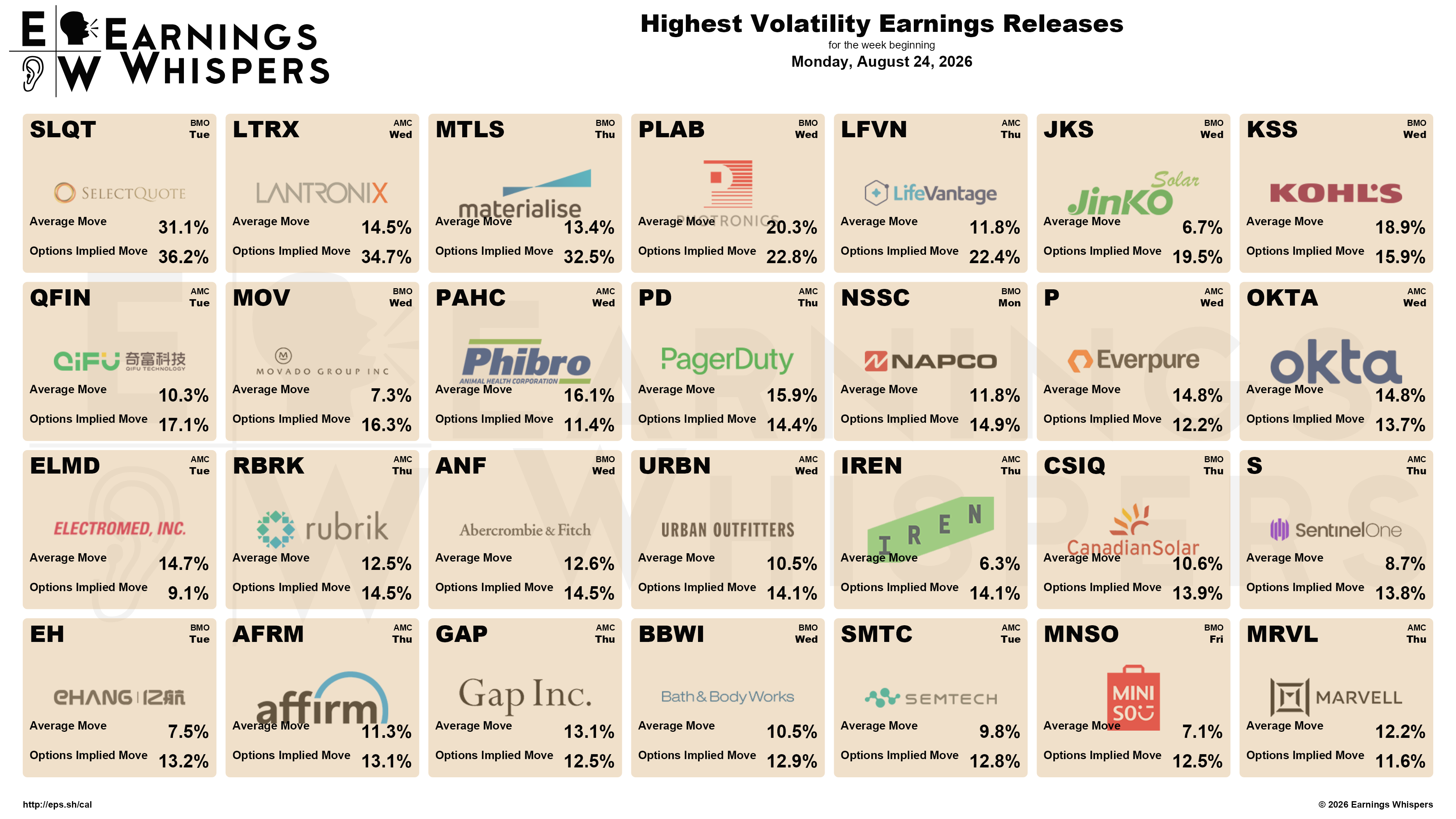
Kohl's (KSS) steps up to report earnings on Wednesday, August 26, 2026 at around 7:00 AM ET, and Wall Street is bracing for trouble. The consensus calls for $0.55 per share on $3.52 billion in revenue, a slight 0.7% dip from last year, though the Earnings Whisper number sits higher at $0.62. The crowd is grumpy, with 42.9% betting on a miss, and short sellers have piled on, boosting short interest by 19.8% since last quarter. Yet the stock has quietly climbed 13.5% since its last report and now sits 2.4% above its 200 day moving average of $17.19. Estimates haven't budged, but this thing is a firecracker on earnings day. Options traders are betting on a 15.9% swing, and the stock has actually averaged an 18.9% move lately. One trader made a splash on August 20, snapping up 2,512 of the $15.00 puts expiring September 18, a clear bet that the doubters could get the last laugh.
Here is what actually matters heading into the print. Last quarter Kohl's posted its best comparable sales in over four years at negative 1.1%, and the all-important Kohl's Card shopper finally stabilized to flat after months of declines. Store brands jumped 6%, digital rose 4%, and the balance sheet got a roughly $800 million cash boost while inventory dropped 8%. That is a genuine turnaround taking shape. The catch is management only reaffirmed full-year guidance instead of raising it, and there is a $190 million tariff refund sitting outside the numbers that could sweeten things if it lands. Watch the soft spots too, since Sephora shops slipped for the first time and men's and footwear are still dragging. The story is improving, but investors want proof, and this report needs to show the momentum is sticking.
Intuit's AI Big Bang Meets a Bruised Tax Season
Intuit (INTU) steps up to report earnings on Tuesday, August 25, 2026 at roughly 4:00 PM ET. Wall Street is looking for $3.57 per share on $4.27 billion in revenue, good for 11.5% growth from a year ago, though the quiet whisper on the street is closer to $3.72. The company itself guided for $3.56 to $3.62 per share on $4.25 to $4.29 billion. Here is the fun tension: investors are leaning bearish going in, yet a whopping 84.6% still expect a beat, so someone is going to be surprised. Short sellers have piled on, up 20.5% since last quarter, but the stock has quietly climbed 17.5% and now sits 17.3% below its 200 day average of $443.63. Estimates have been nudged higher across the board. Options traders are bracing for a 9.7% swing, roughly in line with the 8.9% average lately, and on Friday someone scooped up 3,183 of the $390 calls expiring September 18. Bulls are placing their bets.
Here is what to actually watch. Last quarter Intuit raised its full-year outlook yet again, but the mood on the call flipped from victory laps to "constructively dissatisfied." The growth engines are humming, with assisted tax, payments, and mid-market all growing north of 30%, and a splashy new AI expert platform launching in August. The catch is that the do-it-yourself tax business stumbled, management flat out admitted "we lost on price" to budget filers, Mailchimp got demoted to a fix-it project, and the bottom line is now being propped up by a 17% workforce cut and heavy buybacks rather than a clean sales beat. Translation: the headline numbers may look great, but the quality behind them is the real story to dig into this time.
Okta's AI Bet Meets Its Reality Check
Okta reports Wednesday, August 26 at about 4:00 PM ET, and Wall Street is looking for $0.96 per share on $792.14 million in revenue, or roughly 8.8% growth from a year ago. The quiet whisper on the street is a touch juicier at $1.05. Management already told us to expect $0.95 to $0.97 on revenue between $790 and $794 million. Here is the funny part: investors are walking in bearish, yet 84.6% of them still think the company will beat. Short sellers seem to agree, having backed off by 20.1% since last quarter while the stock climbed 25.7% and now sits a hefty 37.7% above its 200 day average of $98.17. Estimates have been creeping higher too. Option traders are bracing for a 13.7% swing, right in line with the roughly 14.8% shuffle Okta usually delivers, and someone made a noticeable bet on Friday, August 14, snapping up 1,120 of the $90 puts expiring August 28.
Here is the real story to watch. Last quarter Okta finally nudged its full year growth outlook up to 9-10%, its customer retention ticked back up to 107%, and its big AI agent product went live with a who's who of partners including Google, Amazon, OpenAI, and ServiceNow. Management even hinted these AI deals run much bigger than the average. The catch? All that AI buzz is still barely showing up in actual sales, and the company keeps reminding everyone it is baked into guidance only lightly. So the excitement is built on pipeline and promises rather than money in the bank. If Okta can start turning that hype into real revenue, the bears may need a new hobby. If not, that $90 put buyer looks pretty smart.
Synopsys: The Comeback Chip Story Meets a Skeptical Crowd
Synopsys (SNPS) steps up to report earnings on Wednesday, August 26, 2026 at about 4:05 PM ET. Wall Street is looking for $3.66 per share on revenue of $2.44 billion, which would be a hefty 40.3% jump from a year ago, though the whisper number is a touch juicier at $3.85. Management guided for $3.63 to $3.69 per share on revenue of $2.41 to $2.46 billion. Here is the funny part: investors are grumpy going in, yet 72.7% of them still expect a beat. Short sellers have nudged their bets up 1.8% since last quarter, and the stock has slid 22.0% from where it opened after the last report, now sitting 10.8% under its 200 day average of $446.10. Estimates, however, have been creeping higher. Options traders are bracing for a 9.8% swing, right in line with the recent 9.1% average, and someone grabbed 1,060 of the $330 puts expiring September 11 on August 11, so not everyone is feeling brave.
Here is what really matters this time. Last quarter was a turning point, with management raising all four big targets at once (revenue, margin, earnings, and cash flow) after two quarters of playing defense. The key story is the IP business, which they say hit bottom in early 2026 and bounced back 12% in the spring, with more gains expected. Fresh growth drivers are lining up too, from strong PCIe and UCIe chip wins to early money from AI powered design tools. The main wrinkles to watch are activist investor Elliott Management landing a board seat, a still soft China market, and a small divestiture trimming revenue. With an Investor Day set for September 30, this quarter is really about whether the confident new tone holds up.
SelectQuote: A Penny Stock Comeback Story, One Quarter at a Time
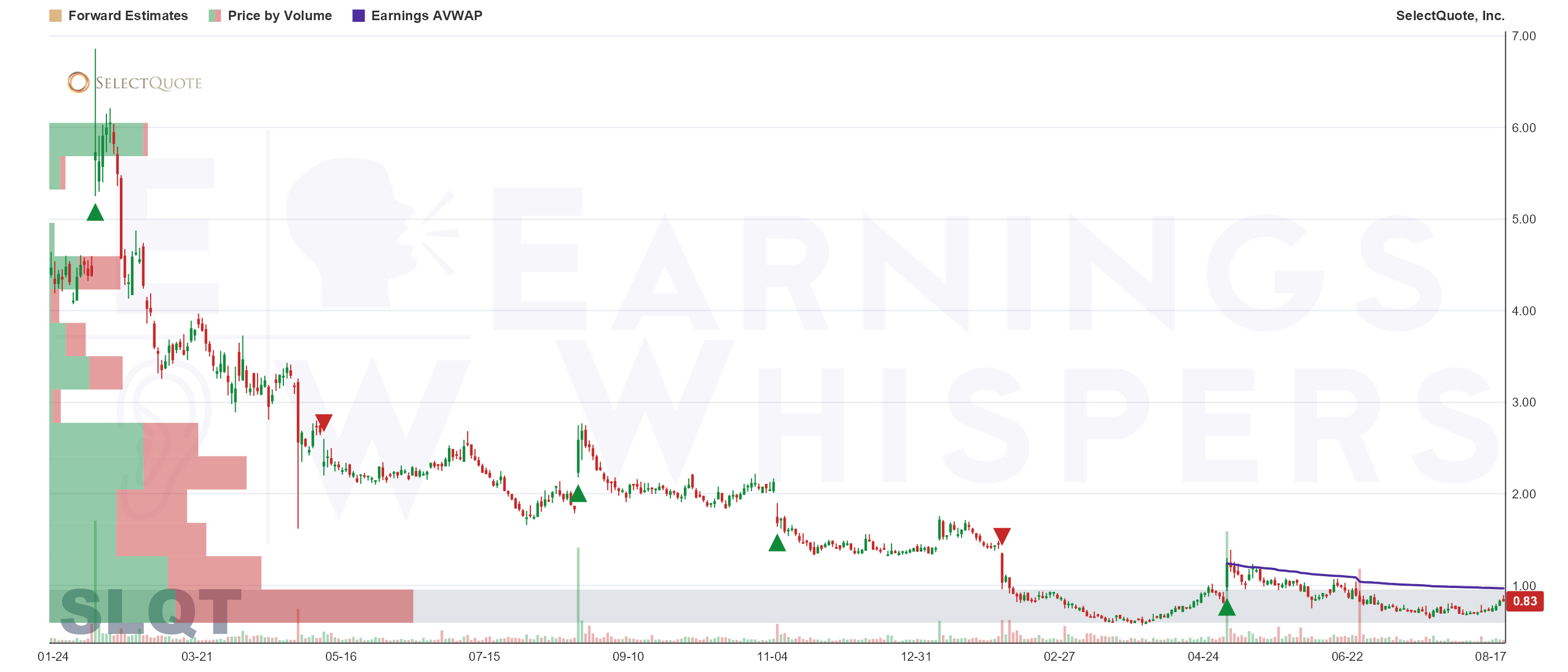
SelectQuote (SLQT) steps up to the plate before the bell on Tuesday, August 25, 2026, at about 7:00 AM ET. Wall Street is bracing for a loss of $0.15 per share on revenue of $375.00 million, which would still be a respectable 8.7% jump from last year. The crowd is cautiously optimistic, with half of investors betting on a beat. Here is the interesting part: short sellers have largely thrown in the towel, with short interest down a whopping 69.8% since the last report. Yet the stock has quietly slid 15.5% since its last earnings pop and now sits 20.3% below its 200 day average of $1.04. Analysts have trimmed their estimates, but with this stock averaging a wild 31.1% swing after earnings, buckle up. And someone is feeling brave, snapping up 514 of the $1.00 calls expiring September 18 back on August 12.
Here is the real story. This is a turnaround in progress, not a victory lap. Last quarter management stopped the bleeding after cutting guidance twice, keeping their forecast steady instead of slashing it again. The pharmacy business, SelectRx, swung back to a profit, the nagging PBM reimbursement headache got resolved with a multi-year deal, and the tone was noticeably more upbeat. But two things to watch closely: the full year bar was permanently lowered from the original plan, and management kept nervously repeating they will do whatever it takes to stay listed on the NYSE. When a company talks that much about keeping its listing, pay attention. The big prize they keep pointing to is roughly $1 billion in commissions owed to them versus a market cap under $200 million. If they can turn that paper into real cash flow, this cheap stock gets a lot more interesting.
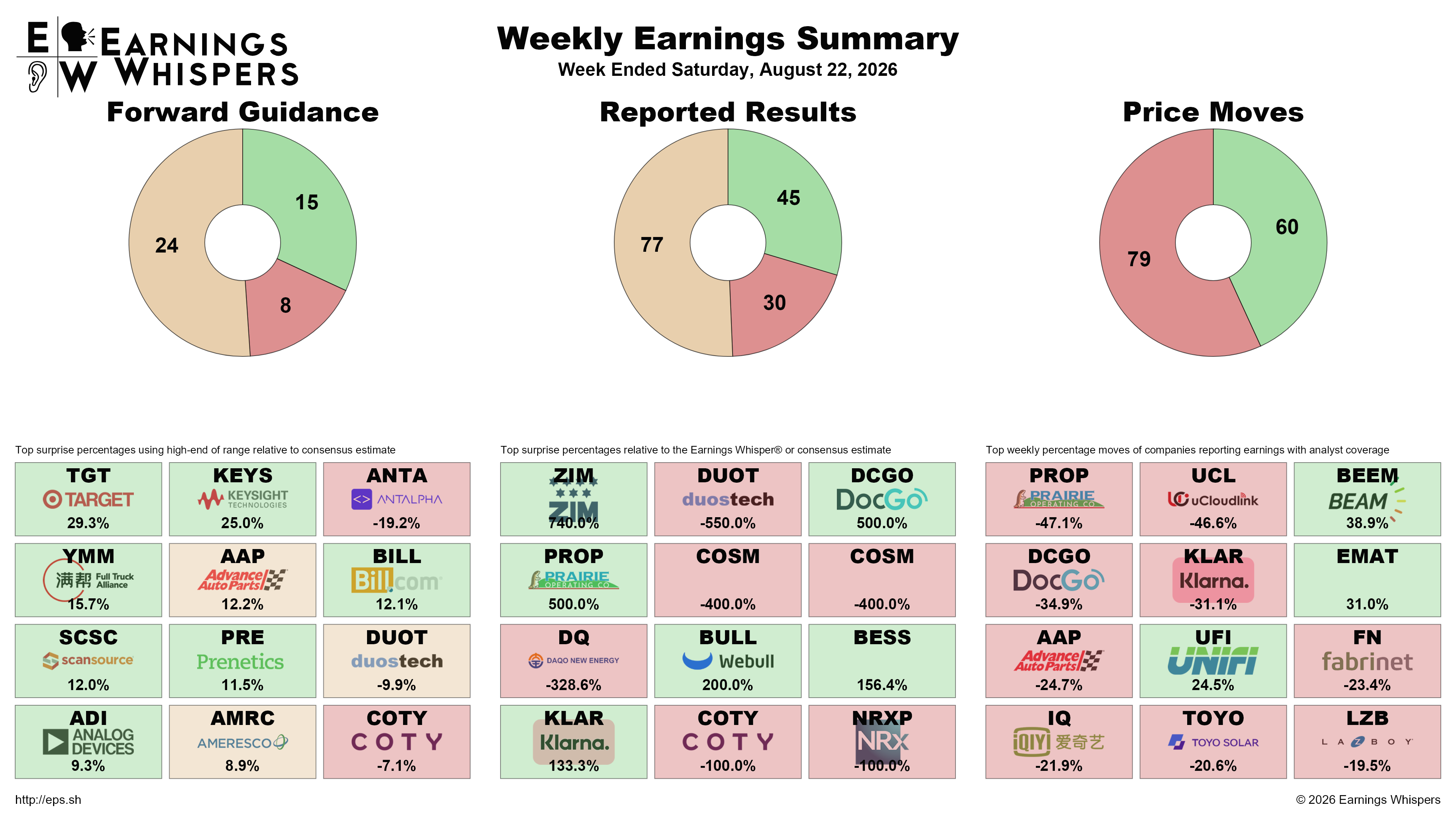
Retail's Great Tariff-Refund Illusion: Winners Raise the Bar as Laggards Stumble
It was a week where America's biggest retailers all got a temporary gift from the same source, and how each one used it told the real story. A wave of tariff refunds padded profits across the board, but the smart money knows a one-time windfall is just window dressing. The genuine standouts spent theirs on offense. Target staged the loudest comeback, swinging from shrinking sales a year ago to a full-blown guidance raise, with shoppers actually walking through the doors again and snack, Lego and toy sales flying off shelves; its stock jumped about 7% on the week. Ross Stores kept its hot streak alive with a double-digit sales gain and its third guidance bump in a row, while TJX, the parent of TJ Maxx, raised its profit outlook yet again even as its flagship division tripped over its own feet, admitting it simply put the wrong stuff in the wrong stores. Walmart, the biggest name of the bunch, quietly lifted its full-year targets across sales, profit and earnings, leaning on its increasingly lucrative advertising, marketplace and membership businesses to paper over a pharmacy pricing drag and more than $2 billion in extra fuel costs.
The flip side was just as revealing. Lowe's used its refund to fight a price war rather than fuel growth, and it showed: the home-improvement chain cut its full-year forecast to the bottom of its range as do-it-yourself demand cooled, competitors slashed prices, and the housing market stayed frozen at 40-year-low turnover. Rival Home Depot fared better, posting its clearest pickup in demand in over a year as big-ticket purchases and its professional-contractor business finally turned the corner, though management stopped short of raising its outlook and is navigating its CEO's temporary medical leave. Beyond retail, the theme of substance over headlines held. Tractor maker Deere raised its profit guidance and signaled the farm-equipment slump has likely hit bottom, with strength in construction and smaller equipment offsetting a rough patch in South America. Overseas, China's tech giants split down the middle: Alibaba's cloud and artificial-intelligence engine roared to its fastest growth in more than five years even as heavy spending dented cash flow, while Baidu and NetEase served up mixed results, with Baidu's robotaxi rides hitting a regulatory speed bump and NetEase watching its splashy new game launch draw a chorus of player complaints. The lesson for investors was clear enough: this earnings season, it paid to look past the sugar high and ask who was actually building something.
Walmart's Money Machine Shifts Into High Gear
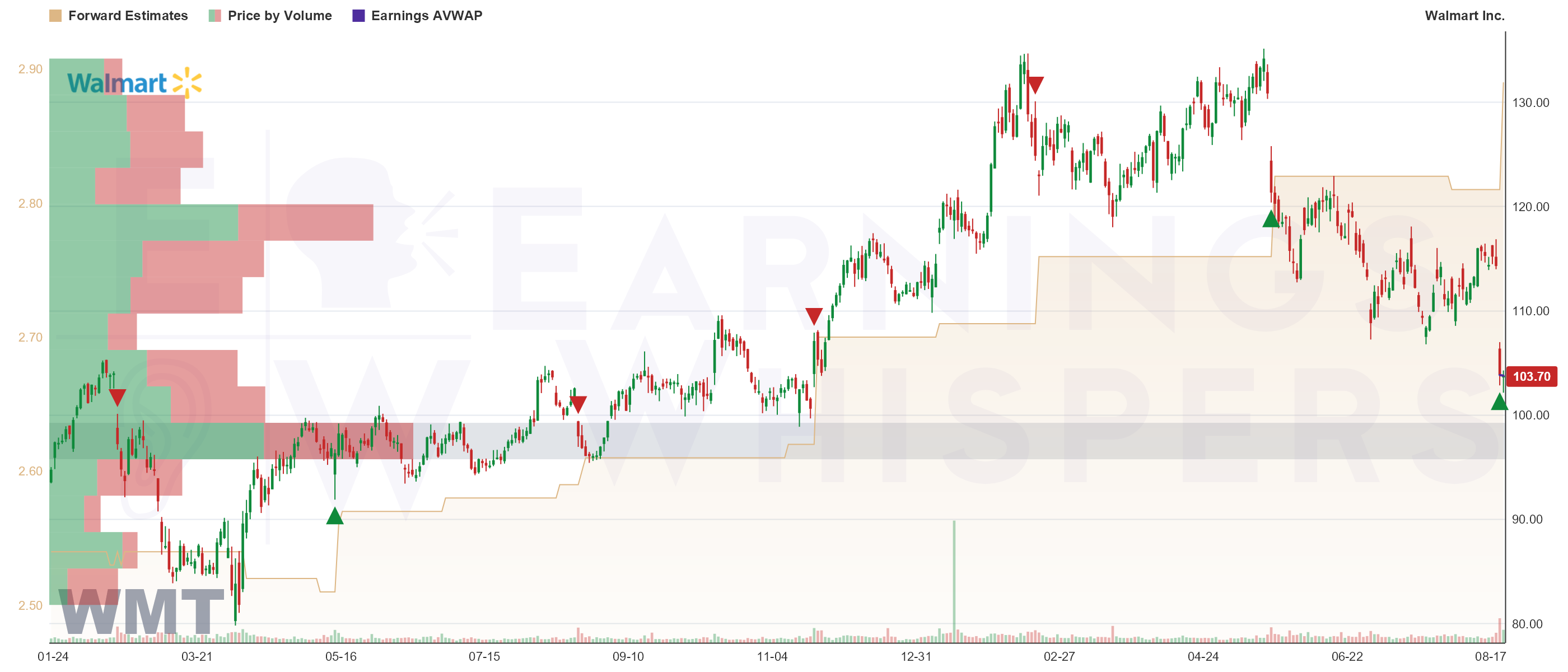
Walmart just wrapped up its fiscal second quarter, ending July 2026, and the results were a comfortable beat. The retail giant earned $0.81 per share on $187.94 billion in revenue, sailing past Wall Street's expectations of $0.73 per share on $186.32 billion. That is an 8 percent earnings beat, with revenue climbing nearly 6 percent from a year ago. Looking ahead, Walmart guided third quarter earnings to $0.62 to $0.64 per share on revenue of $183.13 billion to $184.47 billion, a touch light of the Street's $0.68 and $187.59 billion. But the real story is the full year, where the company nudged up its outlook to $2.80 to $2.87 per share on $734.66 billion to $741.72 billion, up from its earlier call of $2.75 to $2.85 per share. New CEO John Furner summed it up nicely, saying customers keep choosing Walmart because they deliver price, speed, and convenience across a huge selection. In his words, at Walmart, they can have it all.
Here is what to actually watch. Walmart is quietly turning into an advertising and membership powerhouse, and those high-profit engines are doing the heavy lifting. Ad revenue jumped 38 percent, membership fees hit an all-time high, and online sales grew 23 percent. To keep folks coming through the door, they cranked rollbacks up to 11,000 price cuts. The soft spot is the pharmacy counter, where new drug-pricing rules dragged US same-store sales growth down to 2.6 percent, and pricier gas is pinching lower-income shoppers, with June the weakest month. Add over $2 billion in extra fuel costs and next quarter's profit will look sleepy, but the guidance raise across the board tells you management is feeling good. Furner himself said he is even more bullish today.
Alibaba's AI Cloud Engine Roars While Earnings Take a Breather
Alibaba (BABA) posted earnings of $1.26 per share on revenue of $39.64 billion for the fiscal quarter ended June 2026. That earnings number badly missed the $1.94 that Wall Street expected and came up short of the $1.85 whisper figure too, a 31.89% earnings miss. Revenue, on the other hand, actually beat and grew a healthy 14.66% versus a year ago. So think of this as a quarter where the top line showed up to the party but the bottom line stayed home. CEO Eddie Wu called it a strong quarter, pointing to Alibaba Cloud's external revenue growth speeding up to 45% and AI product revenue notching triple-digit growth for the twelfth straight quarter, along with fresh launches like the QwenWork AI workforce agent. In plain English, Alibaba is a giant online shopping company that is quickly turning into a serious AI and cloud player.
Here is the real story: the cloud business has hit its stride. External cloud growth has climbed four quarters in a row and is now at a 22-quarter high, cloud profit margins jumped to about 12%, and AI product revenue is running at roughly $7.3 billion a year. Management even reaffirmed its goal of $100 billion in outside cloud revenue by 2030 with a straight face and rising confidence. The catch is the price tag. Alibaba spent a whopping RMB67.7 billion on capital projects this quarter, which torched free cash flow and knocked GAAP net income down 75%. Add in a soft patch for the China shopping business and some still money-losing side bets, and you get why earnings looked ugly. Bottom line: Alibaba is spending heavily today to own the AI wave tomorrow, and the cloud numbers suggest that bet is starting to pay off.
ADI Smashes Through Its First $4 Billion Quarter as AI Demand Roars
Analog Devices (ADI) just posted its first ever $4 billion quarter, ringing up earnings of $3.45 per share on revenue of $4.02 billion for the fiscal third quarter ended July 2026. That beat Wall Street's call for $3.33 per share on $3.92 billion, and matched the Earnings Whisper number of $3.45. The headline number is revenue up nearly 40% from a year ago, which is a serious sprint for a company this size. Even better, management raised the bar again for next quarter, guiding to earnings of $3.71 to $4.01 per share on revenue of $4.20 to $4.40 billion, well above the $3.67 and $4.02 billion the Street was expecting. CEO Vincent Roche summed up the mood by saying the best is yet to come.
Here is the real story. ADI keeps raising its own targets every single quarter, and this time was no different, with revenue, margins, and profit guidance all stepping up. The engine is the data center, now 80% of the communications business and growing more than 100% year over year in both optical and power chips. The company closed its $1.5 billion all-cash purchase of Empower Semiconductor in July to bolster its AI power play, and says its 2030 market opportunity in data centers and energy has more than doubled in just a year. The only clouds worth mentioning are small ones. Lead times are stretching out because demand is so hot, inflation is nagging at costs, and a routine first-quarter factory shutdown will nick margins. Management also politely tips its hat to the risk that AI spending could cool someday. For now, though, this is a company firing on all cylinders.
Target Finds Its Aim Again
Target (TGT) rang up earnings of $2.46 per share on revenue of $26.54 billion for the fiscal second quarter ended July 2026, comfortably clearing the $2.30 consensus and the $2.35 whisper number. That is a beat of nearly 5%, with revenue up a healthy 5.27% from a year ago. Better yet, management hiked its full-year outlook to earnings of $9.90 to $10.90 per share on roughly $110.02 billion in revenue, a big jump from prior guidance near the high end of $7.50 to $8.50 and well above the Street's $8.43. CEO Michael Fiddelke summed it up nicely, saying the quarter builds on first-quarter momentum and shows the strategy is landing with shoppers, thanks to price cuts on more than 10,000 everyday items and fresh investments in style, convenience, and a better store experience.
Here is the straight talk. This is a real turnaround taking shape, with foot traffic up 3.6% and comparable sales flipping positive again after being underwater not long ago. The fun stuff is working, snacks are up over 15%, Lego over 30%, and even $10 headphones jumped 35%, while new plays like Beauty Studio, a record Love Shack Fancy collab, and AI shopping partnerships are drawing crowds. Two catches, though. First, that eye-popping headline number got a one-time $1.65 boost from a tariff refund, so strip that out and the real growth is a solid but less flashy 20%. Second, home and apparel are still the problem children, stuck in neutral with a fix that likely will not arrive until 2027. Bottom line, Target is back on offense, just don't get dazzled by the shiny headline number.
Home Depot's DIY Comeback Gets Real, But Management Keeps the Champagne on Ice
Home Depot (HD) nailed its fiscal second quarter, posting earnings of $4.92 per share on revenue of $47.86 billion for the period ended July 2026. That topped Wall Street's expected $4.71 per share and $47.50 billion in sales, beating the bottom line by 4.24% while revenue climbed 5.71% from a year ago. Yet despite the win, the company simply reaffirmed rather than raised its full-year outlook, still guiding for fiscal 2027 earnings of $14.69 to $15.28 per share on revenue of $168.80 billion to $172.09 billion. Analysts are penciling in $14.99 per share on $171.65 billion for the year ending January 31, 2027. As CFO Richard McPhail put it, results exceeded expectations with broad based demand as customers tackled smaller projects. Translation: America is back to fixing the leaky faucet, even if it's holding off on the new deck.
Here's the real story. Same-store sales jumped to plus 1.7%, a big step up from the sleepy sub-1% pace shoppers had grown used to, and 13 of 16 departments are now growing versus just 9 last quarter. Even the pricier over-$1,000 purchases picked up steam, and online sales rose 11% for the fifth straight double-digit quarter. So why isn't management doing a victory lap? A couple of reasons. A chunky $685 million tariff refund flattered margins this quarter, but that's a one-time sugar high that fresh cost pressures from fuel, energy, and metals will eat up by year end. Store traffic is still slightly down, meaning growth is coming from bigger tickets, not more feet through the door. Housing turnover is stuck at 40-year lows, and CEO Ted Decker is on temporary medical leave. Bottom line: the demand recovery looks genuine, but with muddy margins and a few overhangs, Home Depot is playing it cool for now.
Away from the tech titans, the retail crowd offers a fascinating mixed bag. Williams-Sonoma is the standout, strolling in with genuine swagger and one of the most confident setups of the entire week, while Abercrombie & Fitch and Urban Outfitters also look poised to keep shoppers and shareholders happy. The discount players tell a murkier story, as Dollar General, Dollar Tree and PDD face lingering questions about whether the bargain-hunting consumer is still showing up. Don't overlook the parade of Canadian banks either, with Royal Bank, TD and Bank of Nova Scotia all reporting to a warm reception and steady footing. Beauty lovers get their moment when Ulta reports, though expectations there are more guarded. Add in wild cards like Affirm, Zoom and Best Buy, all of which are drawing plenty of chatter, and you have a week where fortunes could turn on a dime. The takeaway for the layman is simple: the confident names have room to shine, but the doubted ones are the trap doors to watch.
NVIDIA's AI Party Shows No Sign of a Hangover
NVIDIA (NVDA) is confirmed to report earnings on Wednesday, August 26, 2026 at approximately 4:20 PM ET, and expectations are sky high. The consensus calls for $2.09 per share on revenue of $91.71 billion, which is a jaw-dropping 96.2% jump from a year ago, while the Earnings Whisper number sits a touch higher at $2.12 per share. Management guided to $1.93 to $2.10 per share on revenue of $89.18 billion to $92.82 billion, so the whisper is basically betting they clear the top of their own range. Investors are feeling good, with 83.0% expecting a beat. Short interest crept up 3.4% since last quarter, and the stock has drifted 3.4% lower from where it opened after the last report, leaving it 9.9% above its 200 day moving average of $195.35. Estimates have been moving up, not down, which is what you want to see. Options traders are bracing for a 6.2% swing even though the stock has only moved about 3.8% in recent quarters, so someone thinks fireworks are coming. Worth noting: on August 5th a big buyer grabbed 72,838 of the $170.00 puts expiring September 4th, a sizable hedge worth keeping an eye on.
Here is the real story going in. Last quarter was a blowout, with revenue up 85% and management flat out saying demand has gone parabolic. The new twist is the Vera standalone CPU, which cracks open a fresh $200 billion market and roughly $20 billion in CPU sales this year, plus Anthropic signing on as a new frontier customer. Blackwell and Rubin visibility doubled to $1 trillion, and they sweetened the pot with an $80 billion buyback and a dividend hike from a penny to 25 cents. The only real clouds are heavier spending, softer gaming demand thanks to pricey memory, and China, where H200 licenses exist but nobody is banking a dime of revenue. Bottom line, the trend has pointed straight up for four straight quarters, and the bar is high, but so is the momentum.
Marvell's Chip Rocket Faces a Sky-High Bar
Marvell Technology (MRVL) steps up to the plate Thursday, August 27, 2026 at about 4:05 PM ET. Wall Street wants $0.93 per share on $2.71 billion in sales, which would be a hefty 35.1% jump from a year ago, though the smart money (our Whisper number) is leaning a touch higher at $0.97. The company itself told us to expect $0.88 to $0.98 per share on $2.57 to $2.84 billion. Here's the funny part: investors are feeling grumpy heading in, yet a whopping 80.9% still expect a beat. Talk about wanting it both ways. The doubters have grown too, with short interest up 11.1% since last quarter, but that has not stopped the stock from climbing 19.3% and floating a dizzying 63.7% above its 200 day average of $144.80. Estimates have been marching higher, options traders are bracing for an 11.6% swing (right in line with the recent 12.2% norm), and on August 5th someone scooped up 9,200 of the $280 calls expiring September 18th. Somebody's feeling bold.
The bar is high because Marvell keeps clearing it. Last quarter marked the third straight beat-and-raise, and management sounded like a team firing on all cylinders. They bumped up their full-year targets again, and even pulled forward the timeline to hit $3 billion in a single quarter by three whole months. The real star is the interconnect business, with growth guidance jumped from over 50% to over 70%, plus a beefed-up partnership with NVIDIA that now includes an actual NVIDIA cash investment. The one soft spot to watch is the older communications unit, which is expected to dip a bit as customers work off extra inventory. But with AI demand roaring and custom chip deals stacking up, the only real question is whether even a strong quarter can live up to a stock that has already priced in perfection.
Salesforce: Great AI Buzz, But Show Us the Cash
Salesforce (CRM) steps up to the plate on Wednesday, August 26, 2026 at roughly 4:00 PM ET. Wall Street is looking for $3.27 per share on $11.30 billion in revenue, which would be a solid 10.4% jump from a year ago, though the whisper number is running hotter at $3.45. Here is the funny part: investors are walking in grumpy, yet 67.6% of them still expect a beat. Meanwhile, the short sellers have quietly headed for the exits, with short interest down a whopping 53.1% since last quarter, and the stock has drifted 17.2% higher to sit 4.0% above its 200 day average of $201.12. Estimates have been ticking up too. Options traders are bracing for an 8.2% swing, which is beefy considering the stock usually only moves about 3.4% on these days, and someone made a notable bet on August 6, scooping up 5,037 of the $195 calls that expire in November.
Here is what actually matters this time around. The AI story is on fire, with AgentForce blowing past $1 billion in recurring revenue, tokens processed up 152%, and Slack suddenly showing up in nearly half of the big million dollar deals. That is the good news. The catch is cash flow. Management made a self-inflicted decision to fund a massive $25 billion buyback with debt, and that chopped the cash flow growth outlook all the way down to 4 to 5%. On top of that, the closely watched bookings figure (CRPO) has come in merely fine for two quarters straight, and the promised second half acceleration is still just a promise. Tableau also keeps getting weaker. Bottom line: everyone loves the flashy AI numbers, but this quarter the crowd wants proof that the bookings and cash will follow.
CrowdStrike Rides the AI Security Wave Into Earnings
CrowdStrike (CRWD) is set to report earnings on Wednesday, August 26, 2026 at around 4:05 PM ET. Wall Street is looking for $0.29 per share on revenue of $1.44 billion, which would be 23.2% growth from a year ago, though the Earnings Whisper number sits a touch higher at $0.31. Management guided to $1.16 to $1.17 per share on roughly $1.44 billion in revenue. Here is the funny part: investors are leaning bearish going in, yet 89.3% of them still expect a beat. Short interest has exploded 240.2% since last quarter, but the stock has not cared one bit, drifting up 13.9% since the last report and now sitting 38.3% above its 200 day average of $138.79. Estimates have actually been trimmed lower, option traders are bracing for a 9.2% swing versus the usual 4.4% move, and on Friday someone scooped up 3,150 of the $230.00 calls expiring in December 2027.
Here is what really matters: last quarter was a genuine step change thanks to what management calls the 'mythos' moment, where CrowdStrike became the only cybersecurity company picked by both Anthropic and OpenAI. That lit a fire under demand, and the company took the rare step of raising full year net new ARR guidance mid year, now expecting growth to actually speed up. Their new AI detection product saw ARR jump 250% in a single quarter, margins and cash flow hit records, and they even announced a 4 for 1 stock split. The one thing to watch is that the growth is now leaning heavily on the back half of the year, meaning a big pipeline has to convert. Some skeptics also wonder if part of this AI buying is just panic spending that may not stick. Bottom line, momentum is strong, but the bar just got a lot higher.
IREN's Earnings Optics vs. Its NVIDIA-Powered Reality
IREN Limited (IREN) steps up to the mic Thursday, August 27, 2026 at around 5:15 PM ET, and the mood in the room is jittery. Wall Street is looking for $0.07 per share on revenue of $138.89 million, a 25.8% drop from last year, but our Earnings Whisper number tells a darker story at a loss of $0.35 per share. Investors are leaning bearish, yet a curious 85.2% still expect a beat, which is the kind of split personality that makes earnings season fun. The skeptics have been busy too, with short interest jumping 66.1% since last quarter while the stock slid 34.4% from its post-earnings open to sit 10.4% below its 200 day moving average of $46.72. Overall estimates have drifted lower, option traders are betting on a 14.1% swing versus the usual 6.3%, and last Friday someone snapped up 19,185 of the $27.00 puts expiring August 28, so somebody clearly wants downside protection.
Here is the thing the bears may be missing. The shrinking headline numbers are not a business falling apart, they are the deliberate wind-down of Bitcoin mining as IREN pivots hard into AI. Revenue slid from $240 million to $184.7 million to $144.8 million over the last three quarters, and Q3 posted a $247.8 million net loss, but $140.4 million of that was non-cash impairments from retiring old mining gear. Meanwhile every forward number is pointing up. IREN signed a $3.4 billion five-year AI cloud deal with NVIDIA, landed a broader partnership covering up to 5 gigawatts of infrastructure and a $2.1 billion NVIDIA investment, bought Mirantis and Nostrum to add engineers and crack open Europe, and lifted its ARR target to $3.7 billion with $3.1 billion already under contract. Management says demand is not the constraint and there are no idle chips. So the real question Thursday is not whether the P&L looks ugly, it is whether investors finally look past the mining rearview mirror and see the AI road ahead.
XPeng's Earnings: Weak Rearview, Roaring Road Ahead
XPeng (XPEV) reports before the sun comes up on Monday, August 24, 2026, at roughly 5:00 AM ET, with analysts eyeing $2.95 billion in revenue, a 15.6% jump from a year ago and comfortably inside management's own $2.89 to $3.07 billion guidance. The mood is upbeat, with 70% of investors betting on a beat, and short sellers have backed off, trimming their bets by 18.2% since last quarter. That optimism has not helped the stock, which has drifted 27% lower since its last report and now sits 29.1% below its 200-day average of $17.19. Analysts have quietly trimmed estimates, options traders are bracing for an 11% swing (bigger than the usual 7.3% move), and someone made a big bullish bet on August 5, snapping up 7,171 of the $20 calls that do not expire until January 2028.
Here is the real story. Last quarter's numbers were ugly, with revenue tumbling 41% from the prior quarter and the company flipping from its first-ever profit right back into a loss as chip and battery costs bit. But that looked more like a seasonal air pocket than a broken business. Management came out swinging, guiding for deliveries to rebound more than 50% and calling this the strongest growth stretch in company history. The new GX full-size SUV is selling above expectations with over 30-week wait times, overseas sales are climbing past 20% of revenue, and the newly rebranded 'physical AI' outfit is pushing robotaxis and even a humanoid robot. The catch is that most of those flashy bets do not pay off until 2027 or later, so the near-term print may stay bumpy while the future looks bright.
Kohl's Turnaround Is Real, But Will Anyone Believe It?
Kohl's (KSS) steps up to report earnings on Wednesday, August 26, 2026 at around 7:00 AM ET, and Wall Street is bracing for trouble. The consensus calls for $0.55 per share on $3.52 billion in revenue, a slight 0.7% dip from last year, though the Earnings Whisper number sits higher at $0.62. The crowd is grumpy, with 42.9% betting on a miss, and short sellers have piled on, boosting short interest by 19.8% since last quarter. Yet the stock has quietly climbed 13.5% since its last report and now sits 2.4% above its 200 day moving average of $17.19. Estimates haven't budged, but this thing is a firecracker on earnings day. Options traders are betting on a 15.9% swing, and the stock has actually averaged an 18.9% move lately. One trader made a splash on August 20, snapping up 2,512 of the $15.00 puts expiring September 18, a clear bet that the doubters could get the last laugh.
Here is what actually matters heading into the print. Last quarter Kohl's posted its best comparable sales in over four years at negative 1.1%, and the all-important Kohl's Card shopper finally stabilized to flat after months of declines. Store brands jumped 6%, digital rose 4%, and the balance sheet got a roughly $800 million cash boost while inventory dropped 8%. That is a genuine turnaround taking shape. The catch is management only reaffirmed full-year guidance instead of raising it, and there is a $190 million tariff refund sitting outside the numbers that could sweeten things if it lands. Watch the soft spots too, since Sephora shops slipped for the first time and men's and footwear are still dragging. The story is improving, but investors want proof, and this report needs to show the momentum is sticking.
Intuit's AI Big Bang Meets a Bruised Tax Season
Intuit (INTU) steps up to report earnings on Tuesday, August 25, 2026 at roughly 4:00 PM ET. Wall Street is looking for $3.57 per share on $4.27 billion in revenue, good for 11.5% growth from a year ago, though the quiet whisper on the street is closer to $3.72. The company itself guided for $3.56 to $3.62 per share on $4.25 to $4.29 billion. Here is the fun tension: investors are leaning bearish going in, yet a whopping 84.6% still expect a beat, so someone is going to be surprised. Short sellers have piled on, up 20.5% since last quarter, but the stock has quietly climbed 17.5% and now sits 17.3% below its 200 day average of $443.63. Estimates have been nudged higher across the board. Options traders are bracing for a 9.7% swing, roughly in line with the 8.9% average lately, and on Friday someone scooped up 3,183 of the $390 calls expiring September 18. Bulls are placing their bets.
Here is what to actually watch. Last quarter Intuit raised its full-year outlook yet again, but the mood on the call flipped from victory laps to "constructively dissatisfied." The growth engines are humming, with assisted tax, payments, and mid-market all growing north of 30%, and a splashy new AI expert platform launching in August. The catch is that the do-it-yourself tax business stumbled, management flat out admitted "we lost on price" to budget filers, Mailchimp got demoted to a fix-it project, and the bottom line is now being propped up by a 17% workforce cut and heavy buybacks rather than a clean sales beat. Translation: the headline numbers may look great, but the quality behind them is the real story to dig into this time.
Okta's AI Bet Meets Its Reality Check
Okta reports Wednesday, August 26 at about 4:00 PM ET, and Wall Street is looking for $0.96 per share on $792.14 million in revenue, or roughly 8.8% growth from a year ago. The quiet whisper on the street is a touch juicier at $1.05. Management already told us to expect $0.95 to $0.97 on revenue between $790 and $794 million. Here is the funny part: investors are walking in bearish, yet 84.6% of them still think the company will beat. Short sellers seem to agree, having backed off by 20.1% since last quarter while the stock climbed 25.7% and now sits a hefty 37.7% above its 200 day average of $98.17. Estimates have been creeping higher too. Option traders are bracing for a 13.7% swing, right in line with the roughly 14.8% shuffle Okta usually delivers, and someone made a noticeable bet on Friday, August 14, snapping up 1,120 of the $90 puts expiring August 28.
Here is the real story to watch. Last quarter Okta finally nudged its full year growth outlook up to 9-10%, its customer retention ticked back up to 107%, and its big AI agent product went live with a who's who of partners including Google, Amazon, OpenAI, and ServiceNow. Management even hinted these AI deals run much bigger than the average. The catch? All that AI buzz is still barely showing up in actual sales, and the company keeps reminding everyone it is baked into guidance only lightly. So the excitement is built on pipeline and promises rather than money in the bank. If Okta can start turning that hype into real revenue, the bears may need a new hobby. If not, that $90 put buyer looks pretty smart.
Synopsys: The Comeback Chip Story Meets a Skeptical Crowd
Synopsys (SNPS) steps up to report earnings on Wednesday, August 26, 2026 at about 4:05 PM ET. Wall Street is looking for $3.66 per share on revenue of $2.44 billion, which would be a hefty 40.3% jump from a year ago, though the whisper number is a touch juicier at $3.85. Management guided for $3.63 to $3.69 per share on revenue of $2.41 to $2.46 billion. Here is the funny part: investors are grumpy going in, yet 72.7% of them still expect a beat. Short sellers have nudged their bets up 1.8% since last quarter, and the stock has slid 22.0% from where it opened after the last report, now sitting 10.8% under its 200 day average of $446.10. Estimates, however, have been creeping higher. Options traders are bracing for a 9.8% swing, right in line with the recent 9.1% average, and someone grabbed 1,060 of the $330 puts expiring September 11 on August 11, so not everyone is feeling brave.
Here is what really matters this time. Last quarter was a turning point, with management raising all four big targets at once (revenue, margin, earnings, and cash flow) after two quarters of playing defense. The key story is the IP business, which they say hit bottom in early 2026 and bounced back 12% in the spring, with more gains expected. Fresh growth drivers are lining up too, from strong PCIe and UCIe chip wins to early money from AI powered design tools. The main wrinkles to watch are activist investor Elliott Management landing a board seat, a still soft China market, and a small divestiture trimming revenue. With an Investor Day set for September 30, this quarter is really about whether the confident new tone holds up.
SelectQuote: A Penny Stock Comeback Story, One Quarter at a Time
SelectQuote (SLQT) steps up to the plate before the bell on Tuesday, August 25, 2026, at about 7:00 AM ET. Wall Street is bracing for a loss of $0.15 per share on revenue of $375.00 million, which would still be a respectable 8.7% jump from last year. The crowd is cautiously optimistic, with half of investors betting on a beat. Here is the interesting part: short sellers have largely thrown in the towel, with short interest down a whopping 69.8% since the last report. Yet the stock has quietly slid 15.5% since its last earnings pop and now sits 20.3% below its 200 day average of $1.04. Analysts have trimmed their estimates, but with this stock averaging a wild 31.1% swing after earnings, buckle up. And someone is feeling brave, snapping up 514 of the $1.00 calls expiring September 18 back on August 12.
Here is the real story. This is a turnaround in progress, not a victory lap. Last quarter management stopped the bleeding after cutting guidance twice, keeping their forecast steady instead of slashing it again. The pharmacy business, SelectRx, swung back to a profit, the nagging PBM reimbursement headache got resolved with a multi-year deal, and the tone was noticeably more upbeat. But two things to watch closely: the full year bar was permanently lowered from the original plan, and management kept nervously repeating they will do whatever it takes to stay listed on the NYSE. When a company talks that much about keeping its listing, pay attention. The big prize they keep pointing to is roughly $1 billion in commissions owed to them versus a market cap under $200 million. If they can turn that paper into real cash flow, this cheap stock gets a lot more interesting.
Retail's Great Tariff-Refund Illusion: Winners Raise the Bar as Laggards Stumble
It was a week where America's biggest retailers all got a temporary gift from the same source, and how each one used it told the real story. A wave of tariff refunds padded profits across the board, but the smart money knows a one-time windfall is just window dressing. The genuine standouts spent theirs on offense. Target staged the loudest comeback, swinging from shrinking sales a year ago to a full-blown guidance raise, with shoppers actually walking through the doors again and snack, Lego and toy sales flying off shelves; its stock jumped about 7% on the week. Ross Stores kept its hot streak alive with a double-digit sales gain and its third guidance bump in a row, while TJX, the parent of TJ Maxx, raised its profit outlook yet again even as its flagship division tripped over its own feet, admitting it simply put the wrong stuff in the wrong stores. Walmart, the biggest name of the bunch, quietly lifted its full-year targets across sales, profit and earnings, leaning on its increasingly lucrative advertising, marketplace and membership businesses to paper over a pharmacy pricing drag and more than $2 billion in extra fuel costs.
The flip side was just as revealing. Lowe's used its refund to fight a price war rather than fuel growth, and it showed: the home-improvement chain cut its full-year forecast to the bottom of its range as do-it-yourself demand cooled, competitors slashed prices, and the housing market stayed frozen at 40-year-low turnover. Rival Home Depot fared better, posting its clearest pickup in demand in over a year as big-ticket purchases and its professional-contractor business finally turned the corner, though management stopped short of raising its outlook and is navigating its CEO's temporary medical leave. Beyond retail, the theme of substance over headlines held. Tractor maker Deere raised its profit guidance and signaled the farm-equipment slump has likely hit bottom, with strength in construction and smaller equipment offsetting a rough patch in South America. Overseas, China's tech giants split down the middle: Alibaba's cloud and artificial-intelligence engine roared to its fastest growth in more than five years even as heavy spending dented cash flow, while Baidu and NetEase served up mixed results, with Baidu's robotaxi rides hitting a regulatory speed bump and NetEase watching its splashy new game launch draw a chorus of player complaints. The lesson for investors was clear enough: this earnings season, it paid to look past the sugar high and ask who was actually building something.
Walmart's Money Machine Shifts Into High Gear
Walmart just wrapped up its fiscal second quarter, ending July 2026, and the results were a comfortable beat. The retail giant earned $0.81 per share on $187.94 billion in revenue, sailing past Wall Street's expectations of $0.73 per share on $186.32 billion. That is an 8 percent earnings beat, with revenue climbing nearly 6 percent from a year ago. Looking ahead, Walmart guided third quarter earnings to $0.62 to $0.64 per share on revenue of $183.13 billion to $184.47 billion, a touch light of the Street's $0.68 and $187.59 billion. But the real story is the full year, where the company nudged up its outlook to $2.80 to $2.87 per share on $734.66 billion to $741.72 billion, up from its earlier call of $2.75 to $2.85 per share. New CEO John Furner summed it up nicely, saying customers keep choosing Walmart because they deliver price, speed, and convenience across a huge selection. In his words, at Walmart, they can have it all.
Here is what to actually watch. Walmart is quietly turning into an advertising and membership powerhouse, and those high-profit engines are doing the heavy lifting. Ad revenue jumped 38 percent, membership fees hit an all-time high, and online sales grew 23 percent. To keep folks coming through the door, they cranked rollbacks up to 11,000 price cuts. The soft spot is the pharmacy counter, where new drug-pricing rules dragged US same-store sales growth down to 2.6 percent, and pricier gas is pinching lower-income shoppers, with June the weakest month. Add over $2 billion in extra fuel costs and next quarter's profit will look sleepy, but the guidance raise across the board tells you management is feeling good. Furner himself said he is even more bullish today.
Alibaba's AI Cloud Engine Roars While Earnings Take a Breather
Alibaba (BABA) posted earnings of $1.26 per share on revenue of $39.64 billion for the fiscal quarter ended June 2026. That earnings number badly missed the $1.94 that Wall Street expected and came up short of the $1.85 whisper figure too, a 31.89% earnings miss. Revenue, on the other hand, actually beat and grew a healthy 14.66% versus a year ago. So think of this as a quarter where the top line showed up to the party but the bottom line stayed home. CEO Eddie Wu called it a strong quarter, pointing to Alibaba Cloud's external revenue growth speeding up to 45% and AI product revenue notching triple-digit growth for the twelfth straight quarter, along with fresh launches like the QwenWork AI workforce agent. In plain English, Alibaba is a giant online shopping company that is quickly turning into a serious AI and cloud player.
Here is the real story: the cloud business has hit its stride. External cloud growth has climbed four quarters in a row and is now at a 22-quarter high, cloud profit margins jumped to about 12%, and AI product revenue is running at roughly $7.3 billion a year. Management even reaffirmed its goal of $100 billion in outside cloud revenue by 2030 with a straight face and rising confidence. The catch is the price tag. Alibaba spent a whopping RMB67.7 billion on capital projects this quarter, which torched free cash flow and knocked GAAP net income down 75%. Add in a soft patch for the China shopping business and some still money-losing side bets, and you get why earnings looked ugly. Bottom line: Alibaba is spending heavily today to own the AI wave tomorrow, and the cloud numbers suggest that bet is starting to pay off.
ADI Smashes Through Its First $4 Billion Quarter as AI Demand Roars
Analog Devices (ADI) just posted its first ever $4 billion quarter, ringing up earnings of $3.45 per share on revenue of $4.02 billion for the fiscal third quarter ended July 2026. That beat Wall Street's call for $3.33 per share on $3.92 billion, and matched the Earnings Whisper number of $3.45. The headline number is revenue up nearly 40% from a year ago, which is a serious sprint for a company this size. Even better, management raised the bar again for next quarter, guiding to earnings of $3.71 to $4.01 per share on revenue of $4.20 to $4.40 billion, well above the $3.67 and $4.02 billion the Street was expecting. CEO Vincent Roche summed up the mood by saying the best is yet to come.
Here is the real story. ADI keeps raising its own targets every single quarter, and this time was no different, with revenue, margins, and profit guidance all stepping up. The engine is the data center, now 80% of the communications business and growing more than 100% year over year in both optical and power chips. The company closed its $1.5 billion all-cash purchase of Empower Semiconductor in July to bolster its AI power play, and says its 2030 market opportunity in data centers and energy has more than doubled in just a year. The only clouds worth mentioning are small ones. Lead times are stretching out because demand is so hot, inflation is nagging at costs, and a routine first-quarter factory shutdown will nick margins. Management also politely tips its hat to the risk that AI spending could cool someday. For now, though, this is a company firing on all cylinders.
Target Finds Its Aim Again
Target (TGT) rang up earnings of $2.46 per share on revenue of $26.54 billion for the fiscal second quarter ended July 2026, comfortably clearing the $2.30 consensus and the $2.35 whisper number. That is a beat of nearly 5%, with revenue up a healthy 5.27% from a year ago. Better yet, management hiked its full-year outlook to earnings of $9.90 to $10.90 per share on roughly $110.02 billion in revenue, a big jump from prior guidance near the high end of $7.50 to $8.50 and well above the Street's $8.43. CEO Michael Fiddelke summed it up nicely, saying the quarter builds on first-quarter momentum and shows the strategy is landing with shoppers, thanks to price cuts on more than 10,000 everyday items and fresh investments in style, convenience, and a better store experience.
Here is the straight talk. This is a real turnaround taking shape, with foot traffic up 3.6% and comparable sales flipping positive again after being underwater not long ago. The fun stuff is working, snacks are up over 15%, Lego over 30%, and even $10 headphones jumped 35%, while new plays like Beauty Studio, a record Love Shack Fancy collab, and AI shopping partnerships are drawing crowds. Two catches, though. First, that eye-popping headline number got a one-time $1.65 boost from a tariff refund, so strip that out and the real growth is a solid but less flashy 20%. Second, home and apparel are still the problem children, stuck in neutral with a fix that likely will not arrive until 2027. Bottom line, Target is back on offense, just don't get dazzled by the shiny headline number.
Home Depot's DIY Comeback Gets Real, But Management Keeps the Champagne on Ice
Home Depot (HD) nailed its fiscal second quarter, posting earnings of $4.92 per share on revenue of $47.86 billion for the period ended July 2026. That topped Wall Street's expected $4.71 per share and $47.50 billion in sales, beating the bottom line by 4.24% while revenue climbed 5.71% from a year ago. Yet despite the win, the company simply reaffirmed rather than raised its full-year outlook, still guiding for fiscal 2027 earnings of $14.69 to $15.28 per share on revenue of $168.80 billion to $172.09 billion. Analysts are penciling in $14.99 per share on $171.65 billion for the year ending January 31, 2027. As CFO Richard McPhail put it, results exceeded expectations with broad based demand as customers tackled smaller projects. Translation: America is back to fixing the leaky faucet, even if it's holding off on the new deck.
Here's the real story. Same-store sales jumped to plus 1.7%, a big step up from the sleepy sub-1% pace shoppers had grown used to, and 13 of 16 departments are now growing versus just 9 last quarter. Even the pricier over-$1,000 purchases picked up steam, and online sales rose 11% for the fifth straight double-digit quarter. So why isn't management doing a victory lap? A couple of reasons. A chunky $685 million tariff refund flattered margins this quarter, but that's a one-time sugar high that fresh cost pressures from fuel, energy, and metals will eat up by year end. Store traffic is still slightly down, meaning growth is coming from bigger tickets, not more feet through the door. Housing turnover is stuck at 40-year lows, and CEO Ted Decker is on temporary medical leave. Bottom line: the demand recovery looks genuine, but with muddy margins and a few overhangs, Home Depot is playing it cool for now.